2025 · Hu — Hydrogen-Generating Magnesium Alloy Seed Strand Sensitizes Solid Tumors to Iodine-125 Brachytherapy.
Super-Abstract
An AZ31 magnesium-alloy brachytherapy seed strand (AMASS) implanted directly into tumours releases hydrogen gas alongside radioactive iodine-125 radiation, significantly enhancing tumour cell killing compared to radiation alone. In mouse and rabbit tumour models, hydrogen from AMASS degradation disrupted cancer-cell redox balance, reduced ATP production, and induced DNA damage synergistically with ¹²⁵I radiation, with no notable side effects. (Advanced Science, 2025.)
Commentary
This is a preclinical animal study. Iodine-125 seed implantation is an established brachytherapy technique used clinically, but tumour radioresistance limits its effectiveness for certain tumour types and in advanced disease. The AMASS approach is novel in integrating a biodegradable magnesium alloy directly with the brachytherapy seed, providing local, sustained H₂ release at the tumour site without additional drug delivery systems. The pH-dependent H₂ release (faster in the typically acidic tumour microenvironment) adds targeting selectivity. In-vitro and mouse xenograft data are complemented by a rabbit liver tumour model, strengthening the preclinical evidence base. Clinical translation would require regulatory approval for a modified brachytherapy device and human safety/efficacy studies.
Key quotes
- „Hydrogen from AMASS degradation significantly inhibited tumor proliferation, increased apoptosis, disrupted redox homeostasis and mitochondrial membrane potential, reduced adenosine triphosphate levels, and induced DNA damage due to 125I radiation.“ — mechanistic effects of H₂ enhancing radiation efficacy in vitro
- „In mouse xenograft and rabbit liver tumor models, hydrogen from AMASS showed superior therapeutic effects compared with 125I seeds alone, with no noticeable side effects.“ — in-vivo efficacy finding vs. standard brachytherapy control
- „Hydrogen from AMASS enhanced 125I seed efficacy, supporting the further promotion and application of 125I seed implantation in cancer therapy.“ — authors' translational conclusion
Our assessment
This is a preclinical study (in-vitro + mouse + rabbit) — results cannot be directly transferred to human cancer patients. The combination of an existing clinical technique (¹²⁵I brachytherapy) with local hydrogen generation is a pragmatic and potentially translatable approach, as it builds on an established clinical procedure. Multi-model preclinical evidence (in vitro, mouse, rabbit) is a strength. Remaining open questions: long-term biocompatibility of AZ31 alloy degradation products in human tumours, radiation dosimetry modifications required, and clinical manufacturing standardisation. Human data are absent.
Study design
- Type: preclinical study (in-vitro + mouse xenograft + rabbit orthotopic liver tumour) · Device: AZ31 Mg alloy ¹²⁵I seed strand (AMASS) — pH-dependent slow H₂ release + brachytherapy radiation
- Endpoints: tumour proliferation, apoptosis, ROS/redox homeostasis, mitochondrial membrane potential, ATP levels, DNA damage, tumour volume · Result: superior tumour control vs. ¹²⁵I alone in all models; no notable side effects
Abstract
Radioactive iodine-125 (125I) seed implantation, a brachytherapy technique, effectively kills tumor cells via X-rays and gamma rays, serving as an alternative therapeutic option following the failure of frontline treatments for various solid tumors. However, tumor radioresistance limits its efficacy. Hydrogen gas has anticancer properties and can enhance the efficacy of immunotherapy. However, its role in radiotherapy sensitization has rarely been reported. Many current hydrogen delivery methods involve hydrogen-generating nanomaterials, such as magnesium-based nanomaterials. This study introduces an AZ31 magnesium alloy 125I seed strand (termed AMASS) with pH-dependent slow-release hydrogen characteristics and excellent mechanical properties. AMASS can be implanted into tumors via minimally invasive surgery, releasing hydrogen around the 125I seeds. In vitro experiments showed that hydrogen from AMASS degradation significantly inhibited tumor proliferation, increased apoptosis, disrupted redox homeostasis and mitochondrial membrane potential, reduced adenosine triphosphate levels, and induced DNA damage due to 125I radiation. In mouse xenograft and rabbit liver tumor models, hydrogen from AMASS showed superior therapeutic effects compared with 125I seeds alone, with no noticeable side effects. In addition, AMASS has a uniform radiation dose distribution and simple implantation. Therefore, hydrogen from AMASS enhanced 125I seed efficacy, supporting the further promotion and application of 125I seed implantation in cancer therapy.
Source & links
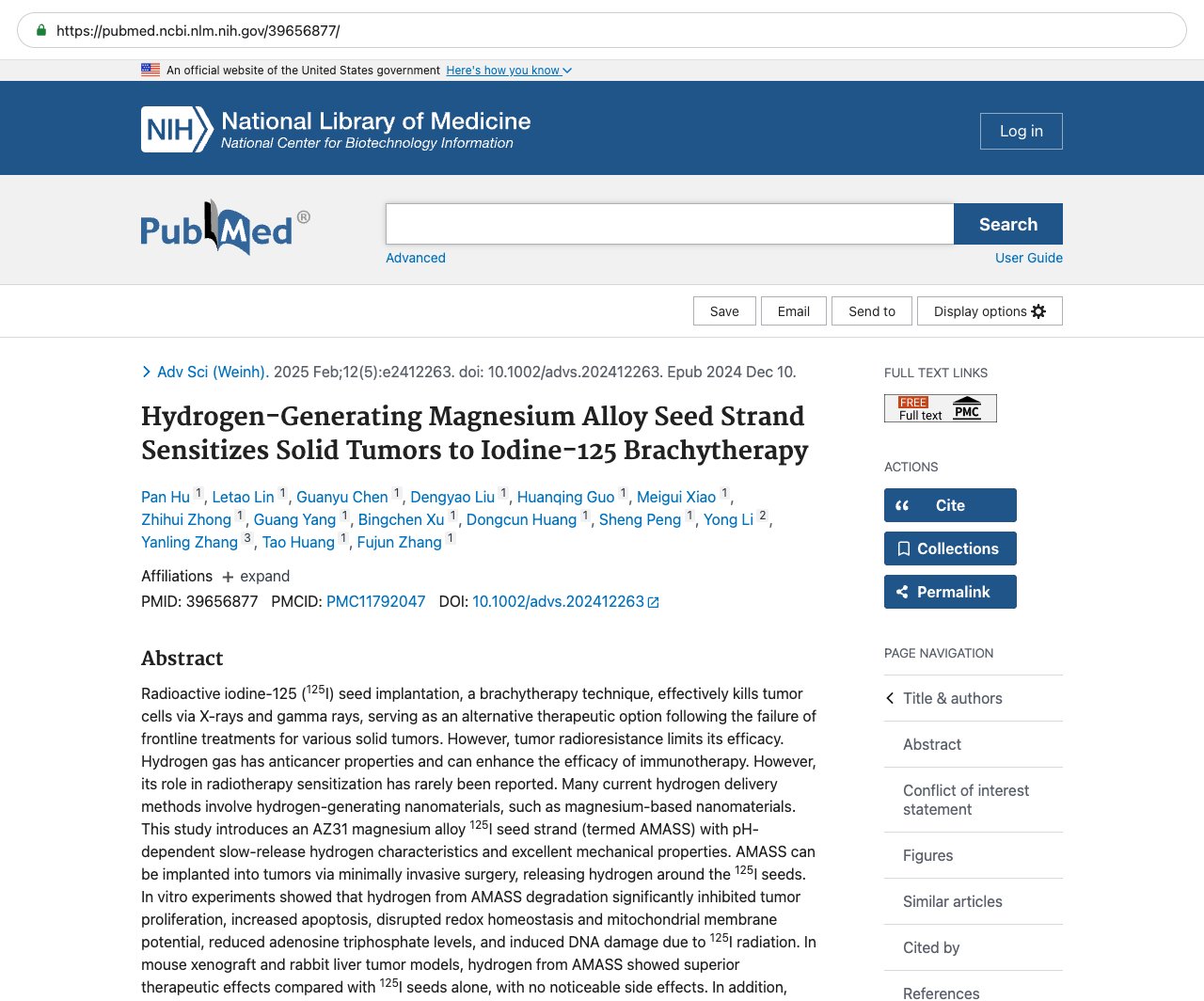
Screenshot of the PubMed page
This page mirrors the published abstract (© the authors / publisher) for reference and citation. The canonical source is the PubMed record linked above. This is not medical advice.