2012 · Chuai — Molecular hydrogen and radiation protection
Super-Abstract
Hydrogen (H₂) as radiation protection: ionizing radiation damages cells mainly via the hydroxyl radical (•OH) — exactly the radical H₂ selectively scavenges. This review summarizes that H₂ protects irradiated cells and animals; in a randomized, placebo-controlled study, drinking H₂ water also improved the quality of life of patients undergoing radiotherapy for liver tumors. (Free Radical Research, 2012.)
Commentary
This review elegantly links two things: the known mechanism of action of H₂ and a concrete clinical problem — the side effects of radiotherapy. Radiation acts largely indirectly: it splits water molecules in the body (radiolysis), producing masses of hydroxyl radicals that damage DNA and tissue and drive cells into programmed death. Because H₂ selectively neutralizes exactly this •OH (and additionally peroxynitrite, ONOO⁻), a radiation-protective effect is plausible. The author group reports that their laboratory was the first to show a protective effect of H₂ in irradiated cells and mice — and emphasizes that this finding was reproduced by themselves and by a second, independent laboratory in different animal models. Reproduction by others is a strong quality signal. The most interesting point: a <strong>randomized, placebo-controlled</strong> human investigation in which drinking H₂ water improved the quality of life of patients undergoing radiotherapy for liver tumors. Staying honest: this is a <strong>review</strong> (secondary literature), and the clinical evidence is a single small study — not a broad evidence base. But as a signpost for where H₂ research in oncology could move, it is relevant.
Key quotes
- „Molecular hydrogen (dihydrogen, H(2)) acts as a therapeutic antioxidant by selectively reducing hydroxyl radicals (•OH) and peroxynitrite (ONOO-).“ — the mechanism of action that makes radiation protection plausible
- „It has been well-known that ionising radiation (IR) causes oxidative damage and consequent apoptosis mainly due to the production of •OH that follows radiolysis of H(2)O.“ — why radiation damages specifically via •OH — H₂'s target radical
- „A randomised, placebo-controlled investigation also showed consumption of H(2) can improve the quality of life of patients treated with radiotherapy for liver tumours.“ — the only human evidence in the review: an RCT on quality of life
Our assessment
The review is relevant because it cleanly links the mechanism (•OH scavenging) with a clinical field of application (radiotherapy side effects) and cites a genuine human RCT. For us it is especially interesting that the cited human study used orally consumed H₂ water — the consumption form matching our products. Nevertheless caution in communication: this concerns quality of life under cancer radiotherapy, a highly sensitive medical field — no cure or cancer-therapy promises may be derived from it. Limitations, stated honestly: it is a review (evidence level 4, secondary source, largely populated by the author group itself), the underlying human evidence is a single small RCT, and a possible interest bias of the reporting group cannot be ruled out.
Study design
- Type: review (summarizing cell, animal and one human study) · n: n/a (secondary literature) · Duration: n/a · H₂ delivery: in cited studies including H₂ drinking water (human RCT) and H₂ in cell/animal models
- Result metrics: protective effect of H₂ in irradiated cells and mice (reproduced by two laboratories); improved quality of life under radiotherapy for liver tumors (randomized, placebo-controlled) — concrete values/p-values not reported in the abstract
Abstract
Molecular hydrogen (dihydrogen, H(2)) acts as a therapeutic antioxidant by selectively reducing hydroxyl radicals (•OH) and peroxynitrite (ONOO-). It has been well-known that ionising radiation (IR) causes oxidative damage and consequent apoptosis mainly due to the production of •OH that follows radiolysis of H(2)O. Our department reported the protective effect of H(2) in irradiated cells and mice for the first time, and this effect is well repeated by us and another laboratory in different experimental animal models. A randomised, placebo-controlled investigation also showed consumption of H(2) can improve the quality of life of patients treated with radiotherapy for liver tumours. These encouraging results suggested that H(2) has a potential as a radioprotective agent with efficacy and non-toxicity.
Source & links
Screenshot of the PubMed page
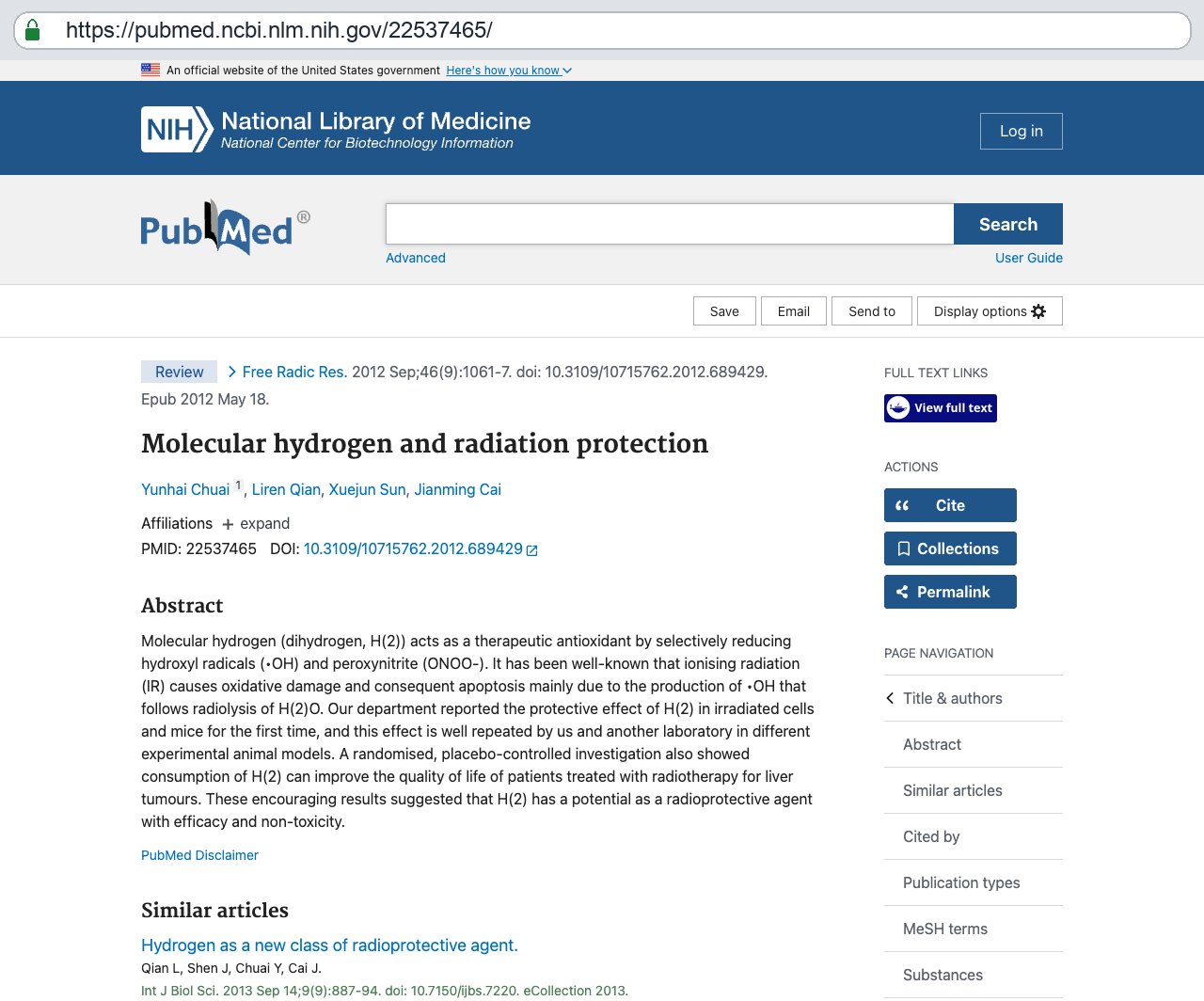
This page mirrors the published abstract (© the authors / publisher) for reference and citation. The canonical source is the PubMed record linked above. This is not medical advice.