2025 · Cao — Nanobiocatalyst-Driven Spatiotemporal Hydrogen Delivery Induces Dormancy Potentiated Catalytic Tumor Therapy.
Super-Abstract
Colorectal cancer cells can be pushed into a dormant, non-dividing state by molecular hydrogen (H₂) — and this dormancy makes them far more vulnerable to oxidative attack. Researchers engineered a platinum-containing metal-organic framework that generates H₂ on demand using light, combined with a drug (5-ASA) that locks tumour cells in dormancy and blocks the NF-κB survival pathway. In three different animal tumour models, the combined approach achieved strong anti-tumour effects. (ACS Nano, 2025.)
Commentary
This is a sophisticated nanomaterial design paper that exploits an underappreciated biological concept: tumour dormancy. The hypothesis is that H₂ induces metabolic quiescence (cell cycle arrest) in cancer cells, and that dormant cells — being metabolically vulnerable — are then selectively destroyed by catalytically generated reactive oxygen species. The addition of 5-aminosalicylic acid (5-ASA) serves to prevent tumours from escaping dormancy via NF-κB reactivation. Validation across three tumour models and multiomics analyses is a methodological strength. However, this is exclusively animal research; all models are rodent xenografts or syngeneic tumours. The clinical gap is large: the nanomaterial must be safe for human use, precisely deliverable to tumours, and the light-activation mechanism requires proximity of an external light source to the tumour (limiting applicability to superficial or accessible tumours). The concept of H₂ inducing tumour dormancy is novel and mechanistically intriguing but not yet established as a clinical strategy.
Key quotes
- „Emerging evidence indicates that molecular hydrogen (H2) exerts antitumor effects through proliferation suppression and induction of a 'tumor dormancy' phenotype characterized by cell cycle arrest and metabolic quiescence.“ — the core hypothesis: H₂ as a dormancy inducer in cancer cells
- „H2-induced dormancy sensitizes tumors to catalytic ROS attacks by potentiating metabolic vulnerabilities, while 5-ASA prevents dormancy from escaping through persistent NF-κB inactivation.“ — the two-drug synergy: dormancy induction plus dormancy lock
- „Mechanistic profiling reveals NF-κB suppression via modulation of the H2/5-ASA-mediated redox-inflammatory axis, systematically validated through multiomics analyses across three tumor models and clinical specimens.“ — multiomics validation across multiple tumour types adds mechanistic credibility
Our assessment
A highly innovative but entirely preclinical study exploring H₂ as a tumour-dormancy inducer combined with catalytic cancer therapy. The multiomics approach and three-model validation are genuine methodological strengths. However, this is animal research — no human data exist, and results cannot be directly transferred to patients. Key translational barriers include: safe delivery of the platinum-MOF nanomaterial to human tumours, dependence on external light activation (limiting tumour accessibility), and the unresolved question of whether inducing widespread dormancy in a patient context is safe and controllable. The concept is compelling and warrants further investigation, but is far from clinical application.
Study design
- Type: animal study (preclinical) · Models: three rodent tumour models + clinical specimen analysis · H₂ delivery: platinum-incorporated metal-organic framework (PM) — light-triggered spatiotemporal H₂ generation via water splitting
- Co-treatment: 5-aminosalicylic acid (5-ASA) to block NF-κB and sustain dormancy · validated by RNA-seq and multiomics
- Result: significant tumour suppression in all three models; mechanistic confirmation of NF-κB suppression via H₂/5-ASA-mediated redox-inflammatory axis modulation
Abstract
Colorectal cancer remains a therapeutic challenge due to systemic toxicity and the suboptimal efficacy of conventional therapies. Emerging evidence indicates that molecular hydrogen (H2) exerts antitumor effects through proliferation suppression and induction of a "tumor dormancy" phenotype characterized by cell cycle arrest and metabolic quiescence. Capitalizing on this mechanism, we engineered a platinum-incorporated metal-organic framework (PM) that integrates H2-mediated dormancy induction with 5-aminosalicylic acid (5-ASA)-potentiated NF-κB suppression. This system enables spatiotemporally light-controlled H2 generation vis-à-vis water splitting, which disrupts redox homeostasis while synchronously releasing 5-ASA to block NF-κB nuclear translocation, thereby collectively inducing sustained proliferative arrest and immunosuppressive tumor microenvironment remodeling. Tumor-localized PM decomposition generates photosensitizers that amplify therapeutic efficacy through catalytic ROS storms, representing a dual-modality strategy that couples H2-driven dormancy with ROS-mediated cytotoxicity. Mechanistic profiling reveals NF-κB suppression via modulation of the H2/5-ASA-mediated redox-inflammatory axis, systematically validated through multiomics analyses across three tumor models and clinical specimens. H2-induced dormancy sensitizes tumors to catalytic ROS attacks by potentiating metabolic vulnerabilities, while 5-ASA prevents dormancy from escaping through persistent NF-κB inactivation. This work introduces a nanomaterial-enabled approach to dormancy therapy, demonstrating the dual functionality of single-atom catalysts in precision catalytic H2 generation and immunomodulatory integration. It proposes a framework for intercepting tumor progression via coordinated cell cycle control and microenvironmental reprogramming.
Source & links
Screenshot of the PubMed page
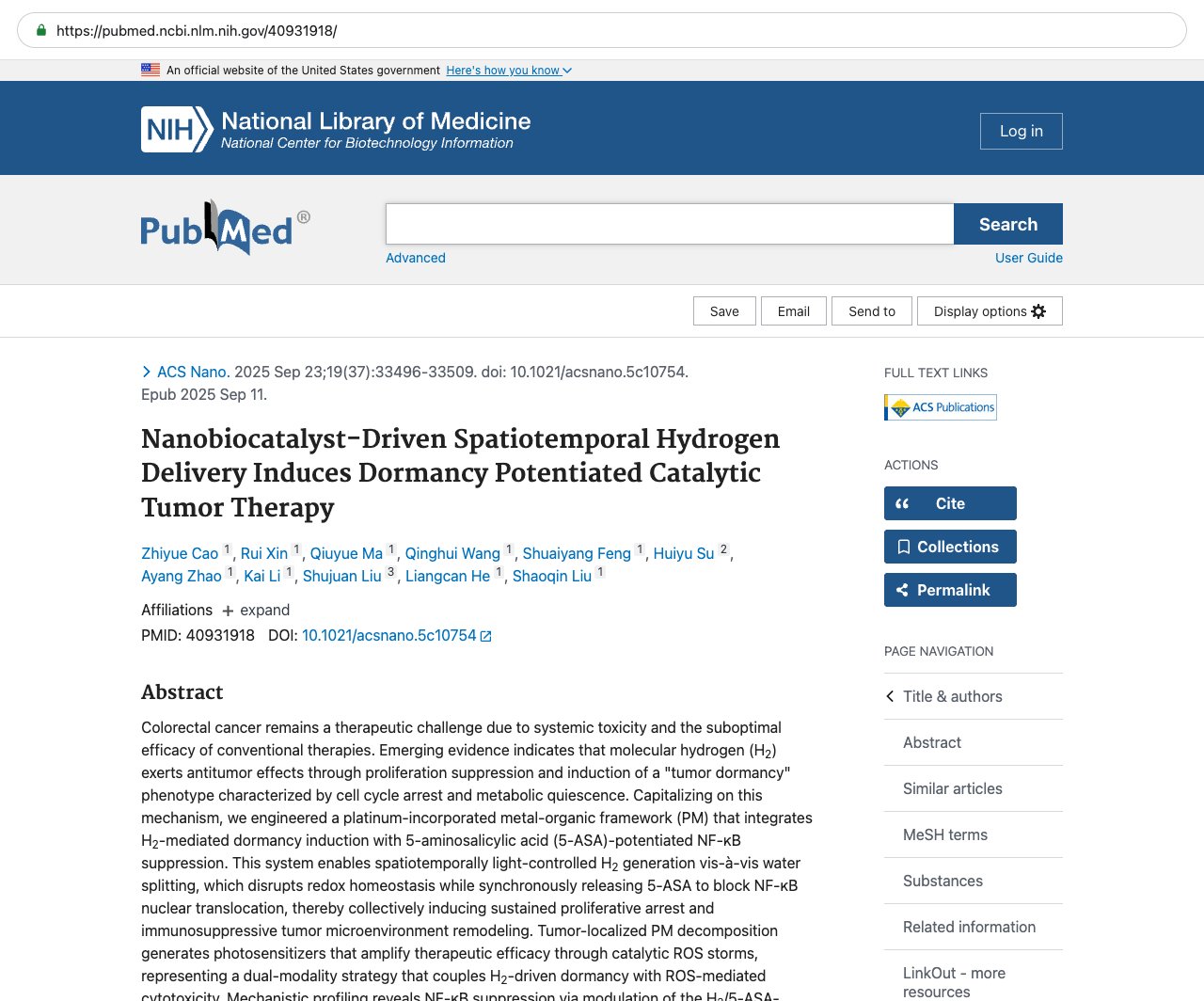
This page mirrors the published abstract (© the authors / publisher) for reference and citation. The canonical source is the PubMed record linked above. This is not medical advice.