2025 · Ye — Molecular hydrogen as a novel regulator of cellular pyroptosis: mechanistic insights and therapeutic implications
Super-Abstract
Pyroptosis — a highly inflammatory form of programmed cell death — drives tissue damage in heart attacks, neurodegeneration, metabolic disease, and cancer; this review demonstrates that molecular hydrogen can regulate pyroptosis through multiple interconnected pathways, producing context-dependent protective or tumour-fighting effects. The field remains largely preclinical, with significant challenges still ahead before clinical use is feasible. (Molecular Biology Reports, 2025.)
Commentary
Pyroptosis is not simple cell death: it involves gasdermin-mediated membrane pores that release massive quantities of IL-1β and IL-18, fuelling a runaway inflammatory cascade. Conventional anti-inflammatory drugs struggle to interrupt this cascade without broad immunosuppression. H₂ offers a mechanistically interesting alternative: the review presents evidence that it can (1) directly modify gasdermin proteins through redox chemistry, (2) alter mitochondrial signals that feed into the NLRP3 inflammasome, and (3) disrupt inflammasome assembly itself. Remarkably, the authors present data suggesting H₂ may promote therapeutic pyroptosis selectively in tumour cells while protecting normal tissue — a striking context-dependency that, if confirmed, would be therapeutically significant. Preclinical evidence across cardiac ischaemia-reperfusion, neuroinflammation, metabolic dysfunction, and cancer models is reviewed. However, the authors are candid: delivery standardisation, dosimetry, and biomarker development remain major unsolved challenges.
Key quotes
- „hydrogen modulates pyroptosis through interconnected pathways including direct gasdermin redox modification, mitochondrial signaling integration, and inflammasome assembly disruption.“ — the three proposed mechanistic pathways through which H₂ regulates pyroptosis
- „cytoprotective in normal tissues while promoting therapeutic pyroptosis in malignant cells.“ — the striking context-dependent behaviour: H₂ protects healthy cells but may trigger death in cancer cells
- „significant translational barriers remain including delivery optimization, dosimetric standardization, and biomarker development.“ — the honest statement of what must be solved before clinical application
Our assessment
This is a preclinical review — virtually all cited evidence comes from animal or cell-culture experiments. The mechanistic framework proposed (gasdermin redox modification, inflammasome disruption) is scientifically plausible but not yet validated in humans. The claimed tumour-selective pro-pyroptotic activity is particularly intriguing but also particularly in need of rigorous confirmation. These findings cannot be directly extrapolated to human therapy. The review is scientifically rigorous in framing limitations, making it a valuable reference for researchers, not a basis for therapeutic recommendations.
Study design
- Type: mechanistic narrative review · n: n/a (literature synthesis) · H₂ delivery: hydrogen-rich water and other methods as reported in source studies (animal and cell models)
- Result: narrative synthesis across cardiac, neurological, metabolic, and oncological pyroptosis models; H₂ proposed to act via gasdermin redox modification, mitochondrial signalling, and inflammasome inhibition; context-dependent cytoprotective vs. tumouricidal effects described; clinical translation barriers explicitly noted
Abstract
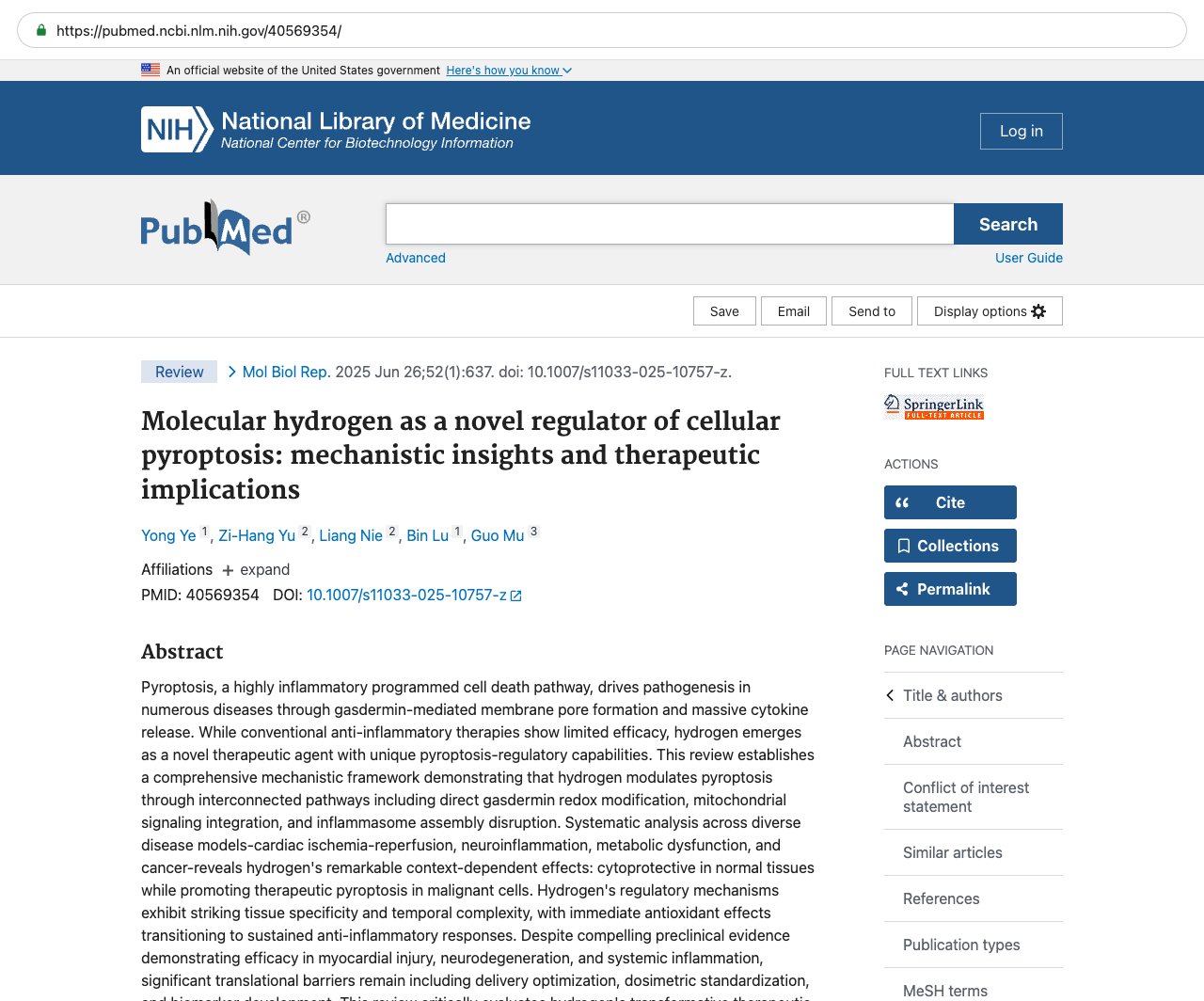
Pyroptosis, a highly inflammatory programmed cell death pathway, drives pathogenesis in numerous diseases through gasdermin-mediated membrane pore formation and massive cytokine release. While conventional anti-inflammatory therapies show limited efficacy, hydrogen emerges as a novel therapeutic agent with unique pyroptosis-regulatory capabilities. This review establishes a comprehensive mechanistic framework demonstrating that hydrogen modulates pyroptosis through interconnected pathways including direct gasdermin redox modification, mitochondrial signaling integration, and inflammasome assembly disruption. Systematic analysis across diverse disease models-cardiac ischemia-reperfusion, neuroinflammation, metabolic dysfunction, and cancer-reveals hydrogen's remarkable context-dependent effects: cytoprotective in normal tissues while promoting therapeutic pyroptosis in malignant cells. Hydrogen's regulatory mechanisms exhibit striking tissue specificity and temporal complexity, with immediate antioxidant effects transitioning to sustained anti-inflammatory responses. Despite compelling preclinical evidence demonstrating efficacy in myocardial injury, neurodegeneration, and systemic inflammation, significant translational barriers remain including delivery optimization, dosimetric standardization, and biomarker development. This review critically evaluates hydrogen's transformative therapeutic potential while addressing realistic implementation challenges, providing a roadmap for advancing this innovative paradigm from bench to bedside.
Source & links
Screenshot of the PubMed page
This page mirrors the published abstract (© the authors / publisher) for reference and citation. The canonical source is the PubMed record linked above. This is not medical advice.