2014 · Coban — DNA-binding studies and antitumor evaluation of novel water soluble organic pip and hpip analogs
Super-Abstract
Two newly synthesized water-soluble organic compounds (pip and hpip analogs) were tested for DNA-binding and antitumor activity in cell culture. Both compounds bind strongly to DNA via electrostatic and intercalative modes, inhibit DNA transcription, and show cytotoxic activity against cancer cells. The hydrogen mentioned in this study refers to intramolecular hydrogen bonding within the compounds — not to therapeutic molecular hydrogen (H₂). (Applied Biochemistry and Biotechnology, 2014.)
Commentary
This is a synthetic chemistry and in-vitro pharmacology study investigating novel organic ligands as potential antitumor agents. The „hydrogen“ in this paper is exclusively about intramolecular hydrogen bonds within the organic molecule structure — a fundamental chemical concept entirely unrelated to dissolved molecular hydrogen gas (H₂) as studied in hydrogen medicine. Compound 2 (hpip analog) showed stronger DNA binding and greater cytotoxicity than compound 1, attributed to its intramolecular hydrogen bond enabling extended co-planarity and better DNA intercalation. This study has no relevance to H₂ inhalation, hydrogen-rich water, or any H₂-based therapy.
Key quotes
- „The extended co-planarity of 2 due to the intramolecular hydrogen bonding may lead to an enhancement of DNA binding affinity of 2.“ — hydrogen bonding here means intramolecular chemistry, not molecular H₂ therapy
- „2 can promote cleavage of pBR322 DNA upon irradiation, it inhibits DNA transcription and it is more cytotoxic at lower concentrations in comparison to 1.“ — antitumor activity of compound 2
- „both compounds show some strong binding to DNA in a mixture of electrostatic and intercalative mode resulting in the intrinsic binding constants Kb of (4.0 ± 0.5) × 10(5) M(-1) and (7.5 ± 0.5) × 10(5) M(-1) for 1 and 2, respectively.“ — quantified DNA-binding affinities
Our assessment
This is a preclinical in-vitro chemistry study on novel organic antitumor compounds. It has no connection to therapeutic molecular hydrogen (H₂). The hydrogen referenced is intramolecular hydrogen bonding — a basic chemical structural feature, not the dissolved gas H₂ studied in hydrogen medicine. This entry appears in the H₂ database due to keyword matching. No conclusions about H₂ therapy can be drawn from this paper.
Study design
- Type: in-vitro synthetic chemistry / pharmacology · Model: cell-free DNA (viscosity, spectroscopy, gel electrophoresis) + pBR322 plasmid DNA · H₂ relevance: none (hydrogen = intramolecular bond within organic molecule)
- Key result: compound 2 binds DNA more strongly (Kb 7.5×10⁵ M⁻¹), promotes DNA cleavage under irradiation, inhibits transcription, and shows higher cytotoxicity than compound 1
Abstract
Two new water-soluble pip and hpip analogs, 1 and 2 pip = 2-phenylimidazo[4,5-f][1, 10]phenanthroline; hpip = 2-(2-hydroxyphenyl)imidazo[4,5-f][1, 10]phenanthroline, have been synthesized and fully characterized by CHN analysis, MALDI-TOF MS, (1)H-NMR, IR (ATR), and UV-Vis methods. The DNA-binding behaviors of both compounds have been studied by viscosity measurements, spectroscopic methods, and gel electrophoresis studies, and potential for antitumor activity was evaluated by measuring their ability to inhibit DNA transcription. The results indicate that both compounds show some strong binding to DNA in a mixture of electrostatic and intercalative mode resulting in the intrinsic binding constants Kb of (4.0 ± 0.5) × 10(5) M(-1) and (7.5 ± 0.5) × 10(5) M(-1) for 1 and 2, respectively. These strong binding affinities for DNA are comparable for that seen for many transition metal-based intercalators. Comparatively, observed difference in the DNA-binding affinities of two complexes can be reasonably explained by the presence of an intra-molecular hydrogen-bonding between the ortho-phenolic group and the nitrogen atom of the imidazole ring. The extended co-planarity of 2 due to the intramolecular hydrogen bonding may lead to an enhancement of DNA binding affinity of 2. In addition, 2 can promote cleavage of pBR322 DNA upon irradiation, it inhibits DNA transcription and it is more cytotoxic at lower concentrations in comparison to 1, as revealed by the spectroscopic measurements.
Source & links
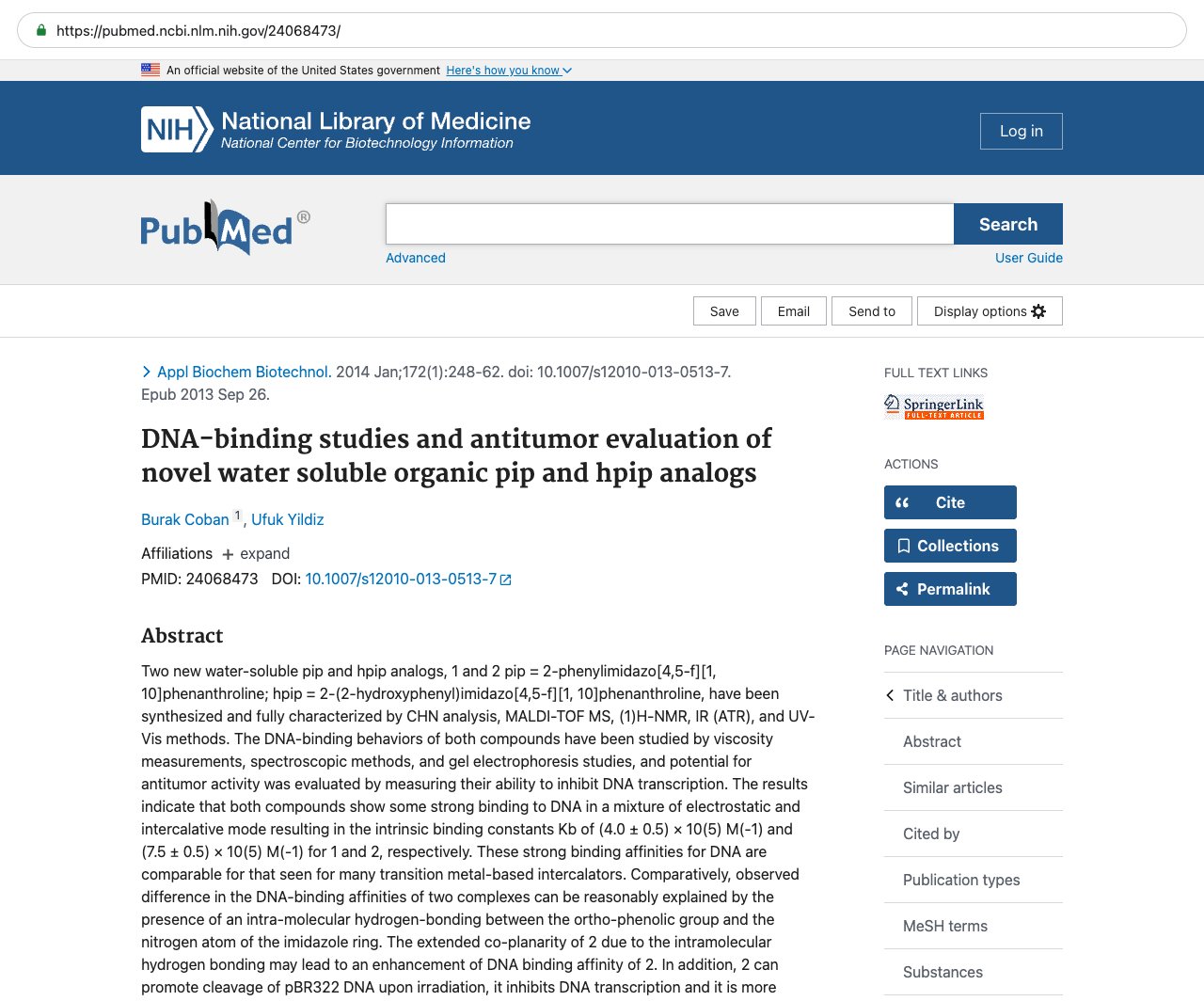
Screenshot of the PubMed page
This page mirrors the published abstract (© the authors / publisher) for reference and citation. The canonical source is the PubMed record linked above. This is not medical advice.