2021 Critical care explorations Pilot / Observational Human H₂ therapy Inhalation Fundamentals / Safety
2021 · Cole et al. — Safety of Prolonged Inhalation of Hydrogen Gas in Air in Healthy Adults
Super-Abstract
In eight healthy adults who inhaled 2.4% hydrogen in medical air through a high-flow nasal cannula for 24 to 72 hours, no clinically significant adverse events occurred. Vital signs, lung function, electrocardiogram, neurological tests and blood tests showed no clinically significant changes, apart from increases in hematocrit and platelet counts that the authors judged clinically insignificant. With eight participants and no control group, the study was not designed to rule out rarer adverse effects, and the authors call for future studies powered to evaluate safety. (Critical Care Explorations, 2021.)
Commentary
Inhaled hydrogen reduced ischemia-reperfusion injury in models of cardiac arrest, shock and stroke, and this study examined its safety at the doses needed for a clinical efficacy study. It was a prospective, single-arm study in a tertiary care hospital. Eight healthy adults aged 18 to 30 years (50% female, 62% non-Caucasian) were admitted and inhaled 2.4% hydrogen gas in medical air through a high-flow nasal cannula at 15 L/min for 24 hours (n = 2), 48 hours (n = 2) or 72 hours (n = 4). Before and after exposure, the team recorded vital signs, symptoms reported by participants and nurses, pulmonary function tests, a 12-lead electrocardiogram, the Mini-Mental State Examination, a neurological examination and blood tests. Two clinicians outside the study team and an external Data and Safety Monitoring Board reviewed all adverse events.
Key quotes
- „No clinically significant adverse events occurred in any patient.“ — the main safety result across all eight participants
- „Compared with baseline measures, there were no clinically significant changes over time in vital signs, pulmonary function testing results, Mini-Mental State Examination scores, neurologic examination findings, electrocardiogram measurements, or serologic tests for hematologic (except for clinically insignificant increases in hematocrit and platelet counts), renal, hepatic, pancreatic, or cardiac injury associated with hydrogen gas inhalation.“ — the measured changes, including small rises in two blood values judged clinically insignificant
- „Inhalation of 2.4% hydrogen gas does not appear to cause clinically significant adverse effects in healthy adults. Although these data suggest that inhaled hydrogen gas may be well tolerated, future studies need to be powered to further evaluate safety.“ — the authors' conclusion, with their own caution about what eight participants can show
Our assessment
The study answers a narrow question: whether healthy young adults tolerate up to 72 hours of 2.4% hydrogen in air. In these eight people, no clinically significant adverse events or test changes occurred. Review of adverse events by clinicians outside the study team and an external board adds weight to this finding. Limitations: only eight participants, four of them exposed for 72 hours, all healthy and aged 18 to 30. There was no control group, so changes such as the rise in hematocrit and platelet counts cannot be compared with a group breathing air alone. The results do not show how critically ill patients, the intended users, would tolerate the gas, and they say nothing about efficacy. The authors themselves call for studies powered to evaluate safety.
Study design
- Type: prospective, single-arm safety study in a tertiary care hospital · n: eight healthy adults aged 18 to 30 · H₂ delivery: 2.4% hydrogen in medical air via high-flow nasal cannula at 15 L/min for 24, 48 or 72 hours
- Comparator: none. Measurements before and after exposure
- Result: no clinically significant adverse events, all participants completed the study. No clinically significant changes in vital signs, lung function, Mini-Mental State Examination, neurological examination, electrocardiogram or blood tests for hematologic, renal, hepatic, pancreatic or cardiac injury. Hematocrit and platelet counts rose, judged clinically insignificant
Abstract
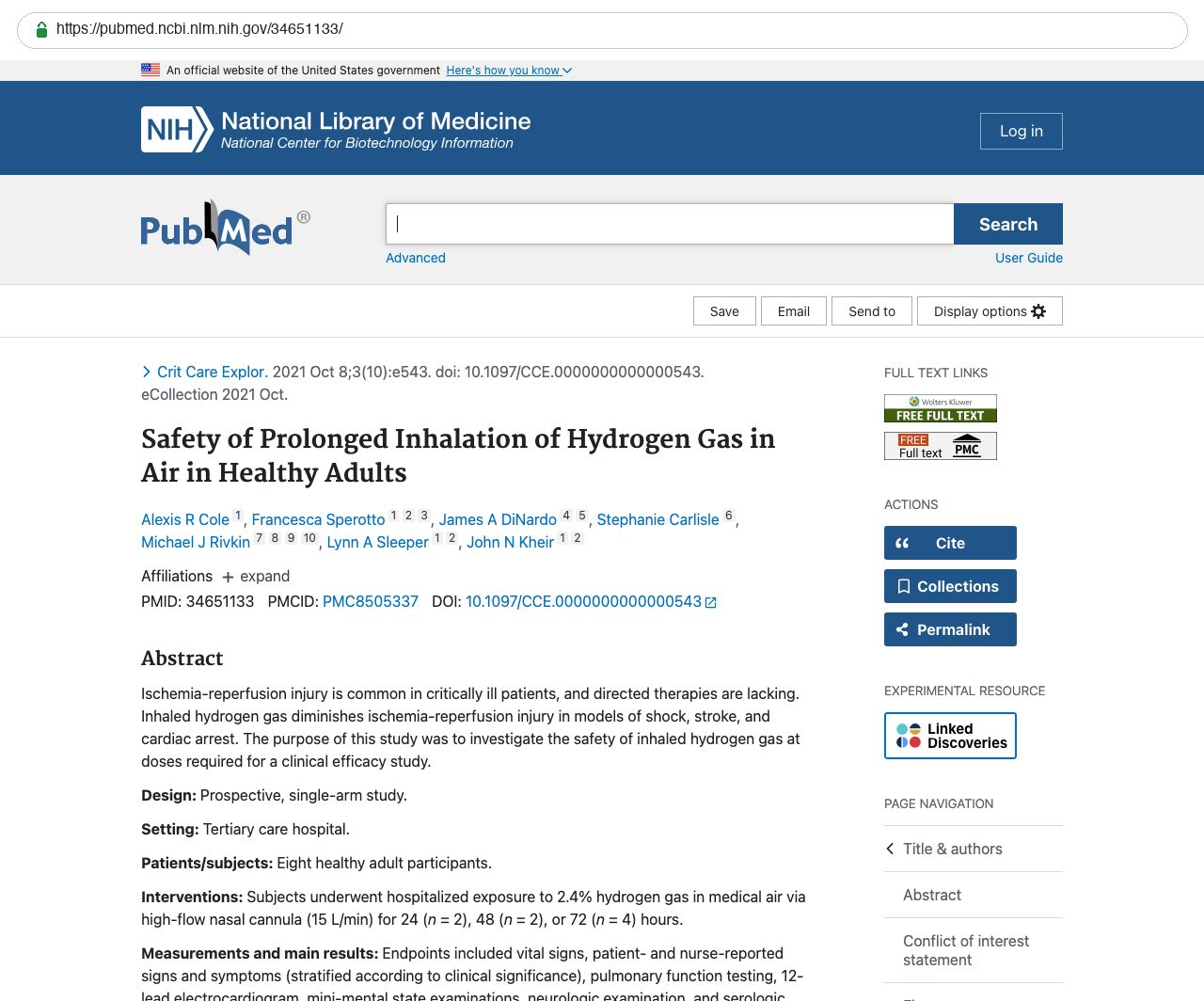
UNLABELLED: Ischemia-reperfusion injury is common in critically ill patients, and directed therapies are lacking. Inhaled hydrogen gas diminishes ischemia-reperfusion injury in models of shock, stroke, and cardiac arrest. The purpose of this study was to investigate the safety of inhaled hydrogen gas at doses required for a clinical efficacy study. DESIGN: Prospective, single-arm study. SETTING: Tertiary care hospital. PATIENTS/SUBJECTS: Eight healthy adult participants. INTERVENTIONS: Subjects underwent hospitalized exposure to 2.4% hydrogen gas in medical air via high-flow nasal cannula (15 L/min) for 24 (n = 2), 48 (n = 2), or 72 (n = 4) hours. MEASUREMENTS AND MAIN RESULTS: Endpoints included vital signs, patient- and nurse-reported signs and symptoms (stratified according to clinical significance), pulmonary function testing, 12-lead electrocardiogram, mini-mental state examinations, neurologic examination, and serologic testing prior to and following exposure. All adverse events were verified by two clinicians external to the study team and an external Data and Safety Monitoring Board. All eight participants (18-30 yr; 50% female; 62% non-Caucasian) completed the study without early termination. No clinically significant adverse events occurred in any patient. Compared with baseline measures, there were no clinically significant changes over time in vital signs, pulmonary function testing results, Mini-Mental State Examination scores, neurologic examination findings, electrocardiogram measurements, or serologic tests for hematologic (except for clinically insignificant increases in hematocrit and platelet counts), renal, hepatic, pancreatic, or cardiac injury associated with hydrogen gas inhalation. CONCLUSIONS: Inhalation of 2.4% hydrogen gas does not appear to cause clinically significant adverse effects in healthy adults. Although these data suggest that inhaled hydrogen gas may be well tolerated, future studies need to be powered to further evaluate safety. These data will be foundational to future interventional studies of inhaled hydrogen gas in injury states, including following cardiac arrest.
Source & links
Screenshot of the PubMed page
This page mirrors the published abstract (© the authors / publisher) for reference and citation. The canonical source is the PubMed record linked above. This is not medical advice.