2017 · Iketani — Molecular Hydrogen as a Neuroprotective Agent
Super-Abstract
Molecular hydrogen (H₂) acts as an antioxidant and anti-inflammatory agent and shows potential in neurological disorders — from stroke through neurodegenerative diseases to brain damage in newborns. (Review by Iketani & Ohsawa, Current Neuropharmacology, 2017.)
Commentary
This <strong>review</strong> comes, with Ikuroh Ohsawa, from one of the pioneers of H₂ medicine — the same Ohsawa who published the key study in <em>Nature Medicine</em> in 2007. It summarizes why H₂ is interesting for nerve diseases: oxidative stress and neuroinflammation trigger many neurological disorders, and H₂ has demonstrably antioxidant and anti-inflammatory effects. The authors categorize the three routes of administration — inhaling H₂ gas, drinking H₂ water, and injecting H₂ saline — and discuss progress in cerebrovascular diseases (e.g. stroke), neurodegenerative disorders (e.g. Parkinson's, Alzheimer's) and brain damage in newborns. They name possible mediators such as signaling molecules and hormones. Central for honesty: most of these neurological diseases are „currently incurable“, the studies show only „clinical potential“ — and the authors explicitly emphasize that the <strong>direct target molecule of H₂ is still unknown</strong> and further research remains necessary.
Key quotes
- „Recently, it has been reported that molecular hydrogen (H2) functions as an antioxidant and anti-inflammatory agent.“ — the mechanistic basis
- „Although most neurological disorders are currently incurable, these studies suggest the clinical potential of H2 administration for their prevention, treatment, and mitigation.“ — honest framing: potential, not cure
- „further investigation will be required to determine the direct target molecule of H2.“ — the open research question: target molecule still unresolved
Our assessment
A valuable, well-cited review from a pioneering author group (Ohsawa) — ideal for documenting the breadth of neurological H₂ research, including drinking H₂ water as a route of administration. This makes it a useful context source for the field. Limitations, stated honestly: a pure review (evidence level 4), no own patient data, and the authors deliberately phrase things cautiously („clinical potential“, „incurable“) — they openly admit that the direct molecular target of H₂ is not yet known. No proof of a cure for neurological diseases, but a survey of the potential.
Study design
- Type: review · n: — (no own cohort) · Duration: — · H₂ delivery: summarized — inhalation of H₂ gas, drinking H₂ water, injection of H₂ saline
- Result metrics: qualitative — clinical potential in cerebrovascular, neurodegenerative and neonatal brain disorders; mechanism: antioxidant and anti-inflammatory; direct target molecule still open
Abstract
Oxidative stress and neuroinflammation cause many neurological disorders. Recently, it has been reported that molecular hydrogen (H2) functions as an antioxidant and anti-inflammatory agent. The routes of H2 administration in animal model and human clinical studies are roughly classified into three types, inhalation of H2 gas, drinking H2-dissolved water, and injection of H2-dissolved saline. This review discusses some of the remarkable progress that has been made in the research of H2 use for neurological disorders, such as cerebrovascular diseases, neurodegenerative disorders, and neonatal brain disorders. Although most neurological disorders are currently incurable, these studies suggest the clinical potential of H2 administration for their prevention, treatment, and mitigation. Several of the potential effectors of H2 will also be discussed, including cell signaling molecules and hormones that are responsible for preventing oxidative stress and inflammation. Nevertheless, further investigation will be required to determine the direct target molecule of H2.
Source & links
Screenshot of the PubMed page
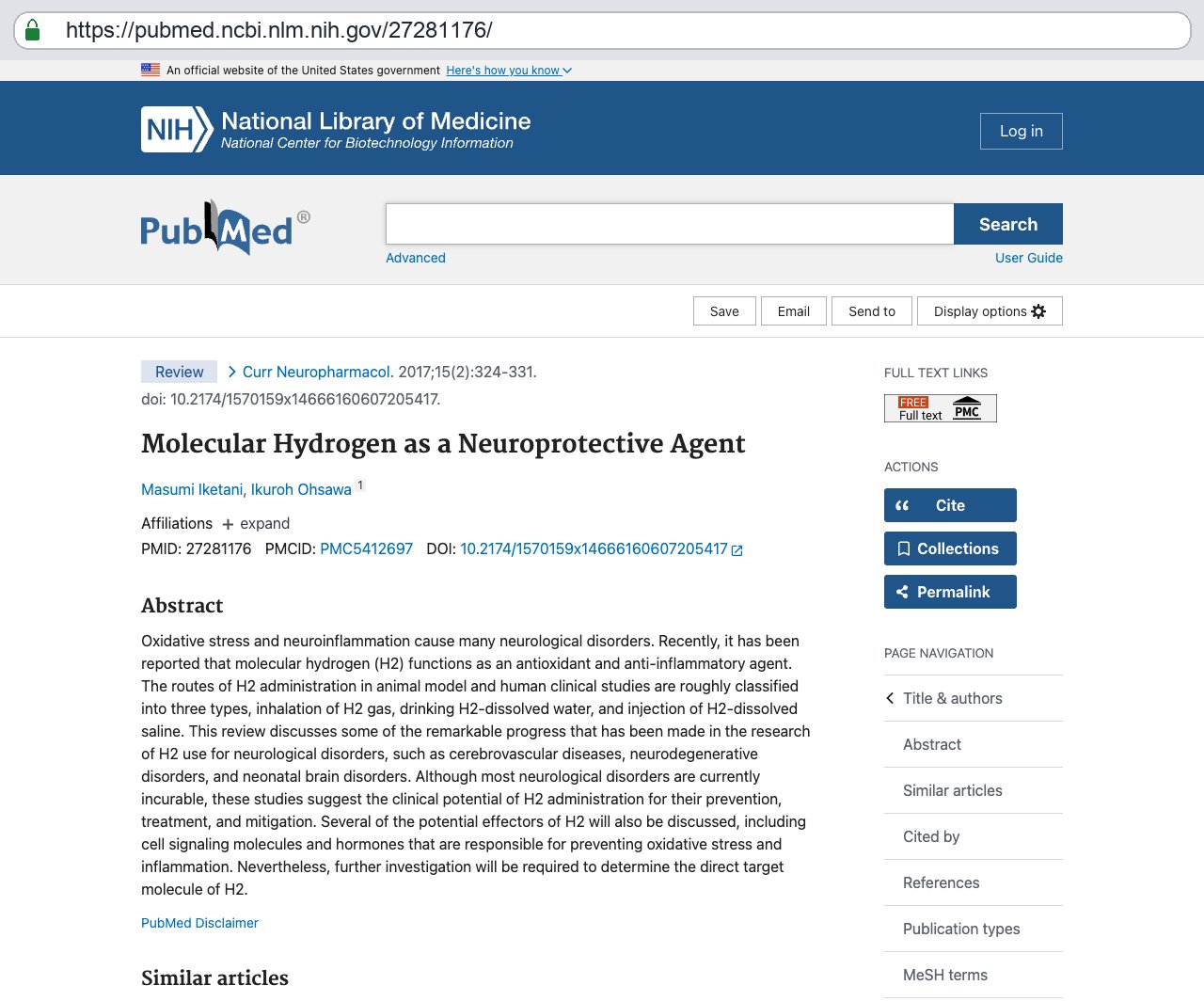
This page mirrors the published abstract (© the authors / publisher) for reference and citation. The canonical source is the PubMed record linked above. This is not medical advice.