2007 · Ohsawa — Hydrogen acts as a therapeutic antioxidant by selectively reducing cytotoxic oxygen radicals
Super-Abstract
Hydrogen (H₂) acts as a selective antioxidant: it specifically neutralizes the most aggressive free radical — the hydroxyl radical (•OH) — while leaving the beneficial, signaling oxygen species untouched. In a rat model, inhaled H₂ markedly reduced brain damage after stroke. (Nature Medicine, 2007 — the key study that launched hydrogen research worldwide.)
Commentary
This study from the renowned journal <em>Nature Medicine</em> is the starting gun of modern hydrogen medicine — almost all of the 2000+ later studies refer back to it. The team around Ohsawa showed in cell cultures that H₂ does not indiscriminately mop up all free radicals but <strong>selectively</strong> targets only the most dangerous one: the hydroxyl radical. This matters, because the body needs some oxygen species as signaling molecules — a „sledgehammer antioxidant“ would disrupt them. H₂ is small and diffuses lightning-fast across cell membranes right into the mitochondria, where oxidative stress arises. In the animal model (brain infarction via ischemia-reperfusion), inhaling H₂ gas visibly reduced the damage. Important for honesty: this is a <strong>preclinical</strong> study (cells + rat), not human proof — but it provides the mechanism on which the entire field is built.
Key quotes
- „H(2) selectively reduced the hydroxyl radical, the most cytotoxic of reactive oxygen species (ROS), and effectively protected cells; however, H(2) did not react with other ROS, which possess physiological roles.“ — the central discovery: selectivity instead of a scattergun
- „The inhalation of H(2) gas markedly suppressed brain injury by buffering the effects of oxidative stress.“ — the animal proof of effect (stroke model)
- „owing to its ability to rapidly diffuse across membranes, it can reach and react with cytotoxic ROS and thus protect against oxidative damage.“ — why H₂ can work at all: membrane permeability
Our assessment
The single most important study in the field — anyone explaining H₂ starts here. The selectivity argument is also the strongest educational argument: H₂ does not interfere with normal redox signaling, unlike high-dose classical antioxidants (which were even harmful in some studies). For us it provides the scientific foundation for every H₂ product. Limitation, stated honestly: purely preclinical — the leap to humans only comes with later RCTs.
Study design
- Type: preclinical (cell culture + rat model) · H₂ delivery: inhalation of H₂ gas
- Result: selective reduction of •OH; marked reduction of brain damage after ischemia-reperfusion
Abstract
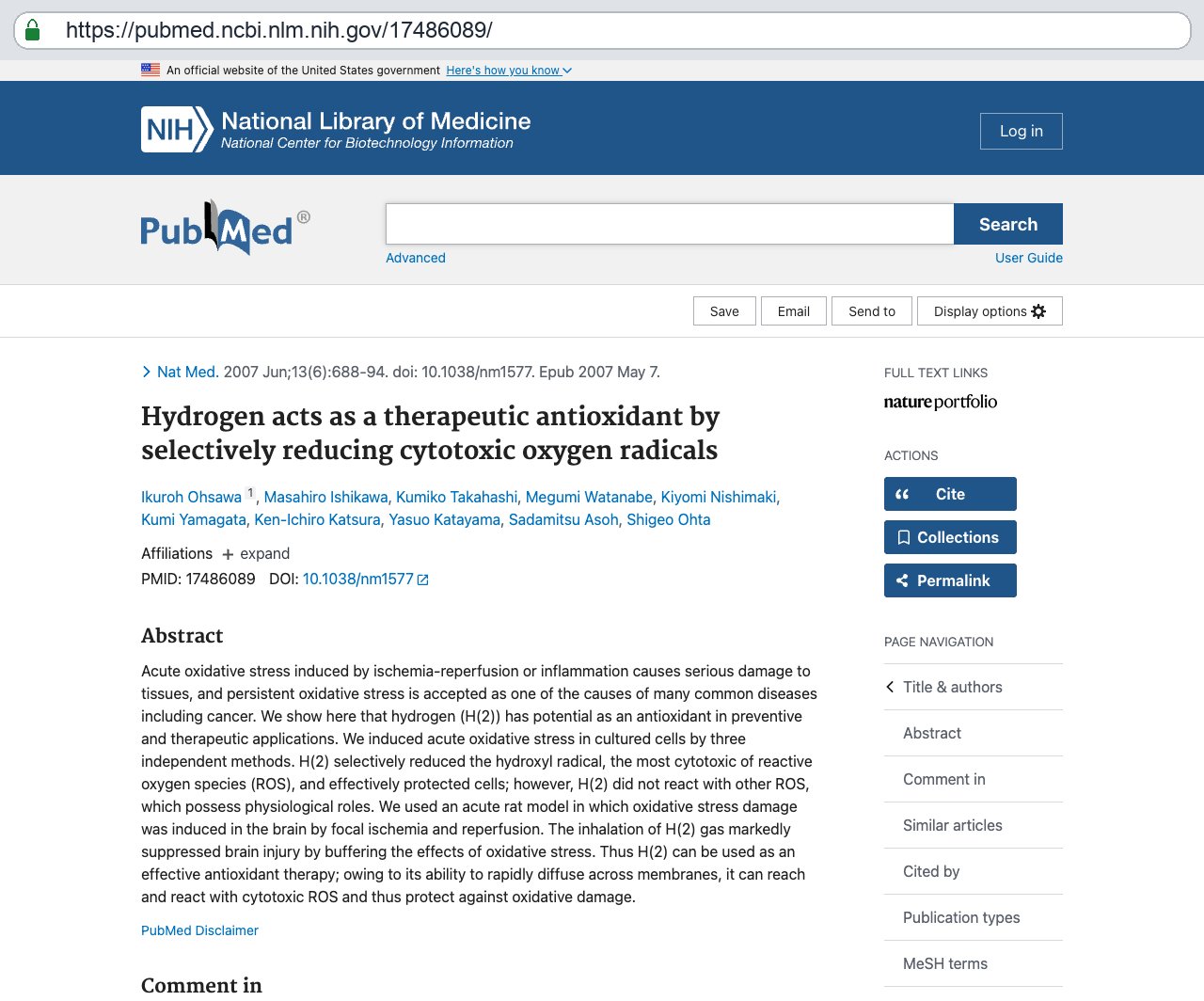
Acute oxidative stress induced by ischemia-reperfusion or inflammation causes serious damage to tissues, and persistent oxidative stress is accepted as one of the causes of many common diseases including cancer. We show here that hydrogen (H(2)) has potential as an antioxidant in preventive and therapeutic applications. We induced acute oxidative stress in cultured cells by three independent methods. H(2) selectively reduced the hydroxyl radical, the most cytotoxic of reactive oxygen species (ROS), and effectively protected cells; however, H(2) did not react with other ROS, which possess physiological roles. We used an acute rat model in which oxidative stress damage was induced in the brain by focal ischemia and reperfusion. The inhalation of H(2) gas markedly suppressed brain injury by buffering the effects of oxidative stress. Thus H(2) can be used as an effective antioxidant therapy; owing to its ability to rapidly diffuse across membranes, it can reach and react with cytotoxic ROS and thus protect against oxidative damage.
Source & links
Screenshot of the PubMed page
This page mirrors the published abstract (© the authors / publisher) for reference and citation. The canonical source is the PubMed record linked above. This is not medical advice.