2021 · Noda — Neuroprotective and Preventative Effects of Molecular Hydrogen
Super-Abstract
Hydrogen (H₂) is neuroprotective: this review summarizes how daily H₂ could slow the progression of neurodegenerative diseases such as Parkinson's and Alzheimer's (for which there are still no specific drugs) — via antioxidant and anti-inflammatory effects and via a surprising stomach-brain connection. (Current Pharmaceutical Design, 2021.)
Commentary
For Parkinson's and Alzheimer's there are still no drugs that halt the disease itself — one can only relieve symptoms. That is exactly why the idea is interesting that something as simple as daily H₂ could slow the course. This review by Noda and colleagues brings together several mechanisms of action. First the known one: H₂ reduces reactive oxygen species (ROS) and is anti-inflammatory — interestingly, according to the review it scavenges not only the hydroxyl radical (•OH) but also affects superoxide. Second, and this is the exciting part: an endocrine effect mediated via the stomach. In Parkinson's model mice, chronic H₂ triggers the release of the hormone ghrelin from the stomach. In Alzheimer's model mice, a sex-dependent effect appears: in female animals H₂ prevents the decline of estrogen and estrogen receptor-β and boosts the nerve growth factor BDNF together with its receptor TrkB. This shifts the picture of H₂ away from a mere radical scavenger toward a modulator of hormone and growth-factor systems. Two points must stay honest: it is a review, and the underlying findings come overwhelmingly from mouse models, not from humans. The authors themselves stress that central questions are open — for instance where exactly in the body the „target“ of H₂ lies.
Key quotes
- „One of the beneficial effects of molecular hydrogen (H2, hydrogen gas) is neuroprotection and prevention of neurological disorders.“ — the core message of the review
- „In Parkinson's disease model mice, chronic intake of H2 causes the release of ghrelin from the stomach.“ — the surprising stomach-brain axis (endocrine mechanism)
- „In female mice, declines of estrogen and estrogen receptor-β (ERβ) are prevented by H2, upregulating brain-derived neurotrophic factor (BDNF) and its receptor, tyrosine kinase receptor B (TrkB).“ — the sex-dependent effect in the Alzheimer's model
Our assessment
The review is relevant because it describes H₂, beyond its antioxidant status, as a modulator of endocrine and neurotrophic systems — providing a more nuanced explanation of how regular H₂ could protect the nervous system. For us it is connectable that the central mouse findings work with drinking H₂ („drinking H2“, „chronic intake“) — i.e. the consumption form that corresponds to our products. Nevertheless it is essential to stay strictly factual: Parkinson's and Alzheimer's are serious diseases; no preventive or curative promises may be derived from an animal review. Limitations, stated honestly: it is a review (evidence level 4), the evidence comes predominantly from mouse models without human confirmation, the sex-dependent effect complicates generalization, and the authors themselves concede that the actual molecular target of H₂ is still unknown.
Study design
- Type: review (focus on mouse models for Parkinson's and Alzheimer's) · n: n/a (secondary literature) · Duration: n/a · H₂ delivery: in the cited studies predominantly oral/chronic H₂ intake (drinking)
- Result: no quantitative endpoints in the abstract; reported are mechanisms — reduction of ROS (•OH and superoxide), ghrelin release from the stomach (Parkinson's model), protection of estrogen/ERβ and upregulation of BDNF/TrkB in female animals (Alzheimer's model)
Abstract
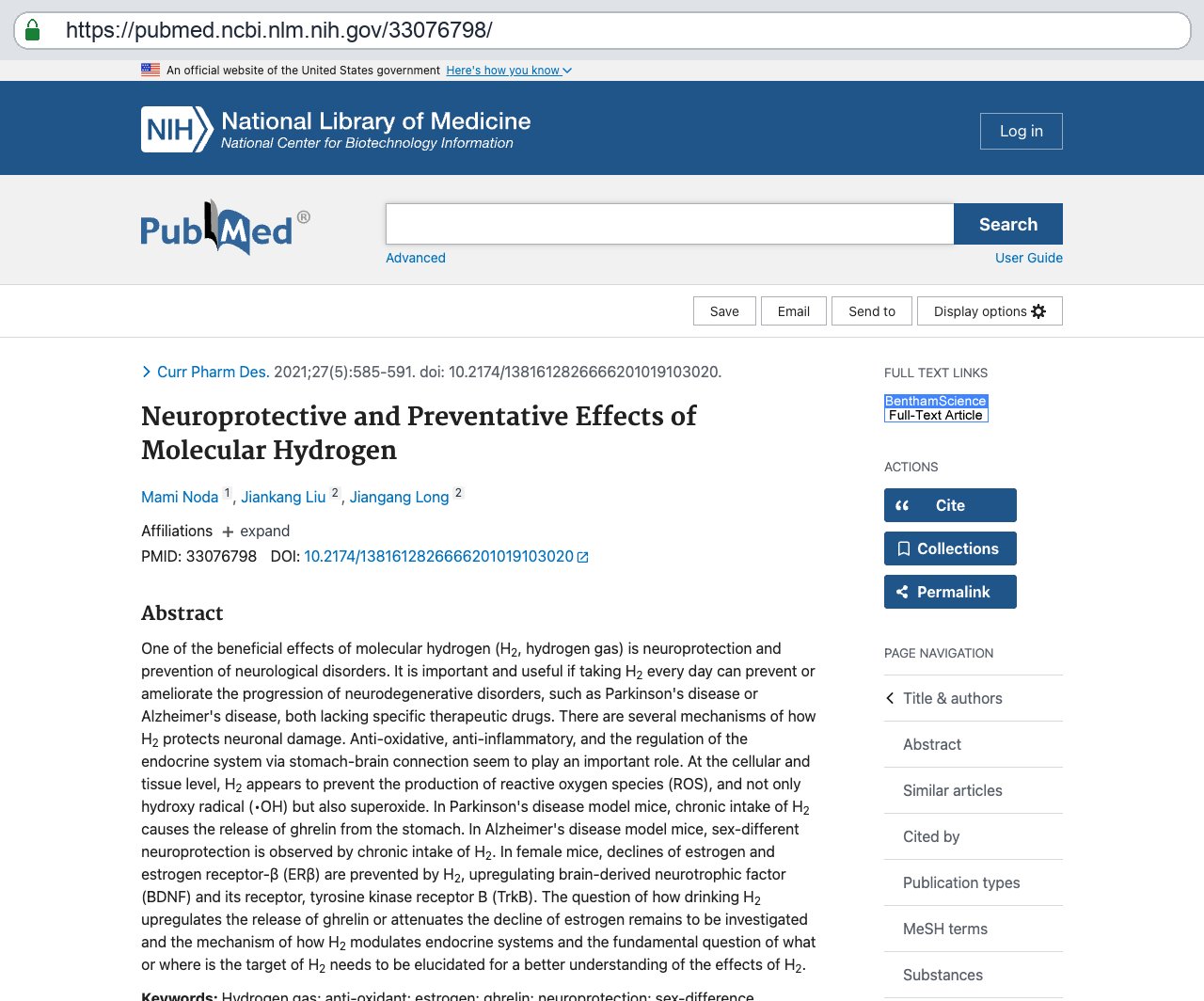
One of the beneficial effects of molecular hydrogen (H2, hydrogen gas) is neuroprotection and prevention of neurological disorders. It is important and useful if taking H2 every day can prevent or ameliorate the progression of neurodegenerative disorders, such as Parkinson's disease or Alzheimer's disease, both lacking specific therapeutic drugs. There are several mechanisms of how H2 protects neuronal damage. Anti-oxidative, anti-inflammatory, and the regulation of the endocrine system via stomach-brain connection seem to play an important role. At the cellular and tissue level, H2 appears to prevent the production of reactive oxygen species (ROS), and not only hydroxy radical (•OH) but also superoxide. In Parkinson's disease model mice, chronic intake of H2 causes the release of ghrelin from the stomach. In Alzheimer's disease model mice, sex-different neuroprotection is observed by chronic intake of H2. In female mice, declines of estrogen and estrogen receptor-β (ERβ) are prevented by H2, upregulating brain-derived neurotrophic factor (BDNF) and its receptor, tyrosine kinase receptor B (TrkB). The question of how drinking H2 upregulates the release of ghrelin or attenuates the decline of estrogen remains to be investigated and the mechanism of how H2 modulates endocrine systems and the fundamental question of what or where is the target of H2 needs to be elucidated for a better understanding of the effects of H2.
Source & links
Screenshot of the PubMed page
This page mirrors the published abstract (© the authors / publisher) for reference and citation. The canonical source is the PubMed record linked above. This is not medical advice.