2016 · Davoren — Design and Optimization of Selective Azaindole Amide M1 Positive Allosteric Modulators
Super-Abstract
This drug-design study developed a new class of small-molecule compounds that selectively activate the M1 muscarinic receptor — a target relevant to cognitive impairment in schizophrenia and Alzheimer's disease. The intramolecular hydrogen bond in these azaindole amide compounds is a key structural element — not molecular hydrogen (H₂) as a bioactive substance. (Bioorganic & Medicinal Chemistry Letters, 2016.)
Commentary
Davoren et al. describe the design, synthesis, and optimization of a series of azaindole amide compounds that act as positive allosteric modulators (PAMs) of the M1 muscarinic acetylcholine receptor. M1 PAMs represent an active research area because selective M1 activation could improve the cognitive deficits of schizophrenia and Alzheimer's disease without the side effects of direct agonists. The structural key is a nitrogen-containing azaindole core that forms an intramolecular hydrogen bond with an amide N-H group, stabilizing the bioactive conformation of the molecule. The lead compound 25 showed potent and selective M1 PAM activity, good brain penetration, and in-vivo activity in animal models. Note: the „hydrogen bond“ in this study refers to a classical chemical bond within a drug molecule — this is entirely unrelated to molecular hydrogen (H₂) therapy or hydrogen medicine. This paper appears in an H₂ database due to keyword overlap only.
Key quotes
- „The nitrogen of the azaindole core is a key design element as it forms an intramolecular hydrogen bond with the amide N-H thus reinforcing the bioactive conformation.“ — structural rationale — hydrogen bond here is a molecular bond in a drug, not H₂ gas
- „Representative compound 25 is a potent and selective M1 PAM that has well aligned physicochemical properties, adequate brain penetration and pharmacokinetic (PK) properties, and is active in vivo.“ — lead compound profile
Our assessment
This is an in-vitro medicinal chemistry and pharmacology study with some in-vivo animal data for a small-molecule drug candidate. It has no connection to hydrogen medicine or H₂ therapy; the „hydrogen bond“ in the title refers to a classical intramolecular bond within the drug structure. The science is credible drug-discovery work for neurological targets, but it is entirely outside the scope of molecular hydrogen (H₂) research. Its inclusion in an H₂ database is a keyword-based false positive.
Study design
- Type: medicinal chemistry / drug design study · Model: in-vitro M1 receptor assays; pharmacokinetic profiling; in-vivo animal efficacy model · Subject: azaindole amide small-molecule M1 PAMs — no H₂ therapeutic component
- Result: compound 25 identified as potent, selective M1 PAM with good brain penetration and in-vivo activity — a drug-discovery milestone unrelated to H₂ therapy
Abstract
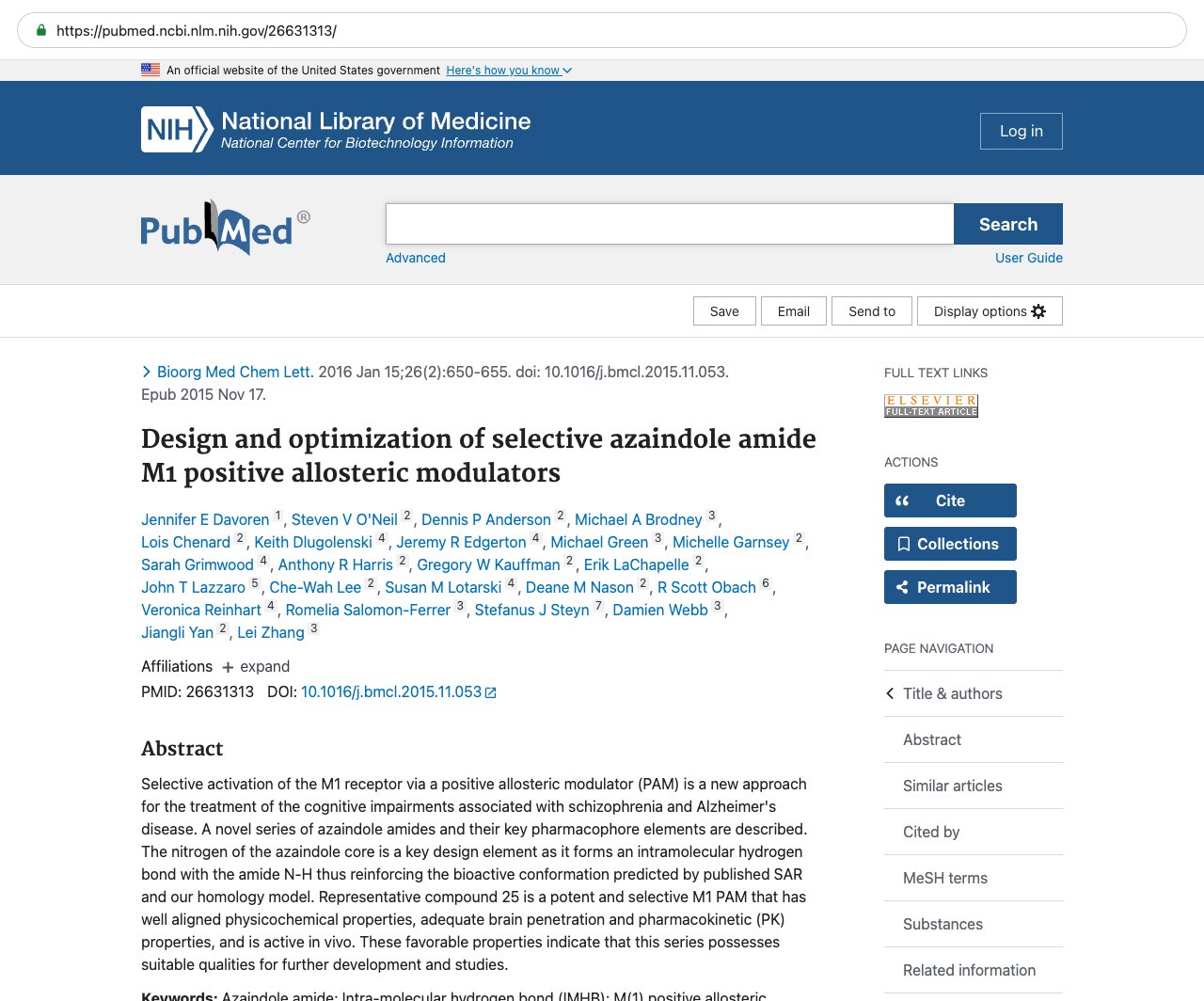
Selective activation of the M1 receptor via a positive allosteric modulator (PAM) is a new approach for the treatment of the cognitive impairments associated with schizophrenia and Alzheimer's disease. A novel series of azaindole amides and their key pharmacophore elements are described. The nitrogen of the azaindole core is a key design element as it forms an intramolecular hydrogen bond with the amide N-H thus reinforcing the bioactive conformation predicted by published SAR and our homology model. Representative compound 25 is a potent and selective M1 PAM that has well aligned physicochemical properties, adequate brain penetration and pharmacokinetic (PK) properties, and is active in vivo. These favorable properties indicate that this series possesses suitable qualities for further development and studies.
Source & links
Screenshot of the PubMed page
This page mirrors the published abstract (© the authors / publisher) for reference and citation. The canonical source is the PubMed record linked above. This is not medical advice.