2024 · Dawson — Early time-restricted eating improves markers of cardiometabolic health but has no impact on intestinal nutrient absorption in healthy adults.
Super-Abstract
Eating only between 08:00 and 14:00 (early time-restricted eating, eTRE) improved blood glucose regulation in healthy adults — but left gut function completely untouched. A randomised crossover trial with 16 participants showed lower 24-hour mean glucose and reduced glycaemic variability, while intestinal absorption, transit time, and gut microbiome composition remained unchanged. (Cell Reports Medicine, 2024.)
Commentary
This trial is methodologically rigorous: controlled diet, bomb calorimetry for energy balance, and a crossover design that serves as its own control. The glucose findings are clinically relevant — lower mean glucose and flatter glycaemic excursions with no change in caloric intake suggest a circadian rather than a caloric mechanism. The hydrogen-related finding is a useful null result: colonic hydrogen gas production (a proxy for fermentation and microbiome activity) did not change with eTRE. This rules out gut fermentation as a mediator of eTRE's metabolic benefits, and incidentally confirms that the gut flora's hydrogen output is remarkably stable under dietary timing changes over 9 days.
Key quotes
- „eTRE has no effect on intestinal energy and macronutrient absorption, gastrointestinal transit time, colonic hydrogen gas production, or stool microbial composition, suggesting eTRE does not impact gastrointestinal function.“ — the null result: gut function and colonic H₂ production are unchanged by eTRE
- „The eTRE schedule is more effective than the control eating schedule for improving markers of cardiometabolic health, including 24-h mean glucose concentrations and glycemic variability.“ — the positive finding: clear cardiometabolic benefit from earlier eating window
Our assessment
A well-controlled study with an honest null result on gut function. The colonic hydrogen gas production data is incidental but scientifically useful: it demonstrates that short-term (9-day) changes in meal timing do not alter fermentation-based H₂ output. Limitations: n=16 is small; the 9-day intervention window may be too short to detect microbiome shifts; only healthy adults were studied, limiting generalisability to metabolic disease populations. The eTRE metabolic findings are encouraging but require longer trials in larger cohorts before clinical recommendations can be drawn.
Study design
- Type: randomised crossover trial · n: 16 healthy adults · H₂ relevance: colonic H₂ gas production measured as a gut fermentation proxy
- Intervention: eTRE (08:00–14:00) vs. control (08:00–20:00), 9 days each, weight-maintenance diet · H₂ result: no significant change in colonic H₂ gas production with eTRE
- Cardiometabolic result: significant reduction in 24-h mean glucose and glycaemic variability (MAGE) with eTRE; no effect on stool microbiome or macronutrient absorption
Abstract
Early time-restricted eating (eTRE) improves aspects of cardiometabolic health. Although the circadian system appears to regulate nutrient absorption, little is known about the effects of eTRE on intestinal absorption. In this randomized crossover trial, 16 healthy adults follow a controlled, weight maintenance diet for 9 days, consuming all calories between 0800 and 1400 (eTRE schedule) or 0800 and 2000 (control schedule). We measure the energy content of the diet, stool, and urine with bomb calorimetry and calculate intestinal energy absorption. The eTRE schedule is more effective than the control eating schedule for improving markers of cardiometabolic health, including 24-h mean glucose concentrations and glycemic variability, assessed as the mean amplitude of glycemic excursions. However, eTRE has no effect on intestinal energy and macronutrient absorption, gastrointestinal transit time, colonic hydrogen gas production, or stool microbial composition, suggesting eTRE does not impact gastrointestinal function. This trial is registered (ClinicalTrials.gov: NCT04877262).
Source & links
Screenshot of the PubMed page
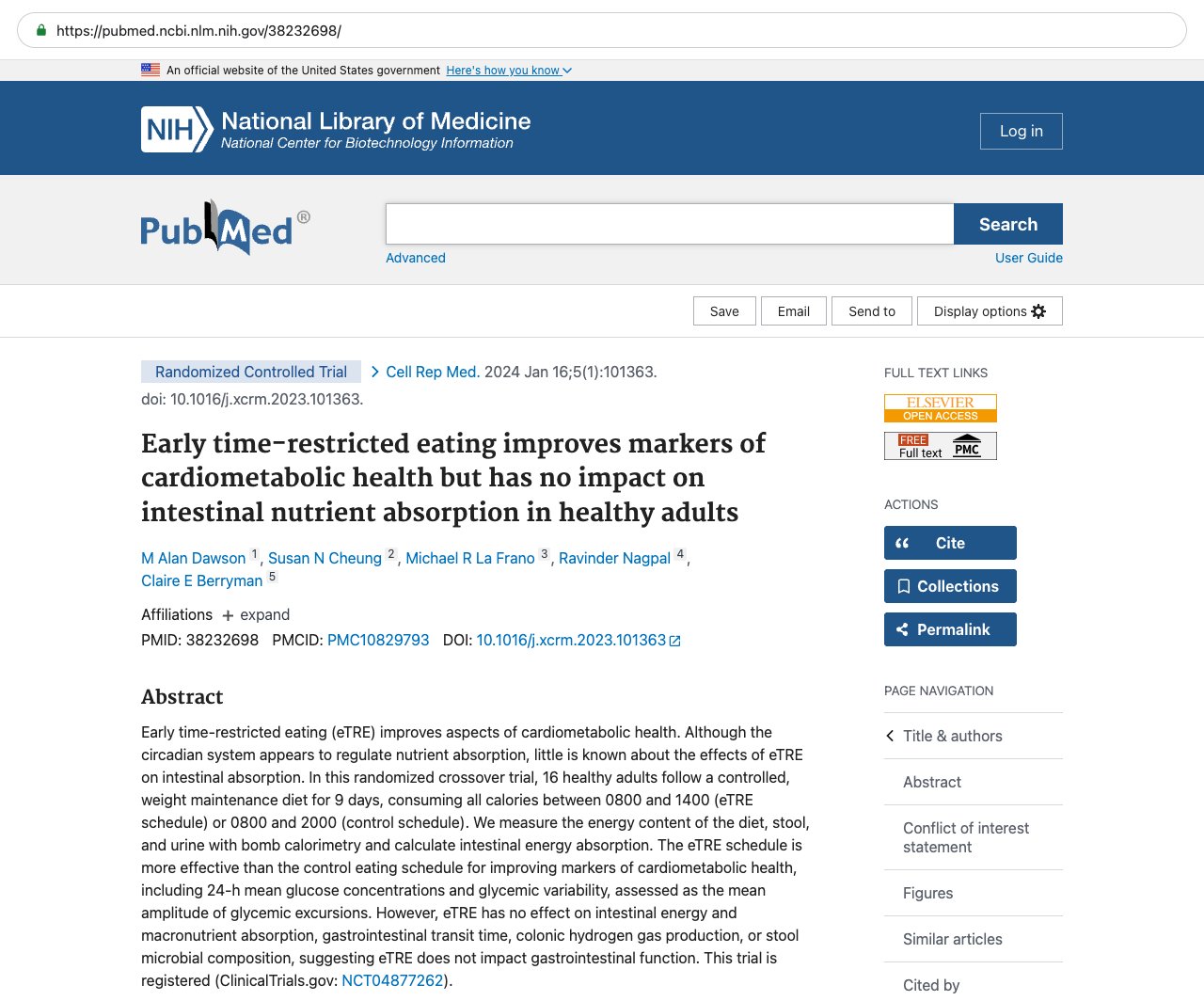
This page mirrors the published abstract (© the authors / publisher) for reference and citation. The canonical source is the PubMed record linked above. This is not medical advice.