2025 · Lin et al. — Molecular Hydrogen as a Potential Adjunctive Therapy to Improve Renal Function and Reduce Fatigue in an Elderly Patient With Chronic Comorbidities: A Case Report
Super-Abstract
An 89-year-old woman with coronary artery disease, type 2 diabetes with nephropathy, and SLE — presenting with recurrent wound infection — showed improved renal function and reduced chronic fatigue after adjuvant hydrogen capsule therapy. Serum creatinine declined, the Brief Fatigue Inventory improved significantly, and immunological evaluation revealed immune modulation consistent with therapeutic benefit. (In Vivo, 2025.)
Commentary
This is a remarkable case both for the patient's age (89) and the complexity of her comorbid burden: coronary artery disease with prior coronary artery bypass graft, diabetic nephropathy, SLE, and an infected wound at the saphenous vein donor site. The clinical scenario presented a situation where no single disease-modifying therapy could safely address all dimensions simultaneously — and H₂ capsules were introduced as an adjunct. The documented improvement in renal function (creatinine reduction) is the most objective and clinically meaningful finding, as CKD in the context of diabetic nephropathy and SLE nephritis is difficult to reverse. Fatigue measured by BFI-T also improved significantly. The immune changes are qualitatively described but provide mechanistic context. The case illustrates H₂'s potential in the geriatric multi-morbidity setting, where polypharmacy is already overwhelming and toxicity tolerance is low.
Key quotes
- „Following the introduction of hydrogen therapy, her renal function improved, evidenced by a reduction in serum creatinine levels.“ — objective renal function improvement — a hard endpoint in a complex case
- „Chronic fatigue, assessed using the Taiwan Brief Fatigue Inventory (BFI-T), showed significant improvement.“ — validated patient-reported fatigue reduction
- „Hydrogen therapy was associated with improved renal function and a reduced chronic fatigue in this elderly patient with multiple comorbidities.“ — authors' summary — association, not proven causation
Our assessment
Single case report in an extreme-comorbidity, elderly patient. The creatinine improvement is a meaningful hard endpoint, but without knowing the baseline trajectory of her CKD and whether her wound infection (the primary presentation) had been resolving, natural history confounds are substantial. The wound itself was being treated with antibiotics concurrently. Antibiotic resolution of infection can independently improve renal function (by removing an infectious burden). H₂ may have contributed to renal and fatigue outcomes, but causal attribution is not possible at n=1. The case does, however, represent one of very few reports of H₂ use in an octogenarian/nonagenarian, and the safety profile was excellent.
Study design
- Type: single case report · n: 1 (89-year-old female, CAD, T2DM with nephropathy, SLE, wound infection) · H₂ delivery: hydrogen capsules (exact formulation not specified), from January 2023
- Endpoints: serum creatinine; Brief Fatigue Inventory (BFI-T); immune phenotyping (qualitative description)
- Result: serum creatinine reduced; BFI-T fatigue significantly improved; immune modulation observed; wound management continued concurrently with antibiotics; no H₂-related adverse events
Abstract
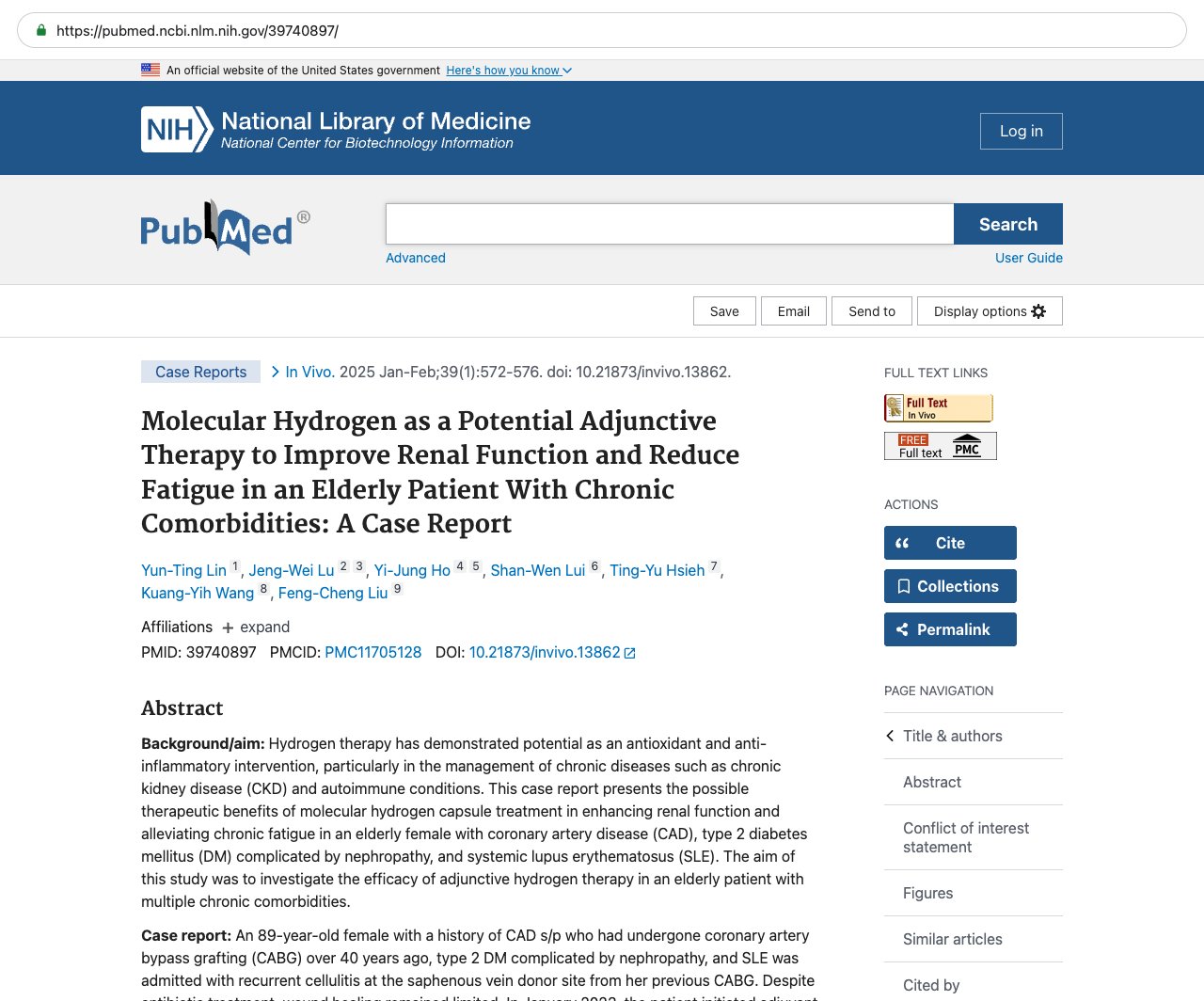
BACKGROUND/AIM: Hydrogen therapy has demonstrated potential as an antioxidant and anti-inflammatory intervention, particularly in the management of chronic diseases such as chronic kidney disease (CKD) and autoimmune conditions. This case report presents the possible therapeutic benefits of molecular hydrogen capsule treatment in enhancing renal function and alleviating chronic fatigue in an elderly female with coronary artery disease (CAD), type 2 diabetes mellitus (DM) complicated by nephropathy, and systemic lupus erythematosus (SLE). The aim of this study was to investigate the efficacy of adjunctive hydrogen therapy in an elderly patient with multiple chronic comorbidities. CASE REPORT: An 89-year-old female with a history of CAD s/p who had undergone coronary artery bypass grafting (CABG) over 40 years ago, type 2 DM complicated by nephropathy, and SLE was admitted with recurrent cellulitis at the saphenous vein donor site from her previous CABG. Despite antibiotic treatment, wound healing remained limited. In January 2023, the patient initiated adjuvant treatment with molecular hydrogen capsules. Following the introduction of hydrogen therapy, her renal function improved, evidenced by a reduction in serum creatinine levels. Chronic fatigue, assessed using the Taiwan Brief Fatigue Inventory (BFI-T), showed significant improvement. Immunological evaluation revealed a series of changes, suggesting that immune modulation may be the mechanism underlying the observed clinical benefits. CONCLUSION: Hydrogen therapy was associated with improved renal function and a reduced chronic fatigue in this elderly patient with multiple comorbidities, including CAD, DM, and SLE. The case underscores the potential therapeutic role of hydrogen therapy in immune modulation and the management of chronic conditions, suggesting the need for further investigation in clinical settings.
Source & links
Screenshot of the PubMed page
This page mirrors the published abstract (© the authors / publisher) for reference and citation. The canonical source is the PubMed record linked above. This is not medical advice.