2026 · Xu et al. — Hydrogen-Enriched Hyaluronic Acid Dressing Ameliorates Diabetic Foot Ulcer via Promoting Mitophagy
Super-Abstract
A hyaluronic acid dressing enriched with molecular hydrogen accelerated wound healing in diabetic foot ulcer patients and, in parallel laboratory experiments, activated the cellular „self-cleaning“ programme for damaged mitochondria (mitophagy). The study combined a clinical intervention (wound dressing plus negative-pressure therapy) with cell-culture experiments to identify the SIRT3/FOXO3A/PINK1–PARKIN signalling cascade as the likely mechanism. (Journal of Diabetes, 2026.)
Commentary
Diabetic foot ulcers are among the most stubborn and costly chronic wounds in medicine — standard care frequently fails, and the molecular mechanisms of impaired healing are complex. This study takes an innovative engineering approach: hydrogen is loaded into a hyaluronic acid matrix, which serves simultaneously as a wound scaffold and a slow-release H₂ source. The human part of the study is small and lacks a control group comparable to the animal arm, but the direction is clinically plausible: reduced oxidative burst, better mitochondrial quality control, less inflammation, more collagen, better vessel ingrowth. The mechanistic chain — H₂ activating SIRT3, which in turn switches on mitophagy via FOXO3A and PINK1–PARKIN — is novel and internally consistent. The animal and cell data support it, but independent confirmation is still pending. This is exploratory translational research, not yet a basis for clinical recommendations.
Key quotes
- „VSD combined with hydrogen-rich saline significantly enhanced wound healing in patients, while reducing inflammation and oxidative damage.“ — the central human clinical finding
- „both HA and hydrogen significantly induced SIRT3 expression and activated the downstream FOXO3A/PINK1-PARKIN signaling pathway, promoting mitochondrial autophagy and reducing cell apoptosis.“ — the proposed mechanistic pathway via mitophagy
- „This study confirmed that the hydrogen-enriched HA dressing has the potential to enhance diabetic wound repair.“ — authors' overall conclusion — carefully worded as potential
Our assessment
An innovative proof-of-concept study that links H₂ for the first time to the SIRT3-mitophagy axis in diabetic wound healing. The human component (vacuum-assisted closure plus hydrogen-rich saline) shows plausible clinical benefit, but lacks a randomised control group and reports no sample size for the patient cohort. The mechanistic data come primarily from animal and cell-culture experiments. Key limitations: mixed study design (clinical + in vivo + in vitro), no blinded outcome assessment reported, no long-term follow-up, small and undefined patient numbers. The result is hypothesis-generating and justifies a powered randomised controlled trial — it does not yet establish clinical efficacy on its own.
Study design
- Type: combined translational study (clinical intervention + rat model + cell culture) · n (human): not specified · H₂ delivery: vacuum-assisted closure with hydrogen-rich saline (clinical); hydrogen-enriched hyaluronic acid dressing (animal/in vitro)
- Result (clinical): improved wound healing, reduced inflammation and oxidative damage in DFU patients treated with VSD + hydrogen-rich saline
- Result (mechanistic): H₂ and HA activated SIRT3/FOXO3A/PINK1–PARKIN pathway promoting mitophagy; reduced ROS and apoptosis, enhanced cell migration in high-glucose conditions
Abstract
OBJECTIVE: Diabetic foot ulcer (DFU) is one of the most common chronic complications of diabetes. This study developed a hydrogen-enriched hyaluronic acid (HA) dressing and aimed to explore its therapeutic effects and mechanisms in DFU treatment. METHODS: A combination of vacuum-assisted closure (VSD) and hydrogen-rich saline was used to treat DFU patients and assess the clinical outcomes of wound repair. A rat model of DFU was established, and treatment with hydrogen-enriched HA dressing. Subsequently, the protective effects of the dressing were evaluated, including histological studies, the expression of inflammatory factors and angiogenesis markers. Western blot was used to analyze the expression levels of mitophagy-related proteins. In vitro, the role of HA and hydrogen on cell mitochondrial damage, apoptosis, migration, and markers associated with mitophagy pathways in human foreskin fibroblast-1 (HFF-1) was assessed. RESULTS: VSD combined with hydrogen-rich saline significantly enhanced wound healing in patients, while reducing inflammation and oxidative damage. In vivo studies showed that the dressing promoted wound healing, increased collagen deposition, reduced inflammatory cytokines, and enhanced neovascularization. In vitro studies, high glucose induced cell morphological damage and oxidative stress, disrupted mitochondrial membrane potential, leading to apoptosis and attenuating cell migration. However, both HA and hydrogen significantly induced SIRT3 expression and activated the downstream FOXO3A/PINK1-PARKIN signaling pathway, promoting mitochondrial autophagy and reducing cell apoptosis. Furthermore, the SIRT3/SOD2 pathway was also activated, decreasing reactive oxygen species (ROS) production and enhancing migration. CONCLUSION: This study confirmed that the hydrogen-enriched HA dressing has the potential to enhance diabetic wound repair.
Source & links
Screenshot of the PubMed page
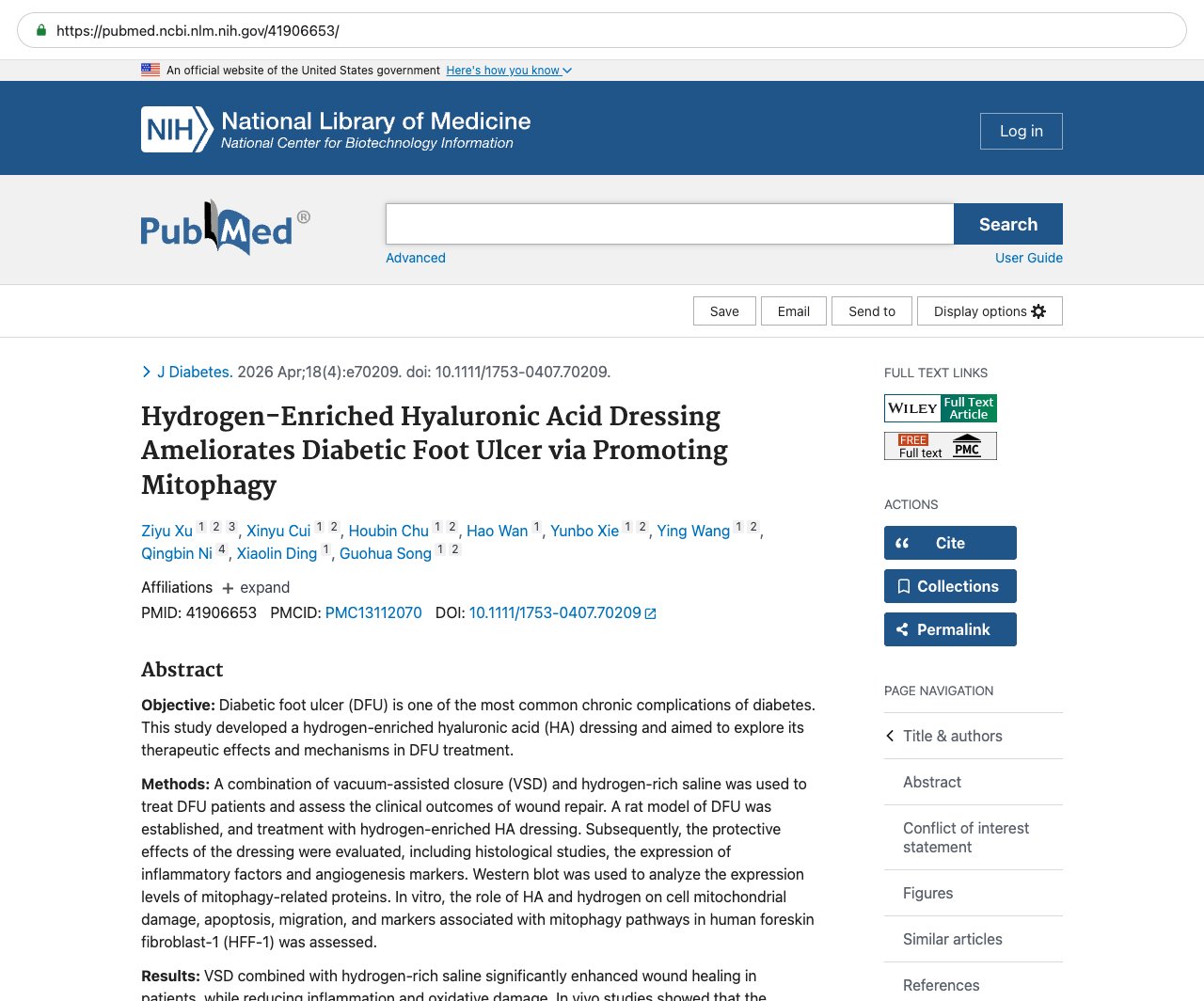
This page mirrors the published abstract (© the authors / publisher) for reference and citation. The canonical source is the PubMed record linked above. This is not medical advice.