2025 Antioxidants (Basel, Switzerland) Pilot / Observational Human H₂ therapy Bath / Topical Skin & Aging
2025 · Debkowska et al. — Topically Applied Molecular Hydrogen Normalizes Skin Parameters Associated with Oxidative Stress: A Pilot Study
Super-Abstract
In 15 healthy adults, four weeks of topical treatments with hydrogen-rich water were followed by a statistically significant reduction in pore visibility, while the reduction in porphyrin levels was not statistically significant. Improvements in pigmentation, wrinkle severity and estimated skin age are reported without statistics in the abstract, and no adverse effects were reported. The study had no control group, so the changes cannot be attributed to hydrogen. (Antioxidants, 2025.)
Commentary
The study tested the hypothesis that hydrogen applied to the skin reduces oxidative stress and inflammation and so improves objectively measured skin parameters. Fifteen healthy adults received topical treatments with hydrogen-rich water for four weeks. Per full text, the study ran at one medical university in Poland, participants were grouped by age (7 aged 21 to 26, 4 aged 33 to 45, 4 aged 55 to 72), and there were four facial sessions at weekly intervals. Per full text, each session combined 10 minutes with a suction handpiece delivering hydrogen-rich water and 5 minutes with a pressurised water jet, using alkaline electrolysed water with a measured H₂ content of 2071 ppb. Porphyrin levels, pigmentation irregularities, pore size, wrinkle severity and biological skin age were measured before treatment and one week after it, per full text with an imaging system that scores each value as a percentile against an age- and sex-matched reference database. There was no control group, and the abstract does not name a primary endpoint.
Key quotes
- „A statistically significant reduction in pore visibility was observed, particularly in younger participants.“ — the only result the abstract labels as statistically significant
- „Although porphyrin levels showed a trend toward reduction, this change was not statistically significant.“ — a null result for porphyrins, stated plainly in the abstract
- „Despite promising outcomes, this study was limited by the absence of a control group and a relatively short follow-up period.“ — the authors name the missing control group and the short follow-up
Our assessment
This small pilot study at one centre can describe changes in device-measured skin scores over a few weeks. Without a control group, the changes cannot be attributed to hydrogen. Per full text, each session also involved suction, a pressurised water jet, cleansing and a moisturiser, so any effect of the hydrogen cannot be separated from the procedure itself. Per full text, pore visibility changed with p = 0.026 and the pigmentation measures with p < 0.001, while the wrinkle change was not statistically significant (p > 0.05) and skin age is reported as group means without a statistical test. The abstract lists wrinkles among the improvements without saying this. Limitations: 15 participants in three small age groups, no blinding, many skin parameters tested, no primary endpoint named, follow-up of one week after treatment, and scores calculated by a device rather than clinical ratings.
Study design
- Type: prospective single-arm pilot study at one centre, no control group · n: 15 healthy adults · H₂ delivery: topical hydrogen-rich water on the face for four weeks; per full text four weekly sessions of 10 minutes suction application plus 5 minutes water jet, alkaline electrolysed water with 2071 ppb H₂
- Comparator: none; values before the first session
- Result: no primary endpoint named. Pore visibility reduced, statistically significant (per full text p = 0.026). Porphyrins: trend toward reduction, not statistically significant. Pigmentation, wrinkle severity and estimated skin age reported as improved; per full text pigmentation p < 0.001, wrinkles p > 0.05, skin age without a test. No adverse effects reported
Abstract
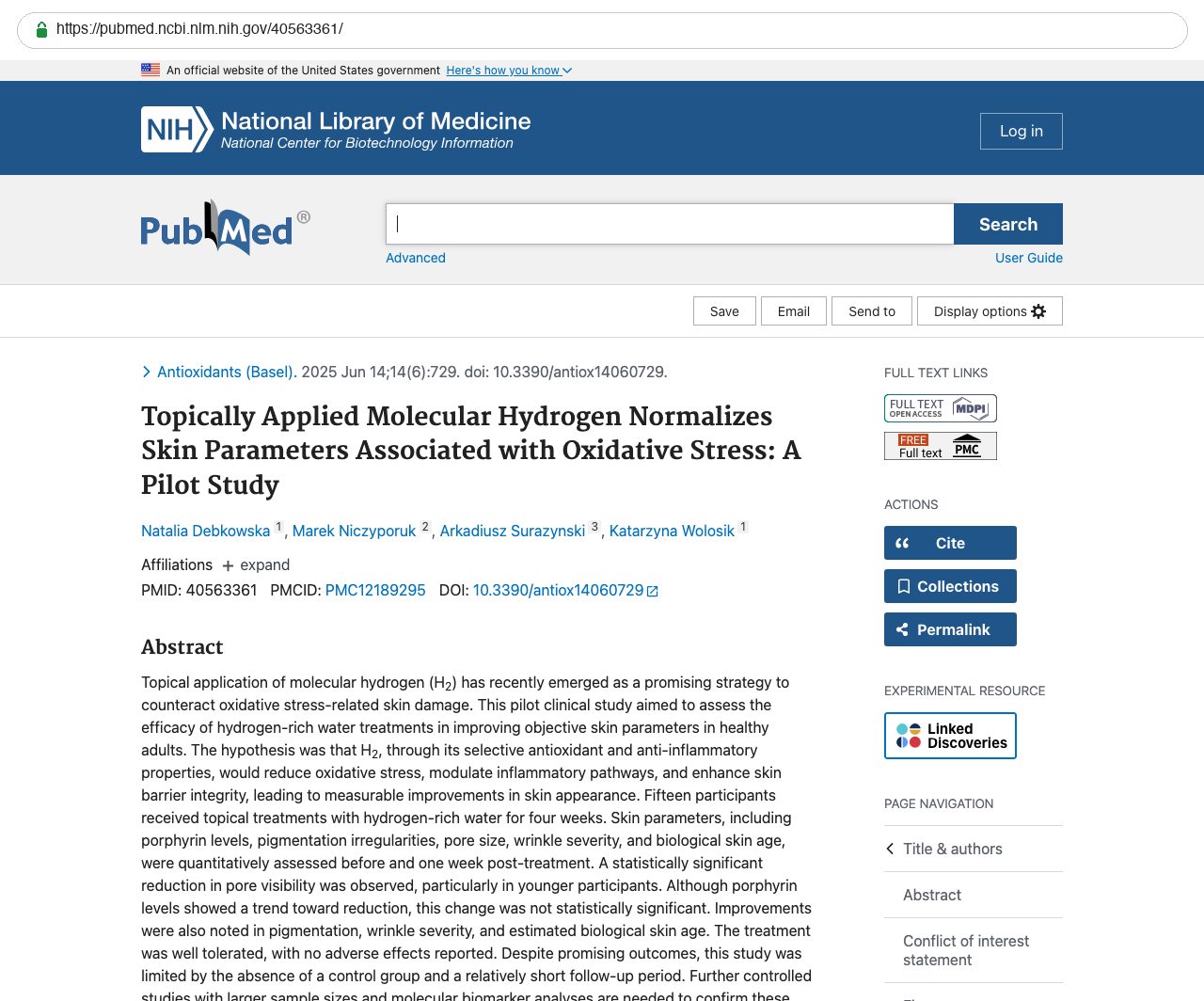
Topical application of molecular hydrogen (H2) has recently emerged as a promising strategy to counteract oxidative stress-related skin damage. This pilot clinical study aimed to assess the efficacy of hydrogen-rich water treatments in improving objective skin parameters in healthy adults. The hypothesis was that H2, through its selective antioxidant and anti-inflammatory properties, would reduce oxidative stress, modulate inflammatory pathways, and enhance skin barrier integrity, leading to measurable improvements in skin appearance. Fifteen participants received topical treatments with hydrogen-rich water for four weeks. Skin parameters, including porphyrin levels, pigmentation irregularities, pore size, wrinkle severity, and biological skin age, were quantitatively assessed before and one week post-treatment. A statistically significant reduction in pore visibility was observed, particularly in younger participants. Although porphyrin levels showed a trend toward reduction, this change was not statistically significant. Improvements were also noted in pigmentation, wrinkle severity, and estimated biological skin age. The treatment was well tolerated, with no adverse effects reported. Despite promising outcomes, this study was limited by the absence of a control group and a relatively short follow-up period. Further controlled studies with larger sample sizes and molecular biomarker analyses are needed to confirm these effects and elucidate the underlying mechanisms. This study addresses a gap in the literature regarding standardized, clinical evaluation of topical H2 application and highlights its potential for utilization in cosmetic and preventive dermatology.
Source & links
Screenshot of the PubMed page
This page mirrors the published abstract (© the authors / publisher) for reference and citation. The canonical source is the PubMed record linked above. This is not medical advice.