2025 · Grepl — Molecular hydrogen inhalation modulates resting metabolism in healthy females: findings from a randomized, double-blind, placebo-controlled crossover study
Super-Abstract
Breathing hydrogen for 60 minutes shifts resting metabolism toward fat burning. In a randomized double-blind crossover trial (20 healthy women), H₂ inhalation significantly lowered the respiratory quotient — a marker of more fat oxidation — especially in participants with higher body fat percentage. (Medical Gas Research, 2025.)
Commentary
This study asks a simple but exciting question: does pure hydrogen breathing change metabolism when you just sit quietly? The design is high quality — <strong>randomized, double-blind, placebo-controlled, crossover</strong> — with 20 physically active women around 22 years old. Each inhaled either hydrogen or normal room air through a nasal cannula (300 ml/min) for 60 minutes on different days. Metabolism was measured by indirect calorimetry, i.e. via the breath gases. The core result: under H₂, the respiratory quotient fell significantly across all measurement intervals — and a lower respiratory quotient means the body burns proportionally more fat instead of carbohydrates. Ventilation also went down. Particularly interesting: the higher the body fat percentage, the stronger this effect (negative correlation from minute 30). What it means: H₂ could trigger resting fat burning — a metabolic effect that goes beyond the pure antioxidant picture. Honestly: very small sample (n = 20), only young women, an acute one-off effect over 60 minutes — no statement about weight loss or long-term effect.
Key quotes
- „Compared with placebo (ambient air), molecular hydrogen inhalation significantly decreased respiratory exchange ratio and ventilation across all intervals.“ — the central finding: lower respiratory quotient = more fat burning
- „the change in respiratory exchange ratio was negatively correlated with body fat percentage from 30 minutes onwards.“ — the higher the body fat percentage, the stronger the effect
- „60 minutes of resting molecular hydrogen inhalation significantly increased resting fat oxidation, as evidenced by decreased respiratory exchange ratio, particularly in individuals with higher body fat percentages.“ — the authors' summarizing conclusion
Our assessment
Relevant for H₂ inhalation products and the topic of metabolism/weight management, because a metabolic effect of H₂ is shown here, not just an antioxidant one. The crossover double-blind design is methodologically strong: each participant is her own control, which increases the validity despite the small sample. Limitation, stated honestly: n = 20, exclusively young, physically active women — no transferability to men or older/overweight people without further studies. This is an acute 60-minute effect; an actual reduction in weight or body fat over time was not investigated. A sister study on oxygen saturation comes from the same research group (Palacký University Olomouc).
Study design
- Type: RCT, randomized/double-blind/placebo-controlled, crossover · n: 20 (healthy, physically active women, 22.1 ± 1.6 yrs) · Duration: 60 min inhalation per session · H₂ delivery: inhalation via nasal cannula, 300 ml/min (placebo = room air)
- Result figures: respiratory quotient ↓ and ventilation ↓ across all four 15-min intervals (significant vs. placebo); negative correlation Δ-respiratory-quotient × body fat from minute 30; increased resting fat oxidation
Abstract
Initially, molecular hydrogen was considered a physiologically inert and non-functional gas. However, experimental and clinical studies have shown that molecular hydrogen has anti-inflammatory, anti-apoptotic, and strong selective antioxidant effects. This study aimed to evaluate the effects of 60 minutes of molecular hydrogen inhalation on respiratory gas analysis parameters using a randomized, double-blind, placebo-controlled, crossover design. The study was conducted at Faculty of Physical Culture, Palacký University Olomouc from September 2022 to March 2023. Twenty, physically active female participants aged 22.1 ± 1.6 years who inhaled either molecular hydrogen or ambient air through a nasal cannula (300 mL/min) for 60 minutes while resting were included in this study. Metabolic response was measured using indirect calorimetry. Breath-by-breath data were averaged over four 15-minute intervals. Compared with placebo (ambient air), molecular hydrogen inhalation significantly decreased respiratory exchange ratio and ventilation across all intervals. Furthermore, the change in respiratory exchange ratio was negatively correlated with body fat percentage from 30 minutes onwards. In conclusion, 60 minutes of resting molecular hydrogen inhalation significantly increased resting fat oxidation, as evidenced by decreased respiratory exchange ratio, particularly in individuals with higher body fat percentages.
Source & links
Screenshot of the PubMed page
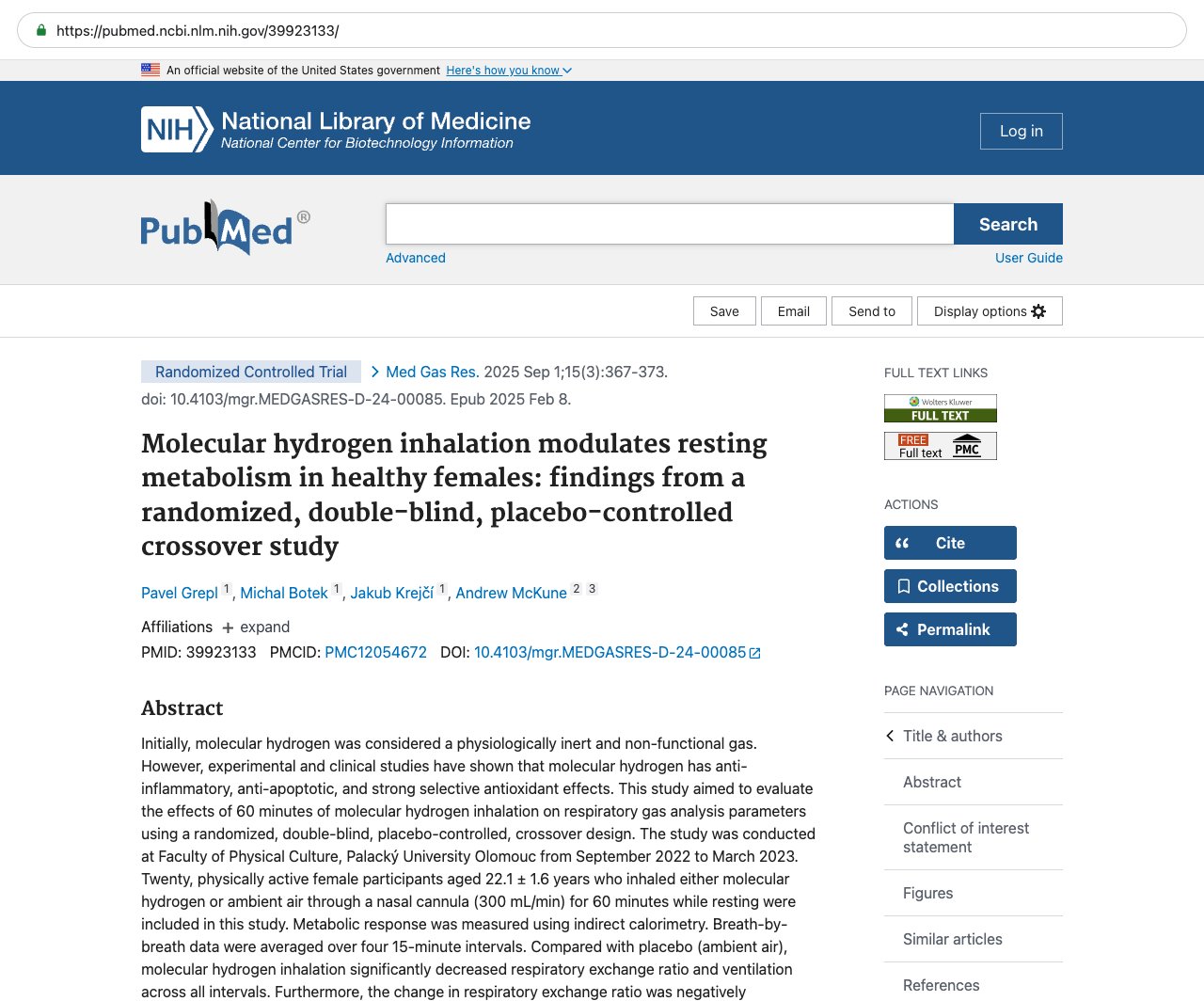
This page mirrors the published abstract (© the authors / publisher) for reference and citation. The canonical source is the PubMed record linked above. This is not medical advice.