2026 · Tsai et al. — Effects of Hydrogen Water Gargling on Oral Mucositis and Pain in Head and Neck Cancer Patients: A Randomized Controlled Pilot Study
Super-Abstract
In a randomised pilot trial in head and neck cancer patients receiving radiotherapy or chemoradiotherapy, the group gargling with hydrogen water showed significant improvement in oral mucositis at day 7 (p = 0.04) and day 14 (p = 0.002). Pain fell significantly in this group by day 14 (p = 0.02) and quality of life improved (p = 0.03), while oral frailty showed no difference between groups (p = 0.74). The abstract names neither a primary endpoint nor the hydrogen concentration; the full text lists 31 participants (16 hydrogen water, 15 control). The trial was single-blind. (Integrative Cancer Therapies, 2026.)
Commentary
Hydrogen water has been studied for antioxidant and anti-inflammatory properties, and this trial tested it as a gargle during cancer treatment. In a single-centre, single-blind, parallel-group design, head and neck cancer patients undergoing radiotherapy or concurrent chemoradiotherapy were randomly assigned to gargle with hydrogen water or with distilled water. The abstract does not give the number of patients (the full text, PMC13305639, lists 31: 16 hydrogen water, 15 control), the hydrogen concentration, how often or for how long patients gargled, or which outcome was primary. Oral mucositis was graded with the World Health Organization Oral Mucositis Grading Criteria, pain with the Brief Pain Inventory-Taiwan, oral frailty with the Oral Frailty Checklist and quality of life with the EORTC QLQ-H&N35 questionnaire. Assessments took place at baseline and on days 1, 3, 7 and 14 post-treatment. The abstract does not define the reference point for these days.
Key quotes
- „The HW group showed significant OM improvement at Day 7 (p = 0.04) and Day 14 (p = 0.002).“ — the main mucositis result, while the abstract names no primary endpoint
- „QoL improved in the HW group (p = 0.03), while OFC scores showed no significant difference between groups (p = 0.74).“ — quality of life improved, oral frailty did not differ between groups
- „HW gargling may serve as a simple, well-tolerated, and effective complementary and integrative therapy during cancer treatment.“ — the authors' conclusion, although the abstract reports no tolerability data
Our assessment
The trial was randomised and used a control gargle of distilled water. The reported results favour hydrogen water for mucositis and pain, but the abstract leaves key details open. It does not give the sample size (31 per the full text), a primary endpoint, the hydrogen concentration or the gargling schedule. It also does not state whether the day 7 and day 14 results compare the two groups or describe changes within the hydrogen group. Quality of life improved, and oral frailty did not differ between groups. Limitations: pilot design at a single centre with single blinding. Several outcomes were tested at five time points without a named primary endpoint, and follow-up lasted 14 days. The abstract contains no adverse event data, although the authors describe gargling as well tolerated. The results suggest a possible benefit for mucositis in this setting that a larger, fully blinded trial would need to confirm.
Study design
- Type: single-centre, single-blind, parallel-group randomised controlled pilot trial · n: 31 (16 hydrogen water, 15 control; per full text) · H₂ delivery: gargling with hydrogen water during radiotherapy or chemoradiotherapy, concentration and schedule not given
- Comparator: gargling with distilled water
- Result: no primary endpoint named. Oral mucositis improved in the hydrogen-water group at day 7 (p = 0.04) and day 14 (p = 0.002), pain decreased at day 14 (p = 0.02), quality of life improved (p = 0.03). Oral frailty: no difference between groups (p = 0.74)
Abstract
BackgroundTraditional, complementary, and integrative medicine (TCIM) is an evolving field in oncology focused on managing cancer symptoms. Hydrogen water (HW) has gained attention for its antioxidant and anti-inflammatory properties, yet its clinical effectiveness needs further exploration. This randomized controlled trial aimed to assess the impact of gargling with HW on oral mucositis severity, pain levels, oral frailty, and quality of life in head and neck cancer patients undergoing radiotherapy or concurrent chemo-radiotherapy.MethodsIn this single-center, single-blind, parallel-group randomized controlled trial, patients were randomly assigned to receive either HW or distilled water (DW) for gargling. Oral mucositis (OM) severity, pain, oral frailty, and quality of life (QoL) were assessed using the World Health Organization Oral Mucositis Grading Criteria (WHO-OMGC), the Brief Pain Inventory-Taiwan (BPI-T), the Oral Frailty Checklist (OFC), and the EORTC QLQ-H&N35 questionnaire. Assessments were conducted at baseline (T0) and on Days 1 (T1), 3 (T2), 7 (T3), and 14 (T4) post-treatment.ResultsThe HW group showed significant OM improvement at Day 7 (p = 0.04) and Day 14 (p = 0.002). Pain decreased significantly in the HW group at Day 14 (p = 0.02). QoL improved in the HW group (p = 0.03), while OFC scores showed no significant difference between groups (p = 0.74).ConclusionHW gargling significantly alleviated OM severity and pain and improved QoL in head and neck cancer (HNC) patients undergoing radiotherapy or CCRT. HW gargling may serve as a simple, well-tolerated, and effective complementary and integrative therapy during cancer treatment.
Source & links
Screenshot of the PubMed page
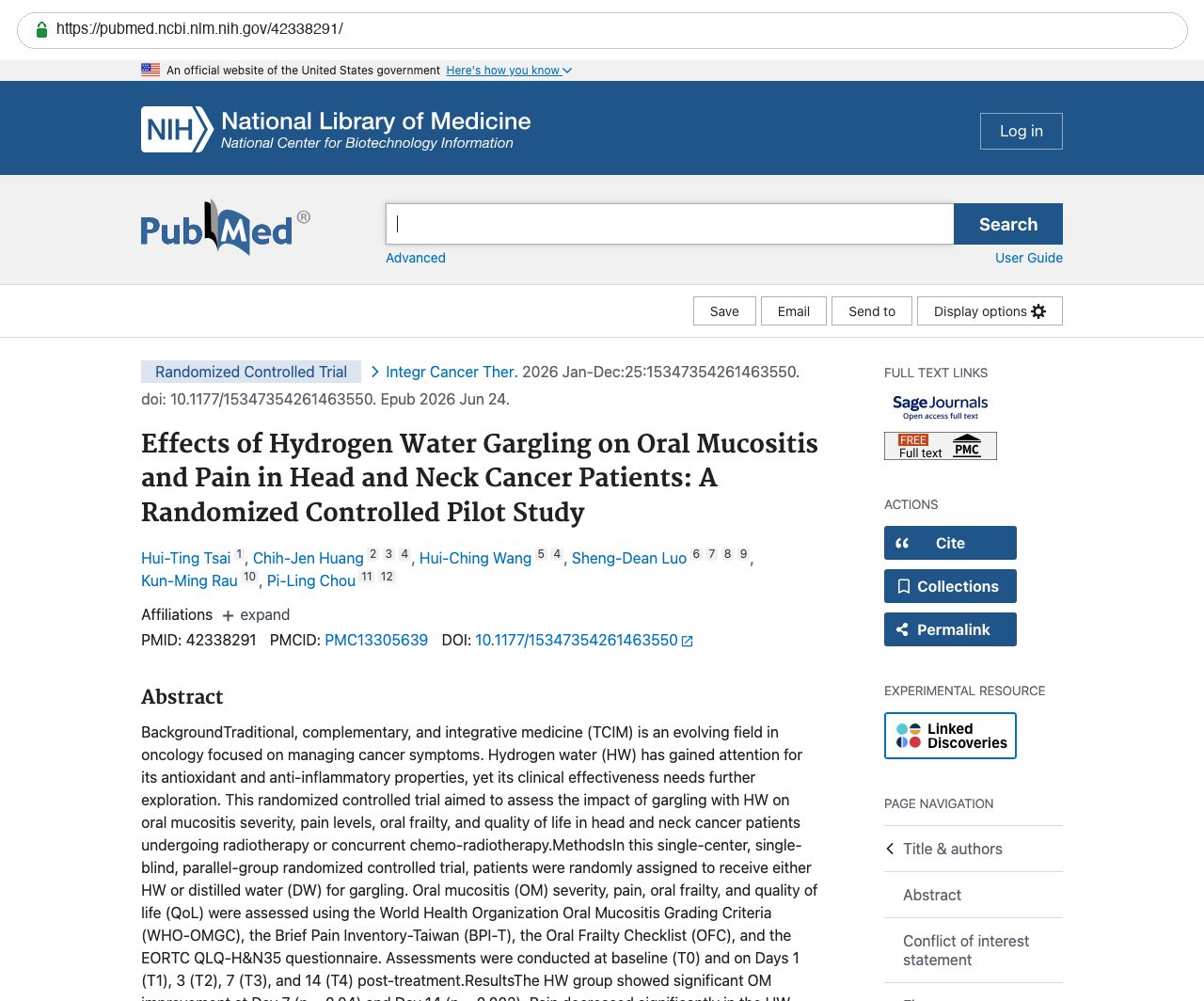
This page mirrors the published abstract (© the authors / publisher) for reference and citation. The canonical source is the PubMed record linked above. This is not medical advice.