2005 · Decroos et al. — Isolation and characterisation of an equol-producing mixed microbial culture from a human faecal sample and its activity under gastrointestinal conditions
Super-Abstract
This in-vitro gut microbiome study shows that hydrogen gas produced during gut fermentation stimulates equol production by a mixed bacterial culture derived from human stool. Equol is a metabolite of the soy isoflavone daidzein with potential hormonal and antioxidant activity. The role of H₂ here is as a microbial fermentation by-product that modulates gut microbiome metabolism — not a human health intervention.
Commentary
Only about one third of humans harbour gut bacteria capable of converting the dietary soy isoflavone daidzein into equol — a metabolite with weak estrogenic activity and possible health relevance. This in-vitro study isolates and characterises an equol-producing mixed culture from human faeces. The key finding relevant to H₂: among several colonic fermentation by-products tested, hydrogen gas was particularly effective at stimulating equol production by the mixed culture. Butyrate and propionate also stimulated, but fructo-oligosaccharides (prebiotics) actually inhibited equol production. The four bacterial species identified in the culture (Lactobacillus mucosae, Enterococcus faecium, Finegoldia magna, Veillonella sp.) did not produce equol individually — it is a community function. The study's H₂ connection is indirect: H₂ from fermentation of indigestible carbohydrates may modulate the microbiome environment in ways that affect secondary metabolite production. This has no direct bearing on exogenous H₂ supplementation effects.
Key quotes
- „hydrogen gas in particular, but also butyrate and propionate, which are all colonic fermentation products from poorly digestible carbohydrates, stimulated equol production by the mixed culture.“ — H₂ from gut fermentation stimulates equol production — in a mixed bacterial culture in vitro
- „when fructo-oligosaccharides were added, equol production was inhibited.“ — the relationship between dietary fibre, H₂, and equol production is not straightforward
- „the equol-producing capacity of the isolated culture was maintained upon its addition to a faecal culture originating from a non-equol-producing individual.“ — the equol-producing microbial community can transfer this capacity to non-producing microbiomes in vitro
Our assessment
An in-vitro gut microbiome study with a peripheral connection to H₂: endogenously produced fermentation H₂ stimulates bacterial equol synthesis in culture. This is not a study of exogenous H₂ supplementation as a health intervention. Findings are from in-vitro bacterial cultures; they do not directly translate to effects of drinking hydrogen-enriched water or inhaling H₂. The study is a niche piece of gut microbiome research with no direct clinical implications for H₂ therapy.
Study design
- Type: in-vitro gut microbiome study · Model: human faecal bacterial cultures (mixed and pure) · H₂ source: added exogenously to culture medium as a fermentation product analogue
- Result: H₂ gas (among other fermentation products) stimulated equol production by mixed culture; fructo-oligosaccharides inhibited it; equol-producing capacity transferable to non-producing faecal cultures
Abstract
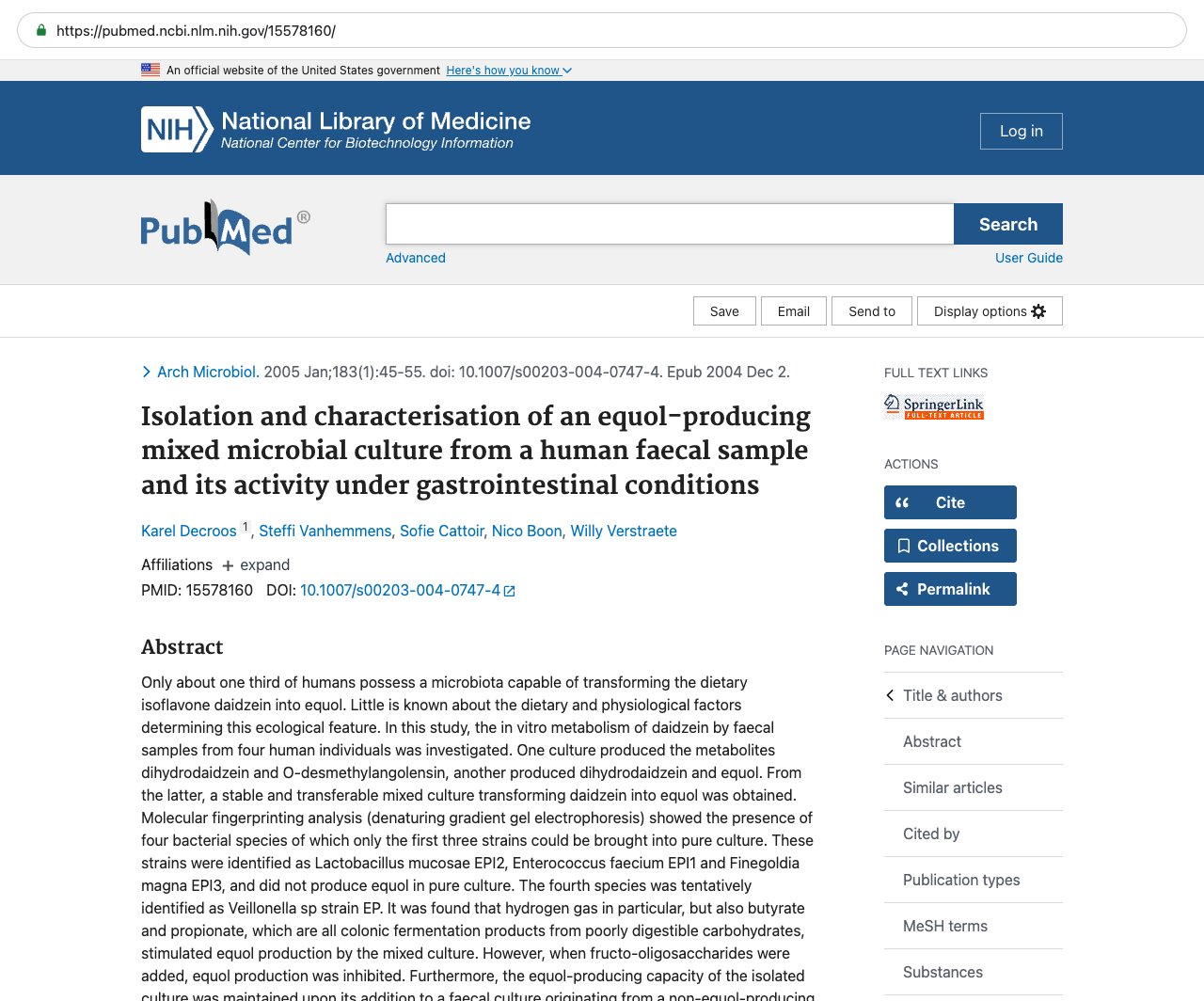
Only about one third of humans possess a microbiota capable of transforming the dietary isoflavone daidzein into equol. Little is known about the dietary and physiological factors determining this ecological feature. In this study, the in vitro metabolism of daidzein by faecal samples from four human individuals was investigated. One culture produced the metabolites dihydrodaidzein and O-desmethylangolensin, another produced dihydrodaidzein and equol. From the latter, a stable and transferable mixed culture transforming daidzein into equol was obtained. Molecular fingerprinting analysis (denaturing gradient gel electrophoresis) showed the presence of four bacterial species of which only the first three strains could be brought into pure culture. These strains were identified as Lactobacillus mucosae EPI2, Enterococcus faecium EPI1 and Finegoldia magna EPI3, and did not produce equol in pure culture. The fourth species was tentatively identified as Veillonella sp strain EP. It was found that hydrogen gas in particular, but also butyrate and propionate, which are all colonic fermentation products from poorly digestible carbohydrates, stimulated equol production by the mixed culture. However, when fructo-oligosaccharides were added, equol production was inhibited. Furthermore, the equol-producing capacity of the isolated culture was maintained upon its addition to a faecal culture originating from a non-equol-producing individual.
Source & links
Screenshot of the PubMed page
This page mirrors the published abstract (© the authors / publisher) for reference and citation. The canonical source is the PubMed record linked above. This is not medical advice.