2022 Bulletin of experimental biology and medicine Pilot / Observational Human H₂ therapy Inhalation
2022 · Deryugina — Dynamics of Metabolic and Oxidative Parameters of Erythrocytes during Treatment of Chronic Heart Failure with Molecular Hydrogen.
Super-Abstract
In patients with chronic heart failure, inhaling 2% molecular hydrogen — either once or repeatedly over five days — improved red blood cell energy metabolism, reduced oxidative stress markers, and enhanced antioxidant enzyme activity. Repeated inhalation produced stronger effects, suggesting a dose-accumulation benefit. (Bulletin of Experimental Biology and Medicine, 2022.)
Commentary
Chronic heart failure (CHF) is characterised by impaired cardiac output, tissue hypoxia, and systemic oxidative stress — including in red blood cells (erythrocytes). Erythrocytes play a critical role in oxygen delivery and microcirculation; their dysfunction compounds the tissue-level oxygen deficit in CHF. This study monitored four erythrocyte parameters: 2,3-diphosphoglyceric acid (2,3-DPG, a molecule that regulates oxygen release from haemoglobin), ATP (cellular energy currency), malondialdehyde (MDA, a lipid peroxidation marker for oxidative damage), and catalase (an antioxidant enzyme). After H₂ inhalation at 2% for 40 minutes, ATP increased in both the single-dose and the five-day groups — more so in the repeated group. 2,3-DPG increased after repeated inhalation only, suggesting that sustained H₂ exposure is needed for haemoglobin oxygen-delivery optimization. MDA decreased (less oxidative damage) and catalase activity increased (better antioxidant defence) after H₂. The authors suggest that improved erythrocyte metabolism could enhance microcirculation in CHF — a clinically meaningful conclusion if confirmed in larger trials.
Key quotes
- „Inhalation of H2 caused an increase in ATP concentration in both research groups, but was more pronounced after repeated inhalation.“ — energy metabolism in red blood cells improved — more so with repeated treatment
- „The increase in metabolic activity under the effect of H2 was accompanied by a decrease in malondialdehyde concentration and an increase in catalase activity.“ — H₂ simultaneously reduced oxidative damage and boosted antioxidant defence
- „This allows us to recommend H2 for protection against ischemic and reperfusion damage to the myocardium.“ — the authors' clinical recommendation — stated cautiously
Our assessment
This is a small mechanistic study with clinically relevant endpoints in a well-defined disease cohort (CHF). The erythrocyte parameters chosen (2,3-DPG, ATP, MDA, catalase) give a multi-dimensional picture of both energy metabolism and oxidative stress. The repeated-inhalation advantage is biologically plausible. Limitations: the paper is from a Russian journal (Bulletin of Experimental Biology and Medicine) — sample size, randomization details, and control conditions are not fully elaborated in the available abstract; no functional cardiac endpoints (ejection fraction, walk distance) are reported; the study design details (n, control group design, patient characteristics) are not specified. The recommendation to use H₂ against myocardial ischaemia is speculative without larger controlled trials. Nonetheless, the erythrocyte mechanism is an underexplored area of H₂ cardiology and this paper offers a useful mechanistic hypothesis.
Study design
- Type: intervention study (two H₂ inhalation protocols) · Population: patients with chronic heart failure · H₂ delivery: 2% H₂ inhalation for 40 min, single dose or 5 daily sessions
- Result: ATP ↑ (both groups, more in repeated); 2,3-DPG ↑ (repeated group only); MDA ↓; catalase activity ↑; authors interpret findings as improved microcirculation and reduced oxidative stress in CHF erythrocytes
Abstract
We studied the effect of molecular hydrogen (H2) on the content of 2,3-diphosphoglyceric acid (2,3-DPG), ATP, malondialdehyde, and catalase activity in erythrocytes in chronic heart failure. Inhalation of 2% molecular hydrogen H2 was carried out for 40 min repeatedly (5 days) or once. Inhalation of H2 caused an increase in ATP concentration in both research groups, but was more pronounced after repeated inhalation. The content of 2,3-DPG increased after repeated exposure to H2. The increase in metabolic activity under the effect of H2 was accompanied by a decrease in malondialdehyde concentration and an increase in catalase activity. Thus, the application of H2 in chronic heart failure reduced oxidative stress and improved metabolism of erythrocytes, which contributes to improvement of microcirculation. This allows us to recommend H2 for protection against ischemic and reperfusion damage to the myocardium.
Source & links
Screenshot of the PubMed page
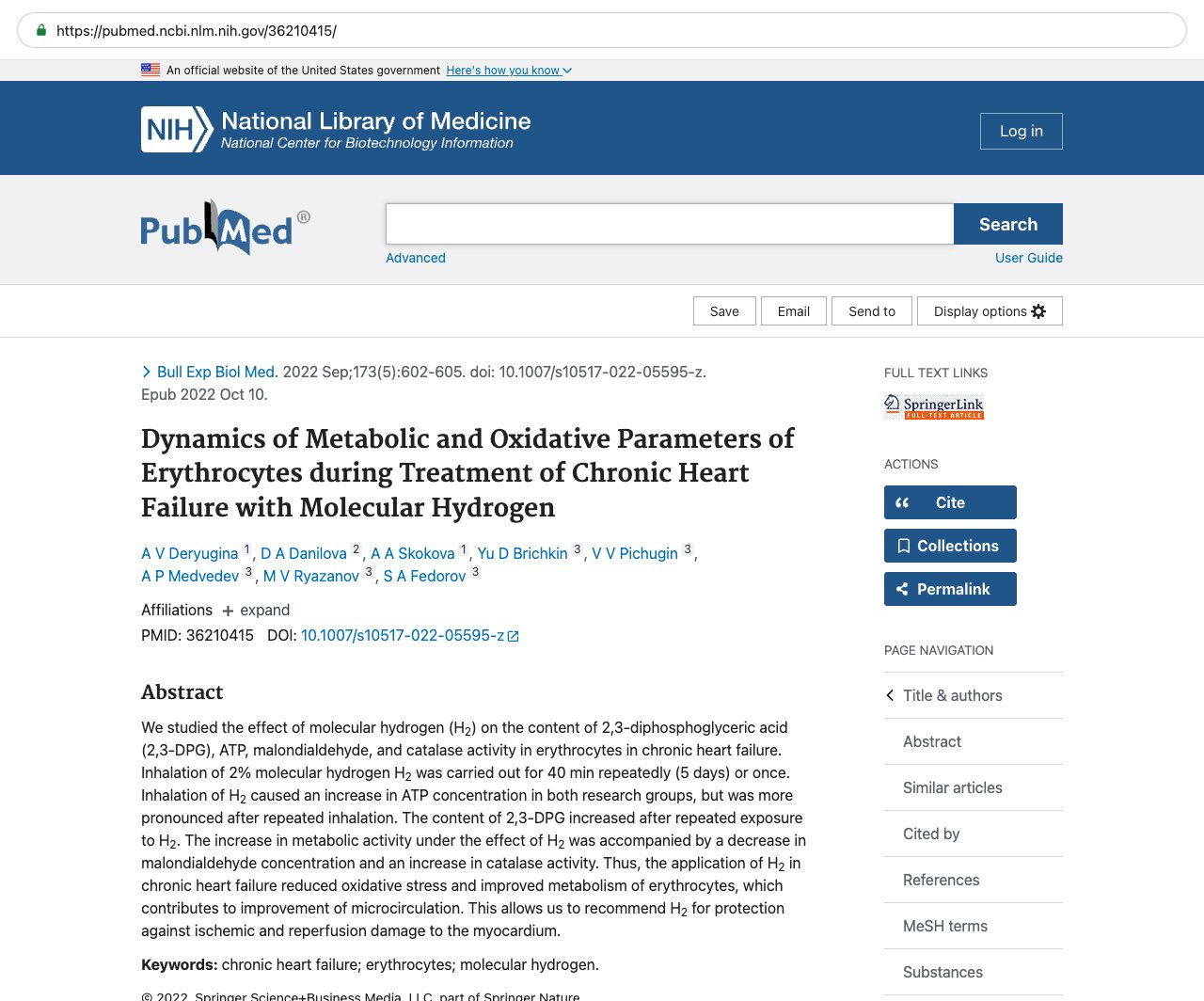
This page mirrors the published abstract (© the authors / publisher) for reference and citation. The canonical source is the PubMed record linked above. This is not medical advice.