2023 · Deryugina — Molecular hydrogen exposure improves functional state of red blood cells in the early postoperative period: a randomized clinical study
Super-Abstract
Hydrogen inhalation during cardiac surgery with a heart-lung machine improves the state of red blood cells and the postoperative course. In a randomized clinical study (heart-valve operations), patients who received 1.5–2.0 % H₂ via ventilation showed less oxidative stress, more stable red blood cells and better cardiac pump function after surgery. (Medical Gas Research, 2023.)
Commentary
This study tests hydrogen in one of the harshest stress situations for the body: cardiac surgery with a heart-lung machine (cardiopulmonary bypass). Such procedures trigger massive oxidative stress and ischemia-reperfusion injury — exactly the scenario H₂ is mechanistically made for. The design is randomized: one group (research group) inhaled H₂ at a concentration of 1.5–2.0 % via the ventilator immediately after intubation and throughout the operation, the control group did not. Blood was drawn at four time points — from induction of anesthesia to 24 hours after surgery. The results for red blood cells: higher electrophoretic mobility, increased metabolism and less clumping (aggregation) compared with the control group. Oxidative stress was most clearly reduced the day after surgery. And there was a statistically significant difference in heart-muscle pump function on days 1 and 3 after the operation. The message: H₂ makes red blood cells more functional and the early postoperative course more favourable. To be honest: the sample is small (about 20–24 patients), and the group-size figures in the abstract are somewhat contradictory (both 20 and 24 patients are mentioned). It is a single-center study from Russia.
Key quotes
- „An increase in electrophoretic mobility, an increase in the metabolism of red blood cells, and a decrease in the aggregation of red blood cells relative to the corresponding indicators of the control group were observed in the research group.“ — functional state of red blood cells improved
- „Patients in the research group had a decrease in oxidative stress manifestations most pronounced one day after the operation.“ — oxidative stress reduced after surgery
- „H2 inhalation leads to improvement of functional state of red blood cells, which is accompanied by a more favorable course of the early postoperative period.“ — the authors' clinical conclusion
Our assessment
A genuine human study (RCT) with H₂ inhalation in a high-risk surgical setting — this is hospital evidence, not just lab evidence. Relevant because it shows that H₂ measurably relieves the body under extreme oxidative stress; this supports the basic antioxidant thesis. Important for honest communication: this is about inhaled H₂ gas in a clinical context, not H₂ drinking water for home use — the findings cannot be transferred 1:1 to everyday life. Limitation, stated honestly: very small sample (about 20–24 patients), single-center, contradictory group-size figures in the abstract, no long-term endpoints. Hypothesis-supporting, but not large multicenter level.
Study design
- Type: RCT, randomized clinical study · n: ~20–24 patients (heart-valve surgery with cardiopulmonary bypass), research group 12 vs. control 12 · Duration: 4 measurement points from anesthesia to 24 h post-op · H₂ delivery: inhalation 1.5–2.0 % H₂ via ventilation circuit from intubation and throughout the operation
- Result: red blood cells — electrophoretic mobility ↑, metabolism ↑, aggregation ↓ (vs. control); oxidative stress ↓ (strongest 24 h post-op); statistically significant difference in myocardial contractile function on days 1 and 3 after surgery
Abstract
Molecular hydrogen (H2) has been considered a preventive and therapeutic medical gas in numerous diseases. The study aimed to investigate the potential role of molecular hydrogen as a component of anesthesia in surgical treatment with cardiopulmonary bypass (CPB) of acquired valve defects on the functional state of red blood cells (RBC) and functional indicators of cardiac activity. This clinical trial was conducted with 20 patients referring to the Specialized Cardiosurgical Clinical Hospital, Nizhny Novgorod, Russian Federation, who underwent elective surgery with CPB. Twenty-four patients were randomly assigned to two groups. First group included 12 patients (research group) who received H2 at a concentration of 1.5-2.0% through a facemask using a breathing circuit of the ventilator together with anesthesia immediately after tracheal intubation and throughout the operation. Second group (control group) included 12 patients who were not given H2. Blood samples were withdrawn from peripheral veins and radial artery at four stages: immediately after the introduction of anesthesia (stage 1), before the start of CPB (stage 2), immediately after its termination (stage 3) and 24 hours after the operation (the early postoperative period) (stage 4). An increase in electrophoretic mobility, an increase in the metabolism of red blood cells, and a decrease in the aggregation of red blood cells relative to the corresponding indicators of the control group were observed in the research group. Patients in the research group had a decrease in oxidative stress manifestations most pronounced one day after the operation. There was a statistically significant difference between the indicators of myocardial contractile function in the research and control group on the 1st and 3rd days after surgery. H2 inhalation leads to improvement of functional state of red blood cells, which is accompanied by a more favorable course of the early postoperative period. These data show the presence of protective properties of molecular hydrogen.
Source & links
Screenshot of the PubMed page
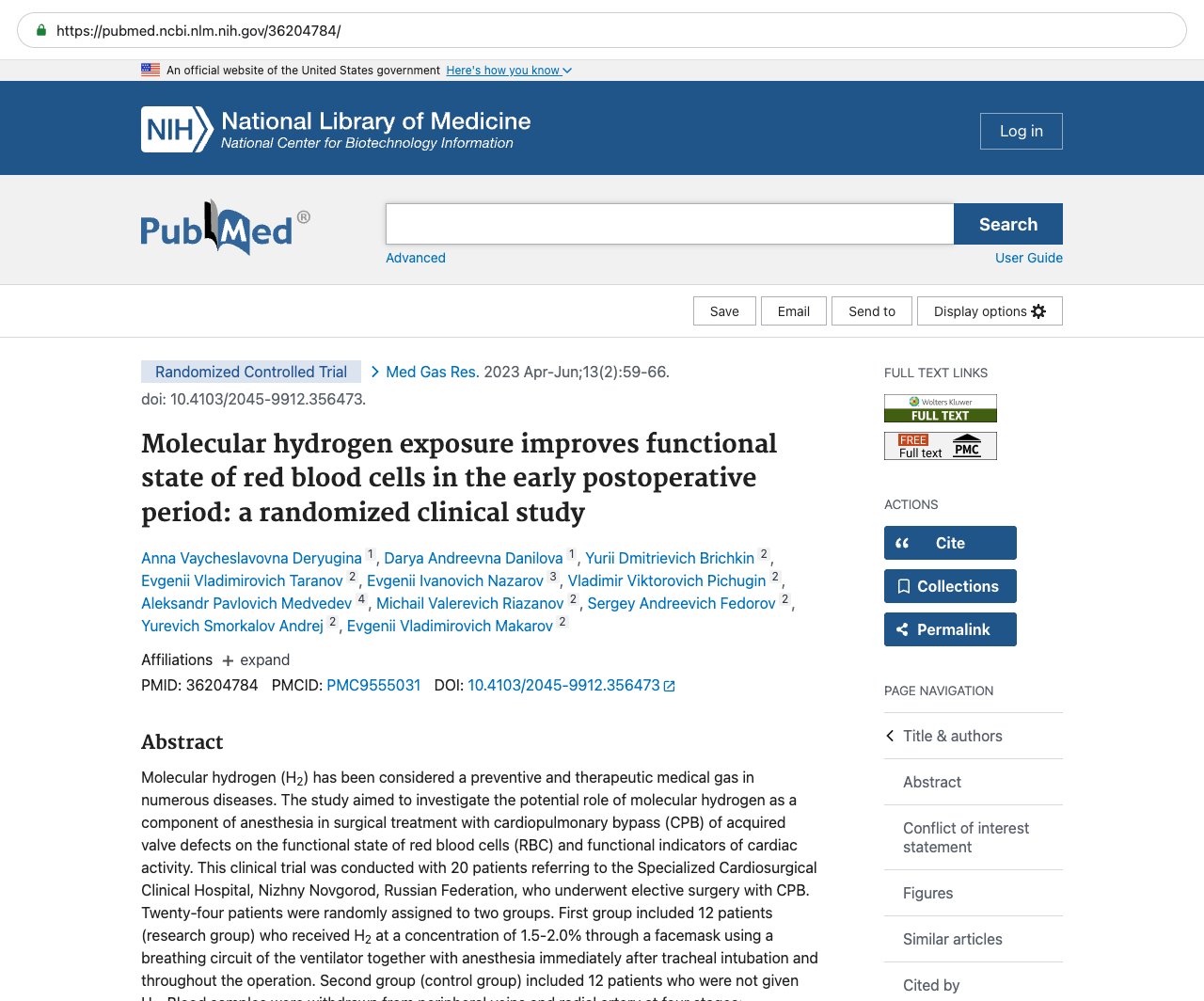
This page mirrors the published abstract (© the authors / publisher) for reference and citation. The canonical source is the PubMed record linked above. This is not medical advice.