2022 International journal of environmental research and public health Pilot / Observational Human H₂ therapy Drinking (HRW)
2022 · Dong — Short-Term Consumption of Hydrogen-Rich Water Enhances Power Performance and Heart Rate Recovery in Dragon Boat Athletes
Super-Abstract
Seven days of hydrogen-rich water improved maximum power output and post-exercise heart rate recovery in competitive dragon boat athletes compared to placebo water. This small pilot RCT points to H₂ as a practical hydration strategy for endurance and power sports, while also noting the limits of a 9-person-per-group design. (International Journal of Environmental Research and Public Health, 2022.)
Commentary
Dragon boat racing involves repeated short, all-out paddling bursts — a demanding mix of power and cardiovascular endurance. The study measured a 30-second rowing dynamometer test, peak and average power output, and heart rate at baseline and after one week of HRW or placebo. The HRW group showed meaningfully higher peak and average power, and their heart rate dropped significantly two minutes into recovery, while the placebo group's heart rate did not drop during the same window. The H₂ group trained four hours daily, so the background oxidative load was high — exactly the context where antioxidant support is most relevant. However, with only 9 participants per arm, confidence intervals will be wide. The lack of blinding verification and the absence of H₂ concentration measurement in the water used are additional gaps. The positive trend is real and internally consistent, but replication in a larger, pre-registered trial is essential before drawing firm conclusions.
Key quotes
- „Drinking HRW increased the maximum power and average power of the 30 s rowing test and decreased the maximum heart rate during the period.“ — the primary performance findings of the HRW group
- „After the rowing test, the HRW group's heart rate dropped significantly after 2 min of recovery, while the PW group's heart rate did not drop.“ — the cardiovascular recovery advantage — a practically meaningful finding for athletes
- „There was no significant difference between the 30 s rowing distance and the predicted duration of rowing 500 m.“ — an honest null finding: not all metrics improved
Our assessment
A promising but underpowered pilot study. The performance and recovery signal is consistent with other H₂ exercise studies, and the within-group heart-rate recovery difference is the most clinically meaningful finding. Limitations: n=9 per group, no H₂ concentration data for the water, unclear blinding quality, single sport and training context, no follow-up beyond day 8. The null findings on 500 m row prediction and rowing distance should be reported as clearly as the positive findings — the paper does so, which is a methodological credit. Treat as hypothesis-generating rather than conclusive.
Study design
- Type: pilot randomised controlled trial · n: 18 dragon boat athletes (9 HRW, 9 placebo) · H₂ delivery: hydrogen-rich water, consumed ad libitum, 7 days
- Outcome measures: 30 s rowing dynamometer test (peak power, average power, distance), heart rate (max during test, recovery at 2 min)
- Result: HRW group: ↑ peak power, ↑ average power, ↓ max heart rate, significantly faster HR recovery at 2 min; no significant difference in rowing distance or predicted 500 m time
Abstract
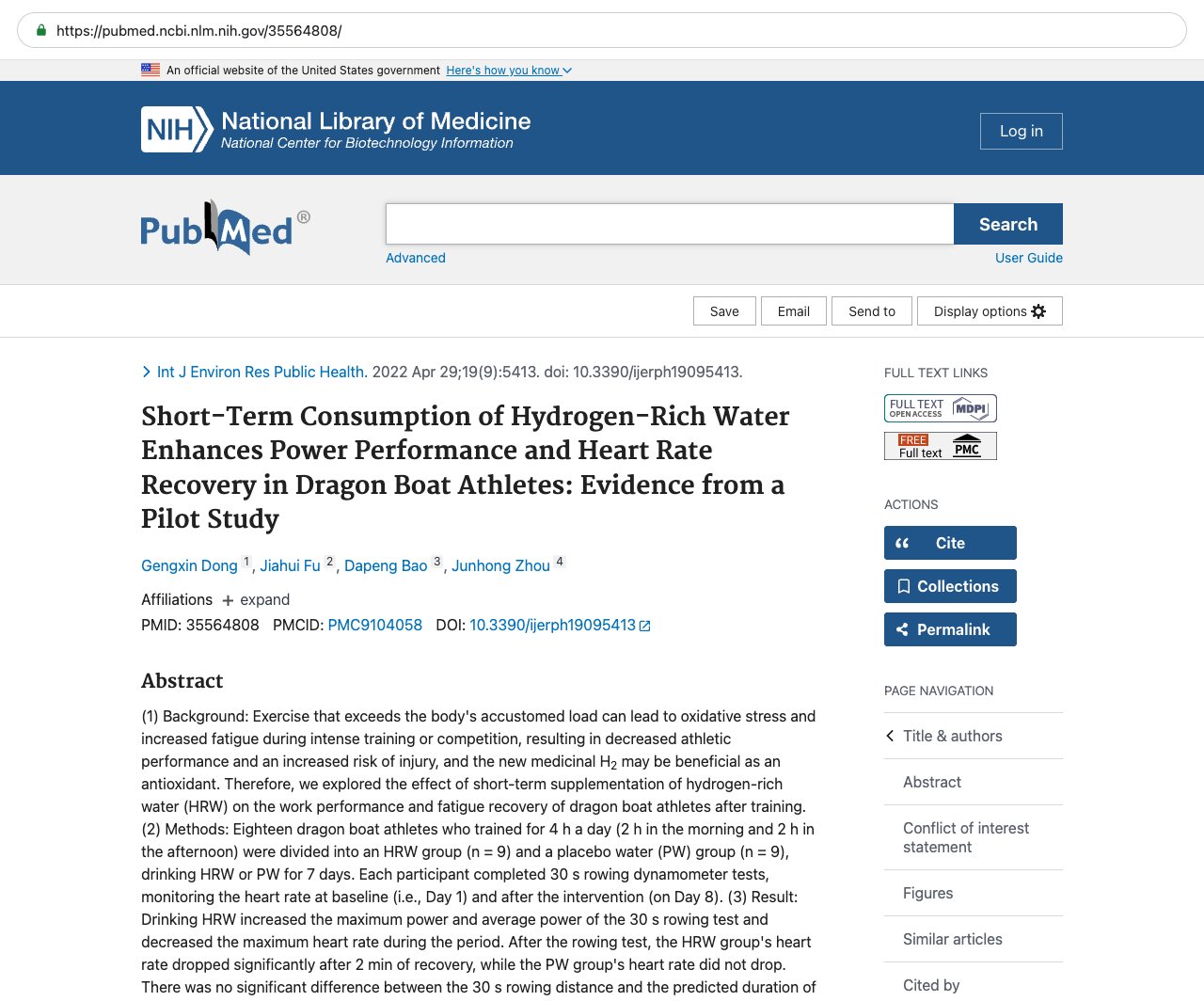
(1) Background: Exercise that exceeds the body's accustomed load can lead to oxidative stress and increased fatigue during intense training or competition, resulting in decreased athletic performance and an increased risk of injury, and the new medicinal H2 may be beneficial as an antioxidant. Therefore, we explored the effect of short-term supplementation of hydrogen-rich water (HRW) on the work performance and fatigue recovery of dragon boat athletes after training. (2) Methods: Eighteen dragon boat athletes who trained for 4 h a day (2 h in the morning and 2 h in the afternoon) were divided into an HRW group (n = 9) and a placebo water (PW) group (n = 9), drinking HRW or PW for 7 days. Each participant completed 30 s rowing dynamometer tests, monitoring the heart rate at baseline (i.e., Day 1) and after the intervention (on Day 8). (3) Result: Drinking HRW increased the maximum power and average power of the 30 s rowing test and decreased the maximum heart rate during the period. After the rowing test, the HRW group's heart rate dropped significantly after 2 min of recovery, while the PW group's heart rate did not drop. There was no significant difference between the 30 s rowing distance and the predicted duration of rowing 500 m. (4) Conclusions: Drinking HRW in the short term can effectively improve the power performance of dragon boat athletes and is conducive to the recovery of the heart rate after exercise, indicating that HRW may be a suitable means of hydration for athletes.
Source & links
Screenshot of the PubMed page
This page mirrors the published abstract (© the authors / publisher) for reference and citation. The canonical source is the PubMed record linked above. This is not medical advice.