2012 · Sun et al. — Oral intake of hydrogen-rich water inhibits intimal hyperplasia in arterialized vein grafts in rats.
Super-Abstract
Vein grafts used in bypass surgery frequently fail due to intimal hyperplasia — thickening of the vessel wall that narrows the lumen over time. This rat study found that drinking hydrogen-rich water (HRW) significantly suppressed intimal hyperplasia after vein grafting, improved endothelial integrity, reduced platelet and immune cell aggregation, and inhibited key inflammatory and remodeling proteins (MMP-2, MMP-9, p38 MAPK). These results are from a rat model — human clinical data do not exist for this specific application.
Commentary
This is a technically detailed animal study with a clear mechanistic story: HRW reduces oxidative stress, which in turn attenuates the inflammatory cascade (ICAM upregulation, platelet aggregation, leukocyte adhesion, MMP activation) that drives intimal hyperplasia after vein grafting. The inclusion of smooth muscle cell culture data (A7r5 cells) showing reduced migration adds a mechanistic in-vitro layer. The HRW generation method — magnesium sticks in tap water — is a practical, commercially available approach, which adds translational relevance. The conclusion that „drinking HW may have therapeutic value" is explicitly conditional and modest. Nevertheless, the jump from rat vein graft model to human bypass surgery outcomes is substantial, and no human trials exist for this indication.
Key quotes
- „HW significantly suppressed intimal hyperplasia.“ — the primary experimental outcome in the rat vein graft model
- „Activation of p38 mitogen-activated protein kinase, matrix metalloproteinase (MMP)-2, and MMP-9 was also significantly inhibited in grafts receiving HW.“ — the mechanistic pathway: key proteins driving vascular remodeling are suppressed
- „Drinking HW significantly reduced neointima formation after vein grafting in rats. Drinking HW may have therapeutic value as a novel therapy for intimal hyperplasia.“ — the authors' conclusion — appropriately cautious with „may have"
Our assessment
This is a preclinical animal study in rats — findings cannot be directly extrapolated to human patients. The mechanistic data are consistent and internally coherent, pointing to anti-inflammatory and antioxidant mechanisms via oxidative stress reduction. The study design is solid for a preclinical vascular study. However, vein graft intimal hyperplasia in humans involves additional complexity, and no clinical trials on this indication exist. The results are hypothesis-generating for potential future clinical investigation.
Study design
- Type: preclinical animal study + in-vitro · n: syngeneic Lewis rats (vein graft model); A7r5 smooth muscle cells · H₂ delivery: HRW by drinking (magnesium stick method, Mg + 2H₂O → Mg(OH)₂ + H₂)
- Result: HRW significantly suppressed intimal hyperplasia; improved endothelial integrity; reduced platelet and WBC aggregation; attenuated ICAM-1 mRNA upregulation; inhibited p38 MAPK, MMP-2, MMP-9 activation; reduced smooth muscle cell migration in vitro
Abstract
AIMS: Arterialized vein grafts often fail due to intimal hyperplasia. Hydrogen potently protects organs and cells from many insults via its anti-inflammatory and antioxidant properties. We investigated the efficacy of oral administration of hydrogen-rich water (HW) for prevention of intimal hyperplasia. METHODS AND RESULTS: The inferior vena cava was excised, stored in cold Ringer solution for 2 h, and placed as an interposition graft in the abdominal aorta of syngeneic Lewis rats. HW was generated by immersing a magnesium stick in tap water (Mg + 2H(2)O → Mg (OH)(2) + H(2)). Beginning on the day of graft implantation, recipients were given tap water [regular water (RW)], HW or HW that had been subsequently degassed water (DW). Six weeks after grafting, the grafts in the rats given RW or DW had developed intimal hyperplasia, accompanied by increased oxidative injury. HW significantly suppressed intimal hyperplasia. One week after grafting, the grafts in HW-treated rats exhibited improved endothelial integrity with less platelet and white blood cell aggregation. Up-regulation of the mRNAs for intracellular adhesion molecules was attenuated in the vein grafts of the rats receiving HW. Activation of p38 mitogen-activated protein kinase, matrix metalloproteinase (MMP)-2, and MMP-9 was also significantly inhibited in grafts receiving HW. In rat smooth muscle cell (A7r5) cultures, hydrogen treatment for 24 h reduced smooth muscle cell migration. CONCLUSION: Drinking HW significantly reduced neointima formation after vein grafting in rats. Drinking HW may have therapeutic value as a novel therapy for intimal hyperplasia and could easily be incorporated into daily life.
Source & links
Screenshot of the PubMed page
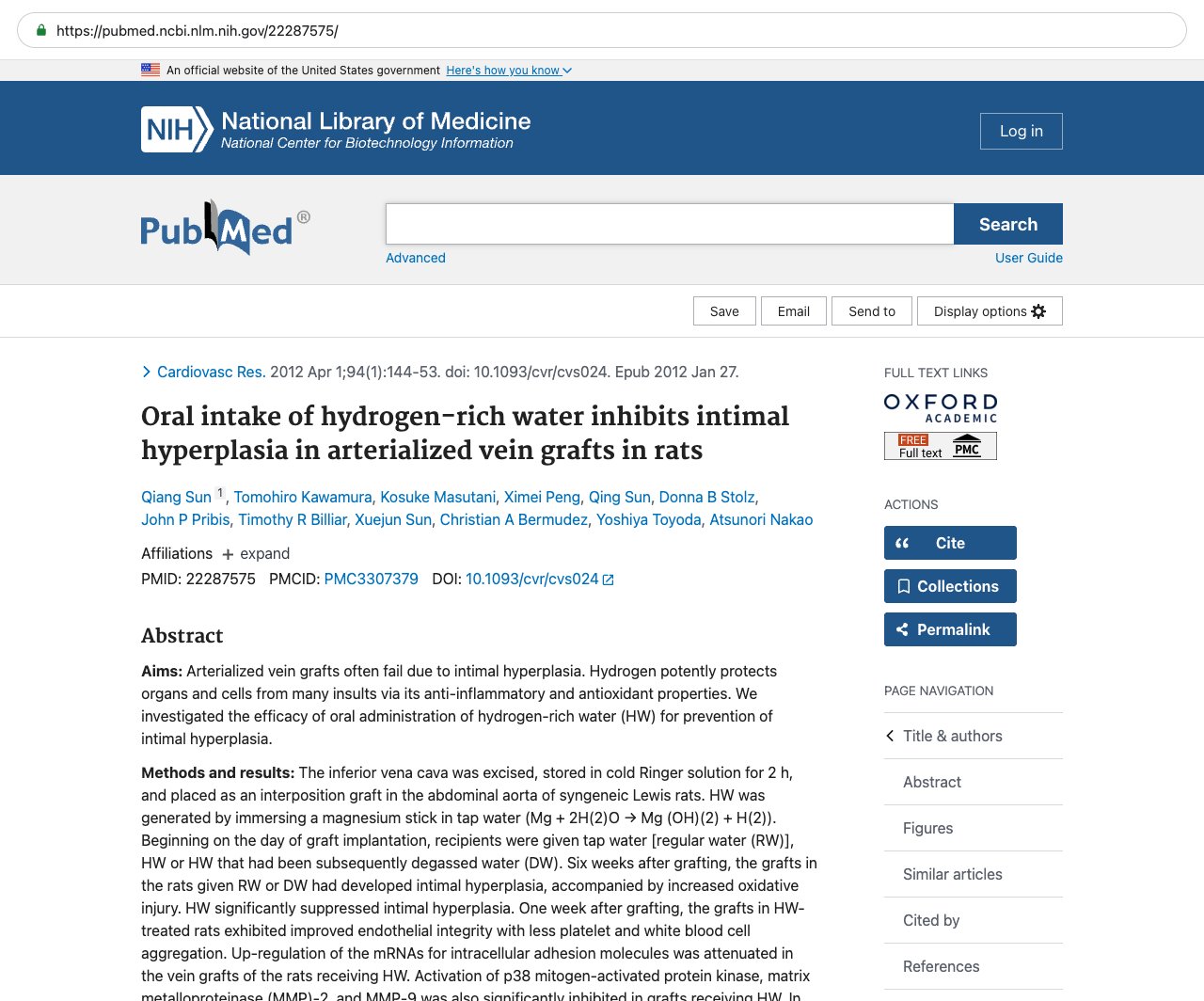
This page mirrors the published abstract (© the authors / publisher) for reference and citation. The canonical source is the PubMed record linked above. This is not medical advice.