2003 · Huang — Reduced hemodialysis-induced oxidative stress in end-stage renal disease patients by electrolyzed reduced water.
Super-Abstract
Patients with end-stage renal disease (ESRD) undergoing chronic hemodialysis showed significantly reduced oxidative stress markers and improved antioxidant status after one month of drinking electrolyzed reduced water (ERW). Inflammatory markers (IL-6, CRP) and oxidized lipid and protein levels were also lowered. (Kidney International, 2003.)
Commentary
Hemodialysis is a life-sustaining treatment for ESRD, but the procedure itself paradoxically generates oxidative stress — increasing reactive oxygen species (ROS) and oxidized molecules in the blood. This study by Huang and colleagues is one of the early clinical papers demonstrating that ERW (a source of dissolved molecular H₂) can partially counteract this dialysis-induced oxidative burden. The researchers measured plasma ROS scavenging capacity, oxidized lipids (phosphatidylcholine hydroperoxide), and proteins (dityrosine, methylguanidine), as well as inflammatory markers (IL-6, CRP). After one month of ERW administration, all these markers improved relative to baseline. Hemodialysis continued to remove some oxidized products (as expected), but ERW added an antioxidant layer on top. This is a clinically meaningful population with a high unmet need — the results are encouraging, though the study has clear limitations in size and design.
Key quotes
- „ERW administration diminished hemodialysis-enhanced Rh2o2 and Rhocl, minimized oxidized and inflammatory markers (CRP and IL-6), and partly restored total antioxidant status during 1-month treatment.“ — the central clinical finding: ERW reduced oxidative and inflammatory burden in dialysis patients
- „Hemodialysis with ERW administration may efficiently increase the H2O2- and HOCl-dependent antioxidant defense and reduce H2O2- and HOCl-induced oxidative stress.“ — the proposed mechanism: ERW boosts ROS-scavenging capacity in dialysis patients
- „Although hemodialysis efficiently removes dityrosine and creatinine, hemodialysis increased oxidative stress, including phosphatidylcholine hydroperoxide, and methylguanidine.“ — important context: dialysis itself worsens oxidative stress, which ERW may help counteract
Our assessment
This is one of the earliest published clinical studies specifically examining ERW (as an H₂ source) in a human patient population with a measurable disease endpoint. The results are positive across multiple oxidative and inflammatory markers over one month, which is encouraging. Limitations to state honestly: the sample size is not reported in the available data (the full paper must be consulted for n); no randomized placebo control is described in the abstract; the one-month follow-up is short; ERW composition (H₂ concentration) is not explicitly quantified. The study predates the 2007 Nature Medicine paper that launched the modern H₂ therapy field, making it an important early data point. Results should be interpreted as hypothesis-generating rather than definitive.
Study design
- Type: clinical intervention study in ESRD patients undergoing hemodialysis · n: not specified in abstract (see full paper) · H₂ delivery: electrolyzed reduced water (ERW) administered orally during hemodialysis
- Duration: 1 month · Key endpoints: plasma ROS scavenging activity (H₂O₂, HOCl), oxidized lipids (phosphatidylcholine hydroperoxide), oxidized proteins (dityrosine, methylguanidine), inflammatory markers (IL-6, CRP), total antioxidant status
- Result: ERW significantly reduced hemodialysis-induced ROS and oxidized markers; inflammatory markers (CRP, IL-6) decreased; total antioxidant status partly restored over 1 month
Abstract
BACKGROUND: Increased oxidative stress in end-stage renal disease (ESRD) patients may oxidize macromolecules and consequently lead to cardiovascular events during chronic hemodialysis. Electrolyzed reduced water (ERW) with reactive oxygen species (ROS) scavenging ability may have a potential effect on reduction of hemodialysis-induced oxidative stress in ESRD patients. METHODS: We developed a chemiluminescence emission spectrum and high-performance liquid chromatography analysis to assess the effect of ERW replacement on plasma ROS (H2O2 and HOCl) scavenging activity and oxidized lipid or protein production in ESRD patients undergoing hemodialysis. Oxidized markers, dityrosine, methylguanidine, and phosphatidylcholine hydroperoxide, and inflammatory markers, interleukin 6 (IL-6), and C-reactive protein (CRP) were determined. RESULTS: Although hemodialysis efficiently removes dityrosine and creatinine, hemodialysis increased oxidative stress, including phosphatidylcholine hydroperoxide, and methylguanidine. Hemodialysis reduced the plasma ROS scavenging activity, as shown by the augmented reference H2O2 and HOCl counts (Rh2o2 and Rhocl, respectively) and decreased antioxidative activity (expressed as total antioxidant status in this study). ERW administration diminished hemodialysis-enhanced Rh2o2 and Rhocl, minimized oxidized and inflammatory markers (CRP and IL-6), and partly restored total antioxidant status during 1-month treatment. CONCLUSION: This study demonstrates that hemodialysis with ERW administration may efficiently increase the H2O2- and HOCl-dependent antioxidant defense and reduce H2O2- and HOCl-induced oxidative stress.
Source & links
Screenshot of the PubMed page
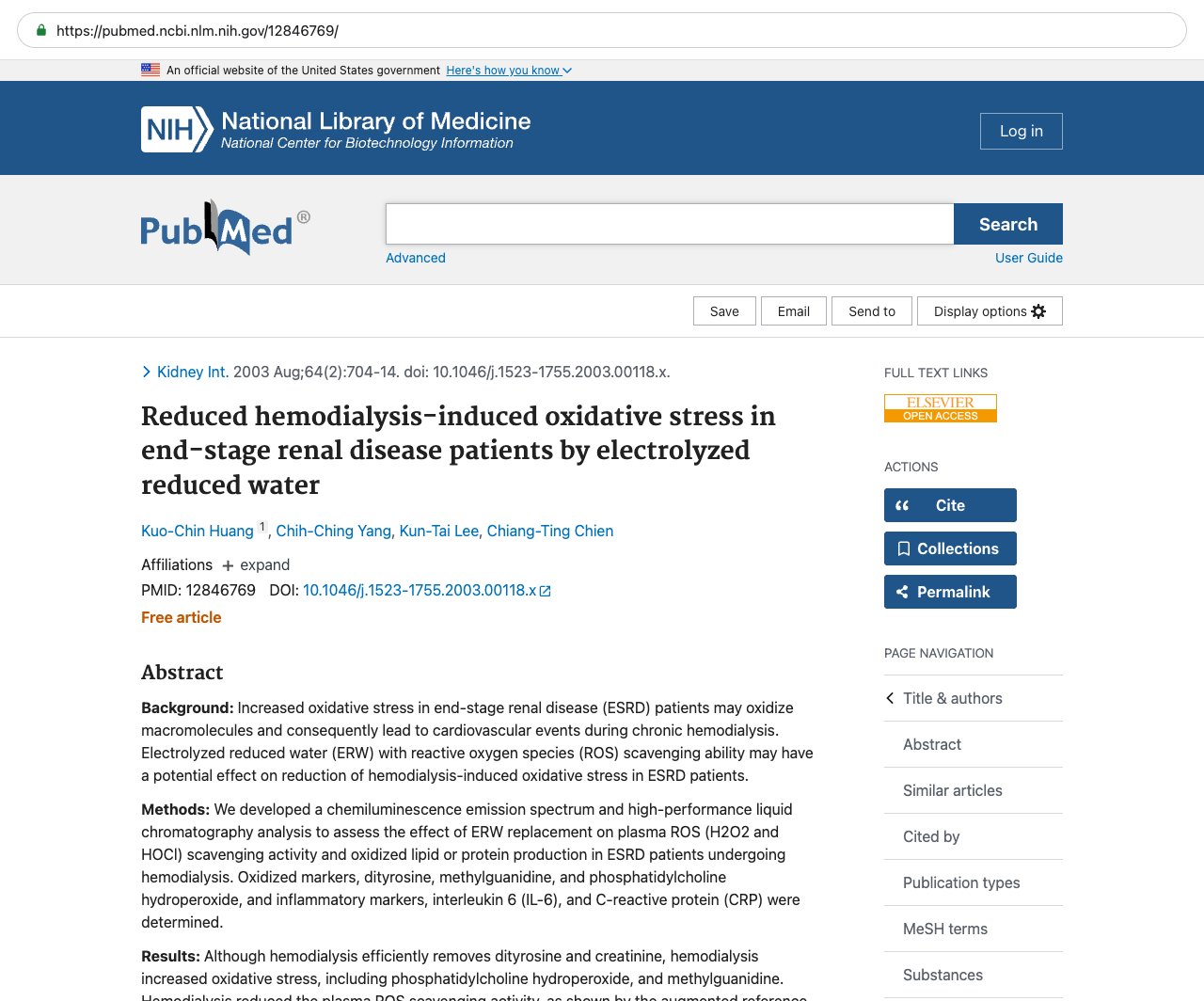
This page mirrors the published abstract (© the authors / publisher) for reference and citation. The canonical source is the PubMed record linked above. This is not medical advice.