2024 · Dong — Hydrogen-Rich Gas Enhanced Sprint-Interval Performance: Metabolomic Insights into Underlying Mechanisms
Super-Abstract
Inhaling hydrogen-rich gas (HRG) for 60 minutes before a sprint-interval test improved late-stage anaerobic performance and reduced performance decline across sprints in healthy men. Metabolomic analysis revealed that H₂ inhalation upregulated several metabolites linked to fat mobilization and coenzyme A synthesis, suggesting a mechanism involving accelerated fat oxidation to replenish ATP during interval recovery. (Nutrients, 2024.)
Commentary
This crossover study is noteworthy for taking a metabolomics approach to understanding why H₂ might help during high-intensity interval exercise — going beyond simple performance metrics to look at blood metabolite profiles. Ten healthy men completed a Wingate sprint-interval test (4 sprints) after HRG or placebo inhalation. Performance improvements were seen specifically in sprint 4 (end-stage), which is where fatigue accumulates most. The upregulation of acetylcarnitine and propionyl-L-carnitine is consistent with enhanced fatty acid transport into mitochondria. The study design is rigorous for its size (double-blind crossover), but n=10 is very small. Results are hypothesis-generating — the metabolomic pathway analysis suggests plausible mechanisms but does not prove them. The journal Nutrients is a legitimate peer-reviewed MDPI journal, though with broad scope.
Key quotes
- „HRG inhalation significantly improved mean power, fatigue index, and time to peak for the fourth sprint and significantly reduced the attenuation values of peak power, mean power, and time to peak between the first and fourth.“ — the specific performance gains: HRG helped maintain sprint capacity over repeated efforts, particularly in the final sprint
- „Metabolomic analysis highlighted the significant upregulation of acetylcarnitine, propionyl-L-carnitine, hypoxanthine, and xanthine upon HRG inhalation, with enrichment pathway analysis suggesting that HRG may foster fat mobilization by enhancing coenzyme A synthesis.“ — the proposed metabolic mechanism: H₂ may shift energy substrate use toward fat oxidation
- „Inhaling HRG before an SIT enhances end-stage anaerobic sprint capabilities and mitigates fatigue. Metabolomic analysis suggests that HRG may enhance ATP recovery during interval stages by accelerating fat oxidation.“ — the authors' summary of both the performance and mechanistic findings
Our assessment
A well-designed small crossover study that advances H₂ sports science from "does it work?" toward "how might it work?". The metabolomics data is genuinely novel and the performance improvements in late-stage sprints are biologically plausible. Key limitations: n=10 is very small — results need replication in a larger sample; only healthy men were studied; the metabolomic pathway analysis is associative, not causal (enrichment analysis cannot prove that the identified pathways are responsible for the performance effect). The H₂ inhalation protocol (60 min pre-exercise) is practically realistic. Overall: promising mechanistic signal, but preliminary.
Study design
- Type: double-blind, placebo-controlled, randomized crossover · n: 10 healthy adult males · H₂ delivery: inhalation of hydrogen-rich gas (HRG) for 60 min pre-exercise
- Exercise protocol: Wingate sprint-interval test (4 sprints), maximum cycling power and fatigue index measured · Metabolomics: venous blood samples before/after gas inhalation and after SIT
- Result: HRG improved sprint 4 mean power, fatigue index, and time to peak; reduced performance attenuation between sprint 1 and 4; upregulated acetylcarnitine, propionyl-L-carnitine, hypoxanthine, xanthine
Abstract
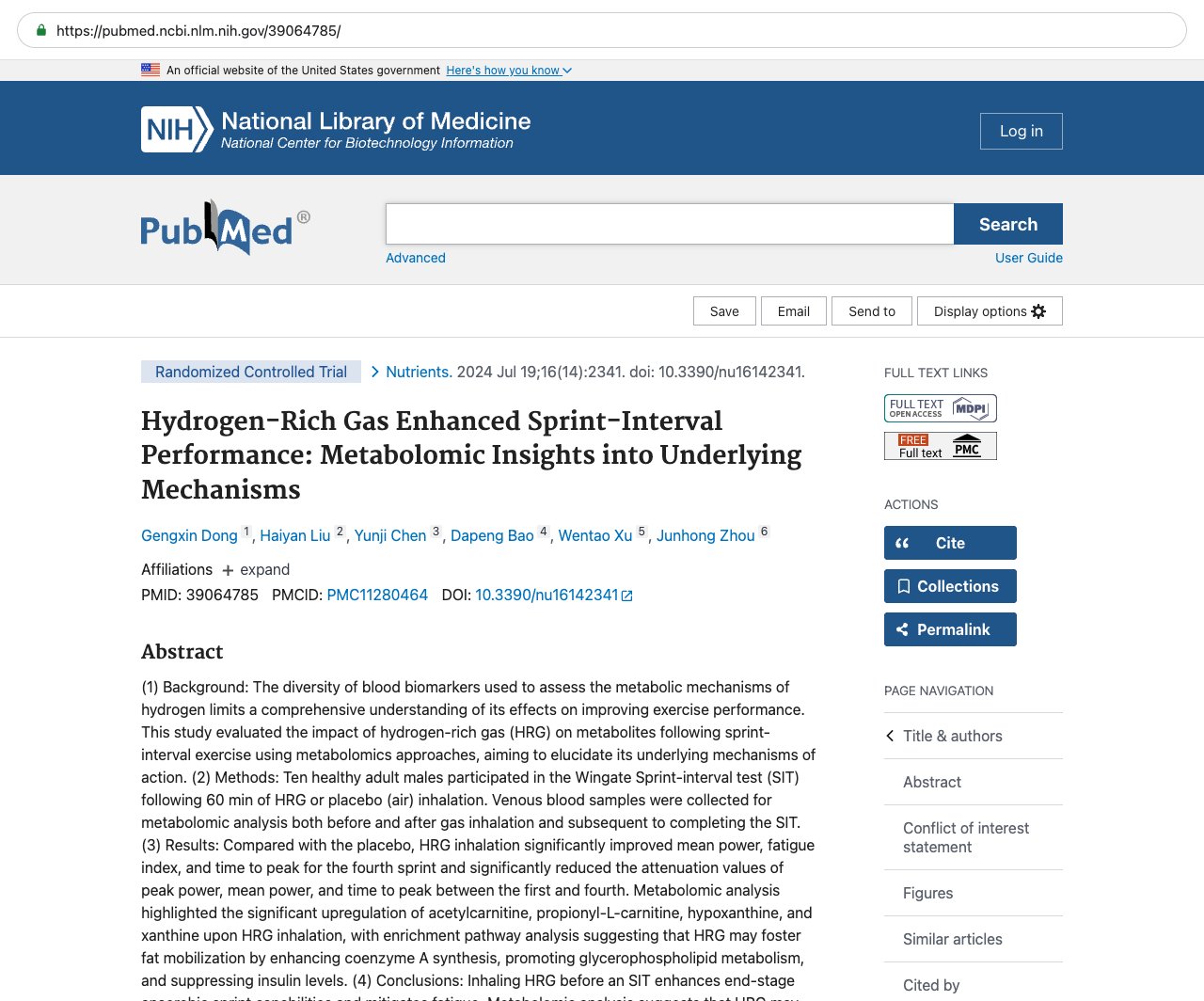
(1) Background: The diversity of blood biomarkers used to assess the metabolic mechanisms of hydrogen limits a comprehensive understanding of its effects on improving exercise performance. This study evaluated the impact of hydrogen-rich gas (HRG) on metabolites following sprint-interval exercise using metabolomics approaches, aiming to elucidate its underlying mechanisms of action. (2) Methods: Ten healthy adult males participated in the Wingate Sprint-interval test (SIT) following 60 min of HRG or placebo (air) inhalation. Venous blood samples were collected for metabolomic analysis both before and after gas inhalation and subsequent to completing the SIT. (3) Results: Compared with the placebo, HRG inhalation significantly improved mean power, fatigue index, and time to peak for the fourth sprint and significantly reduced the attenuation values of peak power, mean power, and time to peak between the first and fourth. Metabolomic analysis highlighted the significant upregulation of acetylcarnitine, propionyl-L-carnitine, hypoxanthine, and xanthine upon HRG inhalation, with enrichment pathway analysis suggesting that HRG may foster fat mobilization by enhancing coenzyme A synthesis, promoting glycerophospholipid metabolism, and suppressing insulin levels. (4) Conclusions: Inhaling HRG before an SIT enhances end-stage anaerobic sprint capabilities and mitigates fatigue. Metabolomic analysis suggests that HRG may enhance ATP recovery during interval stages by accelerating fat oxidation, providing increased energy replenishment for late-stage sprints.
Source & links
Screenshot of the PubMed page
This page mirrors the published abstract (© the authors / publisher) for reference and citation. The canonical source is the PubMed record linked above. This is not medical advice.