1992 · Ellies — Crystallographic Changes in Calcium Phosphates During Plasma-Spraying
Super-Abstract
This in-vitro materials science study examined how plasma-spraying calcium phosphate powders — using hydrogen gas as part of the plasma torch process — causes crystallographic transformations, converting some hydroxyapatite (HA) to more-resorbable beta-tricalcium phosphate (β-TCP) and calcium oxide. Controlling the HA/β-TCP ratio on the coated surface may help tune the resorption rate of orthopedic and dental implant coatings. (Biomaterials, 1992.)
Commentary
This is a materials science and dental/orthopedic implant study — not a hydrogen therapy study. Hydrogen appears here as a component of the plasma torch gas mixture used in the coating process, not as a therapeutic agent. The study characterizes the phase transformations that occur when calcium phosphate powders are plasma-sprayed onto metal implants. The key clinical relevance is that stoichiometric hydroxyapatite degrades least during spraying (only 5%), while calcium-deficient apatite converts more heavily to β-TCP, which is more bioresorbable in vivo. This is an engineering study with implications for implant surface chemistry, not for hydrogen medicine.
Key quotes
- „A precipitated calcium-deficient apatite and a high temperature near-stoichiometric HA were each sprayed onto metal substrate in an argon plasma using several hydrogen gas flow conditions at various temperatures.“ — hydrogen gas used as part of the plasma torch process — not as therapy
- „Stoichiometric HA when plasma-sprayed showed the least (5%) degradation.“ — the key materials finding: near-stoichiometric HA is most stable under plasma conditions
- „Since beta-TCP is more resorbable than HA in vivo, varying the HA/beta-TCP ratio on the plasma-sprayed surface may provide a method to control surface dissolution of the coating.“ — the clinical implication: tunable resorption via phase ratio control
Our assessment
This is a materials science / biomaterials engineering study — not a hydrogen therapy study. Hydrogen gas appears only as a component of the plasma torch gas flow, not as a therapeutic agent. No conclusions about therapeutic H₂ can be drawn from this paper. The study is relevant to dental and orthopedic implant engineering, specifically to the design of calcium phosphate coatings with controlled resorption rates. Researchers in molecular hydrogen medicine will find nothing applicable here.
Study design
- Type: in-vitro materials science study (X-ray diffraction + scanning electron microscopy) · Model: calcium phosphate coatings on metal substrates · H₂ delivery: not applicable — H₂ is a plasma torch process gas, not a therapeutic agent
- Result: plasma-sprayed products contain mixtures of HA, β-TCP, and CaO; stoichiometric HA shows least degradation (5%); calcium-deficient apatite converts more heavily to β-TCP; HA/β-TCP ratio is tunable via spraying conditions
Abstract
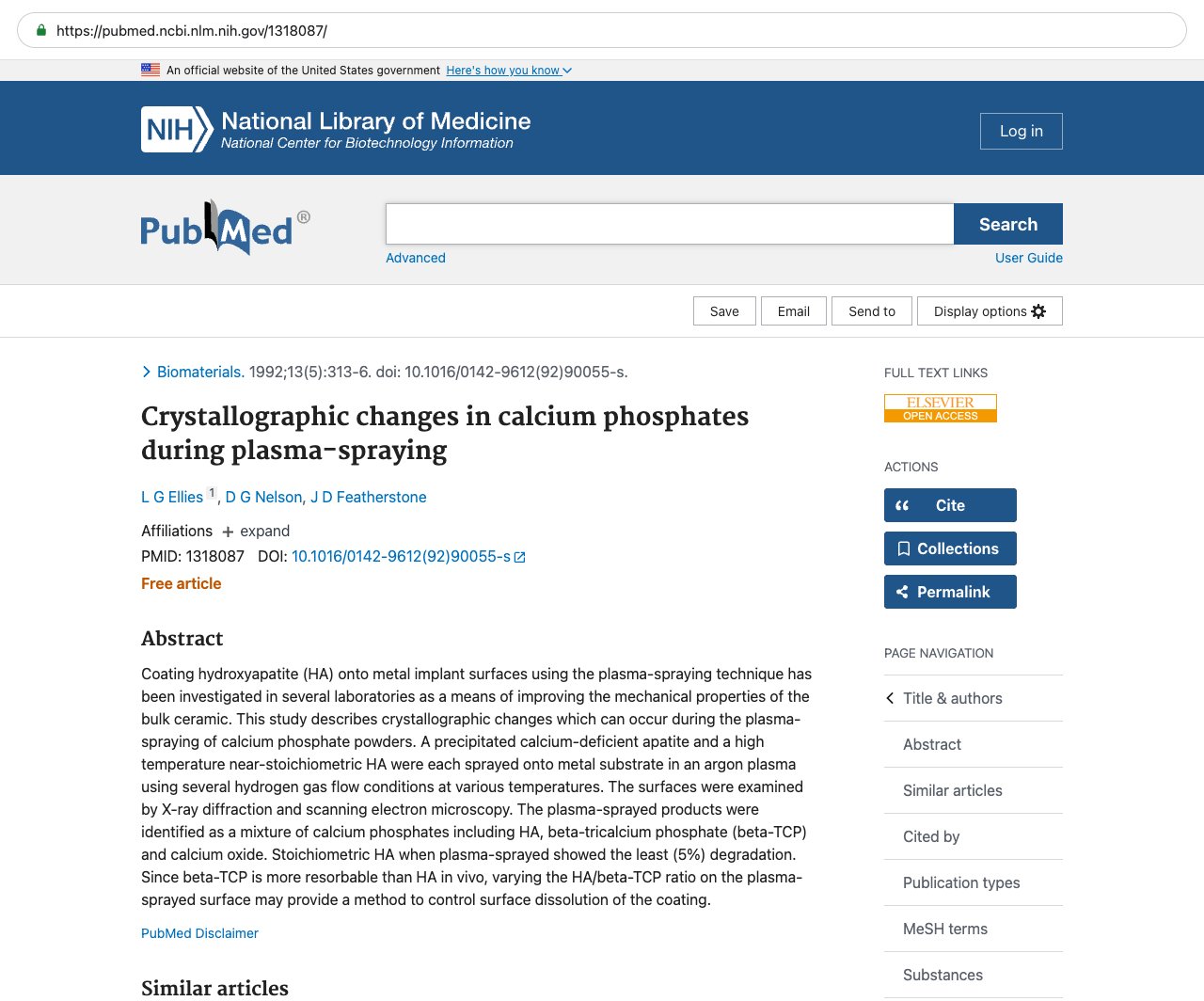
Coating hydroxyapatite (HA) onto metal implant surfaces using the plasma-spraying technique has been investigated in several laboratories as a means of improving the mechanical properties of the bulk ceramic. This study describes crystallographic changes which can occur during the plasma-spraying of calcium phosphate powders. A precipitated calcium-deficient apatite and a high temperature near-stoichiometric HA were each sprayed onto metal substrate in an argon plasma using several hydrogen gas flow conditions at various temperatures. The surfaces were examined by X-ray diffraction and scanning electron microscopy. The plasma-sprayed products were identified as a mixture of calcium phosphates including HA, beta-tricalcium phosphate (beta-TCP) and calcium oxide. Stoichiometric HA when plasma-sprayed showed the least (5%) degradation. Since beta-TCP is more resorbable than HA in vivo, varying the HA/beta-TCP ratio on the plasma-sprayed surface may provide a method to control surface dissolution of the coating.
Source & links
Screenshot of the PubMed page
This page mirrors the published abstract (© the authors / publisher) for reference and citation. The canonical source is the PubMed record linked above. This is not medical advice.