2018 · Franceschelli — Modulation of the Oxidative Plasmatic State in Gastroesophageal Reflux Disease with the Addition of Hydrogen-Rich Water: A New Biological Vision
Super-Abstract
In 84 patients with gastroesophageal reflux disease (GERD), adding electrolyzed reduced water rich in molecular hydrogen to standard proton pump inhibitor therapy significantly improved both oxidative stress markers and GERD-related quality of life versus PPI alone. This study positions H₂ as a complementary, not standalone, GERD intervention. (Journal of Cellular and Molecular Medicine, 2018.)
Commentary
GERD is among the most prevalent gastrointestinal conditions, and while proton pump inhibitors (PPIs) are the standard treatment, they do not address the underlying oxidative stress component. Franceschelli and colleagues tested whether adding electrolyzed reduced water (ERW) — which is rich in molecular hydrogen — to standard PPI therapy could improve outcomes. The study enrolled 84 GERD patients in two groups: PPI + tap water (control) vs. PPI + ERW (experimental), treated over 3 months. Multiple oxidative stress parameters were assessed: d-ROMs (oxidative metabolites), BAP (antioxidant potential), superoxide anion, nitric oxide, and malondialdehyde, alongside the validated GERD-Health Related Quality of Life Questionnaire (GERD-HRQL). The results indicate that combining ERW with standard PPI therapy restored a more optimal oxidative balance and reduced GERD symptoms. Critically, Spearman's correlation analysis showed that improvements in heartburn and regurgitation scores correlated significantly with laboratory oxidative stress parameters — supporting the mechanistic link between oxidative stress reduction and symptom improvement.
Key quotes
- „an optimal oxidative balance can be restored and GERD symptoms can be reduced rapidly via the integration of ERW in GERD patients.“ — the central claim: ERW as an add-on to PPI improves both lab markers and symptoms
- „The relative variation of heartburn and regurgitation score was significantly correlated with laboratory parameters.“ — mechanistic validation: symptom improvement tracks oxidative stress markers — not just subjective
- „combination treatment with PPI and ERW improves the cellular redox state leading to the improvement of the quality of life as demonstrated by the correlation analysis between laboratory parameters and GERD symptoms.“ — conclusion tying mechanism to clinical outcome
Our assessment
A mechanistically grounded and clinically well-designed study with a meaningful primary outcome (QoL in GERD) supported by laboratory correlates. Published in a peer-reviewed molecular medicine journal (Wiley). Limitations: the H₂ delivery method (ERW — electrolyzed reduced water) carries the same caveats as in other ERW studies: the H₂ concentration is not specified; ERW contains other components (mineral ions, adjusted pH) that could theoretically contribute; the study design is not explicitly randomized and blinded — „control vs. experimental treatment“ allocation details are limited in the abstract; n = 84 is modest for a 3-month controlled study; the „unspecified“ methods flag in the source data suggests the H₂ delivery details may be incomplete. Results are promising but deserve replication with better-characterized H₂ delivery.
Study design
- Type: controlled trial (84 GERD patients, 3 months) · n: 84 (control: PPI + tap water; experimental: PPI + ERW) · H₂ delivery: electrolyzed reduced water (ERW), delivered orally as drinking water
- Outcomes: GERD-HRQL questionnaire; oxidative stress markers (d-ROMs, BAP, superoxide anion, nitric oxide, malondialdehyde)
- Result: significant improvement in oxidative balance and GERD symptoms with PPI + ERW vs. PPI alone; heartburn and regurgitation scores significantly correlated with lab parameters (Spearman)
Abstract
Gastroesophageal reflux disease (GERD), a clinical condition characterized by reflux of gastroduodenal contents in the oesophagus, has proved to demonstrate a strong link between oxidative stress and the development of GERD. Proton pump inhibitors (PPIs) have been universally accepted as first-line therapy for management of GERD. The potential benefits of electrolysed reduced water (ERW), rich in molecular hydrogen, in improving symptoms and systemic oxidative stress associated with GERD was assessed. The study was performed on 84 GERD patients undergoing control treatment (PPI + tap water) or experimental treatment (PPI + ERW) for 3 months. These patients were subjected to the GERD-Health Related Quality of Life Questionnaire as well as derivatives reactive oxigen metabolites (d-ROMs) test, biological antioxidant potential (BAP) test, superoxide anion, nitric oxide and malondialdehyde assays, which were all performed as a proxy for the oxidative/nitrosative stress and the antioxidant potential status. Spearman's correlation coefficient was used to evaluate the correlation between scores and laboratory parameters. Overall results demonstrated that an optimal oxidative balance can be restored and GERD symptoms can be reduced rapidly via the integration of ERW in GERD patients. The relative variation of heartburn and regurgitation score was significantly correlated with laboratory parameters. Thus, in the selected patients, combination treatment with PPI and ERW improves the cellular redox state leading to the improvement of the quality of life as demonstrated by the correlation analysis between laboratory parameters and GERD symptoms.
Source & links
Screenshot of the PubMed page
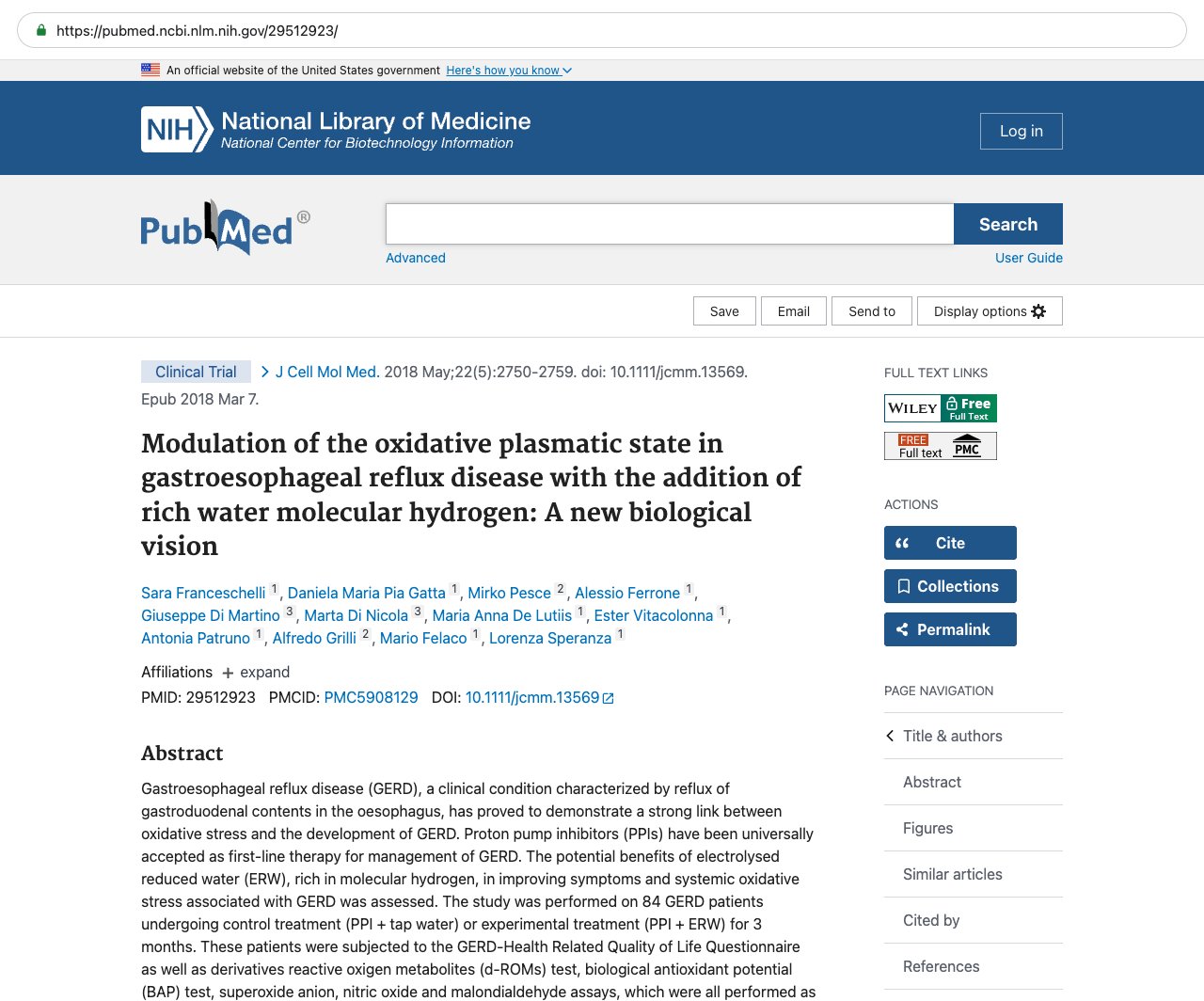
This page mirrors the published abstract (© the authors / publisher) for reference and citation. The canonical source is the PubMed record linked above. This is not medical advice.