2018 Liver transplantation : official publication of the American Association for the Study of Liver Diseases and the International Liver Transplantation Society Mechanism / Preclinical Unspecified
2018 · Tamaki — Hydrogen Flush After Cold Storage as a New End-Ischemic Ex Vivo Treatment for Liver Grafts Against Ischemia/Reperfusion Injury
Super-Abstract
A novel ex-vivo technique — flushing rat liver grafts with hydrogen-saturated solution (1.0 ppm) after cold storage — significantly reduced ischemia/reperfusion injury markers and preserved both sinusoidal endothelia and bile duct function, compared to controls. The route of H₂ flushing mattered: portal vein flushing protected sinusoidal cells, while arterial flushing better preserved bile canaliculi. This is a rat organ-preservation study; human transplant trials are required. (Liver Transplantation, 2018.)
Commentary
Tamaki and colleagues address a practical problem in transplantation: cold ischaemia inevitably damages donor livers, and reperfusion injury amplifies this damage. Their „HyFACS” (hydrogen flush after cold storage) technique is elegantly simple — a brief end-ischemic flush with H₂-saturated solution directly into the organ ex vivo, just before implantation. The dual-route experiment (portal vs. arterial vs. both) is particularly informative: it demonstrates that H₂ distribution within the organ during flush determines which cellular compartment is protected. The oxidative mechanism is supported by the glutathione/GSSG ratio improvement. The authors are honest about limitations: this is a rat model with 2-hour oxygenated reperfusion only (not a full transplant surgery), and clinical scale-up would face engineering challenges around H₂ flammability and delivery system design.
Key quotes
- „HyFACS significantly lowered portal venous pressure, transaminase, and high mobility group box protein 1 release compared with vehicle-treated controls.“ — multi-marker evidence for reduced ischaemia/reperfusion injury
- „HyFACS significantly protected liver grafts from IRI by ameliorating oxidative damage upon reperfusion in the characteristic manner with its route of administration.“ — route-dependent protection — the mechanistic insight
- „Given its safety, simplicity, and cost-effectiveness, end-ischemic HyFACS may be a novel pretransplant conditioning for cold-stored donor organs.“ — authors' optimistic but cautiously framed conclusion
Our assessment
A creative and well-controlled preclinical study with a clinically motivated question. The HyFACS concept is practical, low-cost, and avoids systemic H₂ exposure issues. Route-specificity of protection is a genuinely novel mechanistic observation. Limitations: rat liver, not human; only 24 h cold storage + 2 h reperfusion — not a full transplant; no long-term graft function or survival data; H₂ concentrations and dosing will need careful optimisation for clinical application. This is promising preclinical groundwork, but human transplant organ trials are several steps away.
Study design
- Type: controlled animal/ex-vivo organ study · Model: Wistar rat liver grafts · Cold storage: 24 h in UW solution
- H₂ delivery: ex-vivo cold flush with 1.0 ppm H₂ solution via portal vein, hepatic artery, or both · Reperfusion: 2 h oxygenated reperfusion at 37 °C
- Result: HyFACS reduced portal pressure, transaminase, HMGB1 (P < 0.01); portal route preserved sinusoidal endothelia; arterial route better protected bile canaliculi; improved glutathione/GSSG ratio in liver tissue
Abstract
Cold storage (CS) remains the gold standard for organ preservation worldwide, although it is inevitably associated with ischemia/reperfusion injury (IRI). Molecular hydrogen (H2 ) is well known to have antioxidative properties. However, its unfavorable features, ie, inflammability, low solubility, and high tissue/substance permeability, have hampered its clinical application. To overcome such obstacles, we developed a novel reconditioning method for donor organs named hydrogen flush after cold storage (HyFACS), which is just an end-ischemic H2 flush directly to donor organs ex vivo, and, herein, we report its therapeutic impact against hepatic IRI. Whole liver grafts were retrieved from Wistar rats. After 24-hour CS in UW solution, livers were cold-flushed with H2 solution (1.0 ppm) via the portal vein (PV), the hepatic artery (HA), or both (PV + HA). Functional integrity and morphological damages were then evaluated by 2-hour oxygenated reperfusion at 37°C. HyFACS significantly lowered portal venous pressure, transaminase, and high mobility group box protein 1 release compared with vehicle-treated controls (P < 0.01). Hyaluronic acid clearance was significantly higher in the HyFACS-PV and -PV + HA groups when compared with the others (P < 0.01), demonstrating the efficacy of the PV route to maintain the sinusoidal endothelia. In contrast, bile production and lactate dehydrogenase leakage therein were both significantly improved in HyFACS-HA and -PV + HA (P < 0.01), representing the superiority of the arterial route to attenuate biliary damage. Electron microscopy consistently revealed that sinusoidal ultrastructures were well maintained by portal HyFACS, while microvilli in bile canaliculi were well preserved by arterial flush. As an underlying mechanism, HyFACS significantly lowered oxidative damages, thus improving the glutathione/glutathione disulfide ratio in liver tissue. In conclusion, HyFACS significantly protected liver grafts from IRI by ameliorating oxidative damage upon reperfusion in the characteristic manner with its route of administration. Given its safety, simplicity, and cost-effectiveness, end-ischemic HyFACS may be a novel pretransplant conditioning for cold-stored donor organs.
Source & links
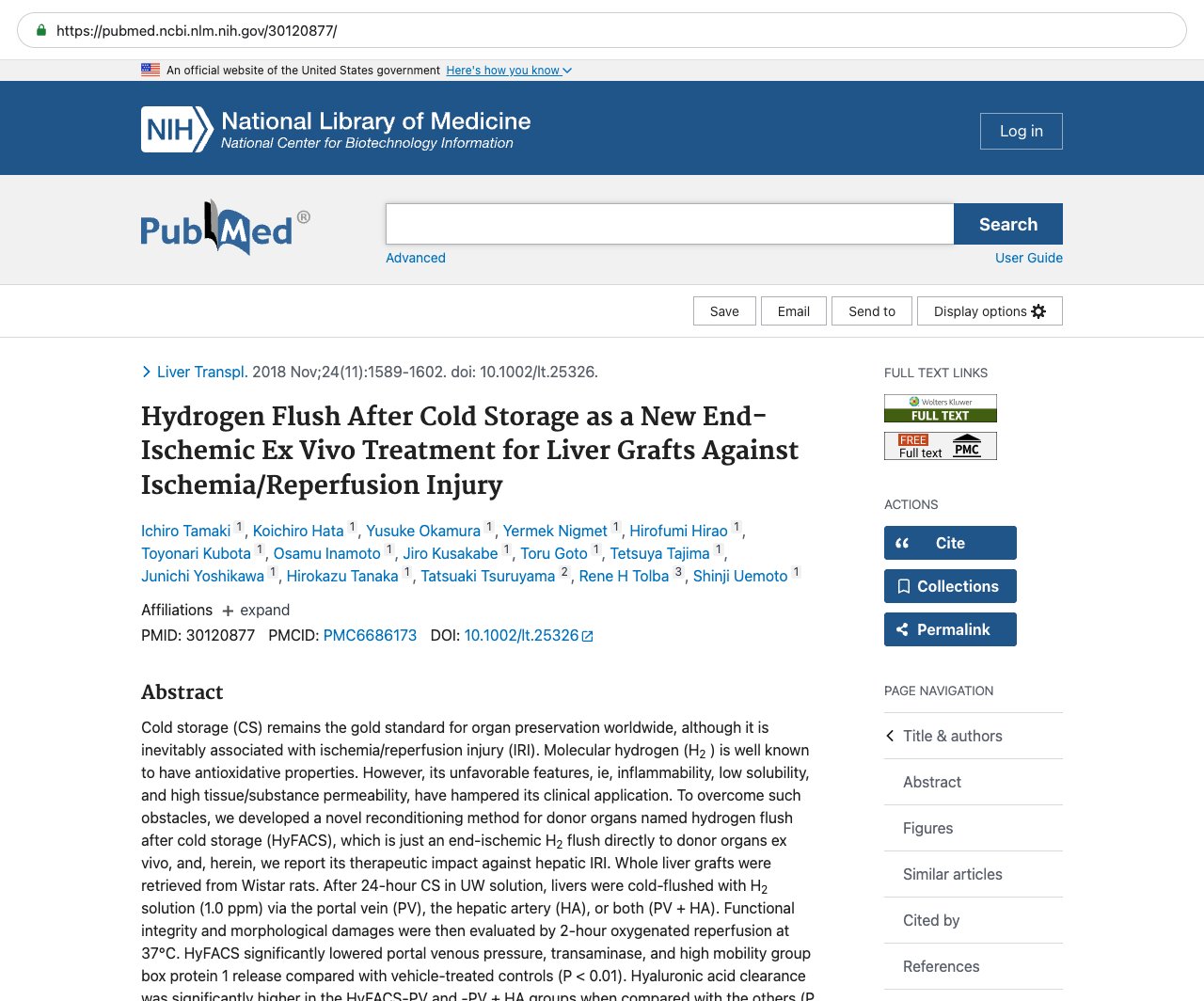
Screenshot of the PubMed page
This page mirrors the published abstract (© the authors / publisher) for reference and citation. The canonical source is the PubMed record linked above. This is not medical advice.