2015 · Song et al. — Molecular hydrogen stabilizes atherosclerotic plaque in low-density lipoprotein receptor-knockout mice.
Super-Abstract
In atherosclerosis-prone mice, molecular hydrogen stabilized vulnerable plaque — increasing collagen content, reducing macrophage infiltration, and suppressing the endoplasmic reticulum stress and oxidative damage that drive plaque rupture. This is a preclinical animal study; its relevance to human cardiovascular disease remains to be established in clinical research. (Free Radical Biology and Medicine, 2015.)
Commentary
Song and colleagues used LDLR-knockout mice fed an atherogenic diet — a well-characterized mouse model for accelerated atherosclerosis. H₂ treatment was compared to simvastatin (a standard cholesterol-lowering drug), and both showed plaque-stabilizing effects. The mechanistic work in cell culture (macrophage-derived foam cells) identified two pathways: suppression of endoplasmic reticulum stress (ERS) and activation of the Nrf2 antioxidant pathway — with Nrf2 siRNA knockdown confirming Nrf2 as a required mediator. The comparison with simvastatin is notable, as it anchors H₂'s effects relative to an established drug. However, LDLR-knockout mice are a specific model with cardiovascular parameters that differ substantially from typical human atherosclerosis.
Key quotes
- „H2 or simvastatin significantly enhanced plaque stability by increasing levels of collagen, as well as reducing macrophage and lipid levels in plaques.“ — the central morphological finding — H₂ compared favorably with a statin drug
- „H2 increased Nrf2 (NF-E2-related factor-2, an important factor in antioxidant signaling) activation and Nrf2 small interfering RNA abolished the protective effect of H2 on ox-LDL-induced cellular ROS production.“ — mechanistic validation: Nrf2 knockdown confirms its role as a required mediator
- „H2 treatment decreased serum ox-LDL level and apoptosis in plaques with concomitant inhibition of endoplasmic reticulum stress (ERS) and reduction of reactive oxygen species (ROS) accumulation in the aorta.“ — multiple parallel mechanisms contributing to plaque stabilization
Our assessment
A well-executed preclinical study in an established atherosclerosis mouse model, showing plaque-stabilizing effects of H₂ comparable to simvastatin with mechanistic support from both in-vivo and in-vitro experiments. This is animal research — the findings cannot be directly applied to human cardiovascular disease. The LDLR-knockout model has known limitations in translating to human plaque biology. The Nrf2 pathway finding and the comparison with an approved drug (simvastatin) make this a strong hypothesis-generating study warranting clinical follow-up investigation.
Study design
- Type: combined animal (in vivo) and cell culture (in vitro) study · Model: LDLR-knockout mice on atherogenic diet; macrophage-derived foam cells (in vitro) · H₂ delivery: daily H₂ dosing (route not specified in abstract); H₂ medium for cell experiments · Comparator: simvastatin
- Result: H₂ and simvastatin both increased plaque collagen, reduced macrophage/lipid content, reduced dendritic cells, increased regulatory T cells; H₂ reduced serum ox-LDL and aortic ROS; inhibited ERS; activated Nrf2 — Nrf2 siRNA abolished protection confirming mechanistic dependence
Abstract
Hydrogen (H(2)) attenuates the development of atherosclerosis in mouse models. We aimed to examine the effects of H(2) on atherosclerotic plaque stability. Low-density lipoprotein receptor-knockout (LDLR(-/-)) mice fed an atherogenic diet were dosed daily with H(2) and/or simvastatin. In vitro studies were carried out in an oxidized-LDL (ox-LDL)-stimulated macrophage-derived foam cell model treated with or without H(2). H(2) or simvastatin significantly enhanced plaque stability by increasing levels of collagen, as well as reducing macrophage and lipid levels in plaques. The decreased numbers of dendritic cells and increased numbers of regulatory T cells in plaques further supported the stabilizing effect of H(2) or simvastatin. Moreover, H(2) treatment decreased serum ox-LDL level and apoptosis in plaques with concomitant inhibition of endoplasmic reticulum stress (ERS) and reduction of reactive oxygen species (ROS) accumulation in the aorta. In vitro, like the ERS inhibitor 4-phenylbutyric acid, H(2) inhibited ox-LDL- or tunicamycin (an ERS inducer)-induced ERS response and cell apoptosis. In addition, like the ROS scavenger N-acetylcysteine, H(2) inhibited ox-LDL- or Cu(2+) (an ROS inducer)-induced reduction in cell viability and increase in cellular ROS. Also, H(2) increased Nrf2 (NF-E2-related factor-2, an important factor in antioxidant signaling) activation and Nrf2 small interfering RNA abolished the protective effect of H(2) on ox-LDL-induced cellular ROS production. The inhibitory effects of H(2) on the apoptosis of macrophage-derived foam cells, which take effect by suppressing the activation of the ERS pathway and by activating the Nrf2 antioxidant pathway, might lead to an improvement in atherosclerotic plaque stability.
Source & links
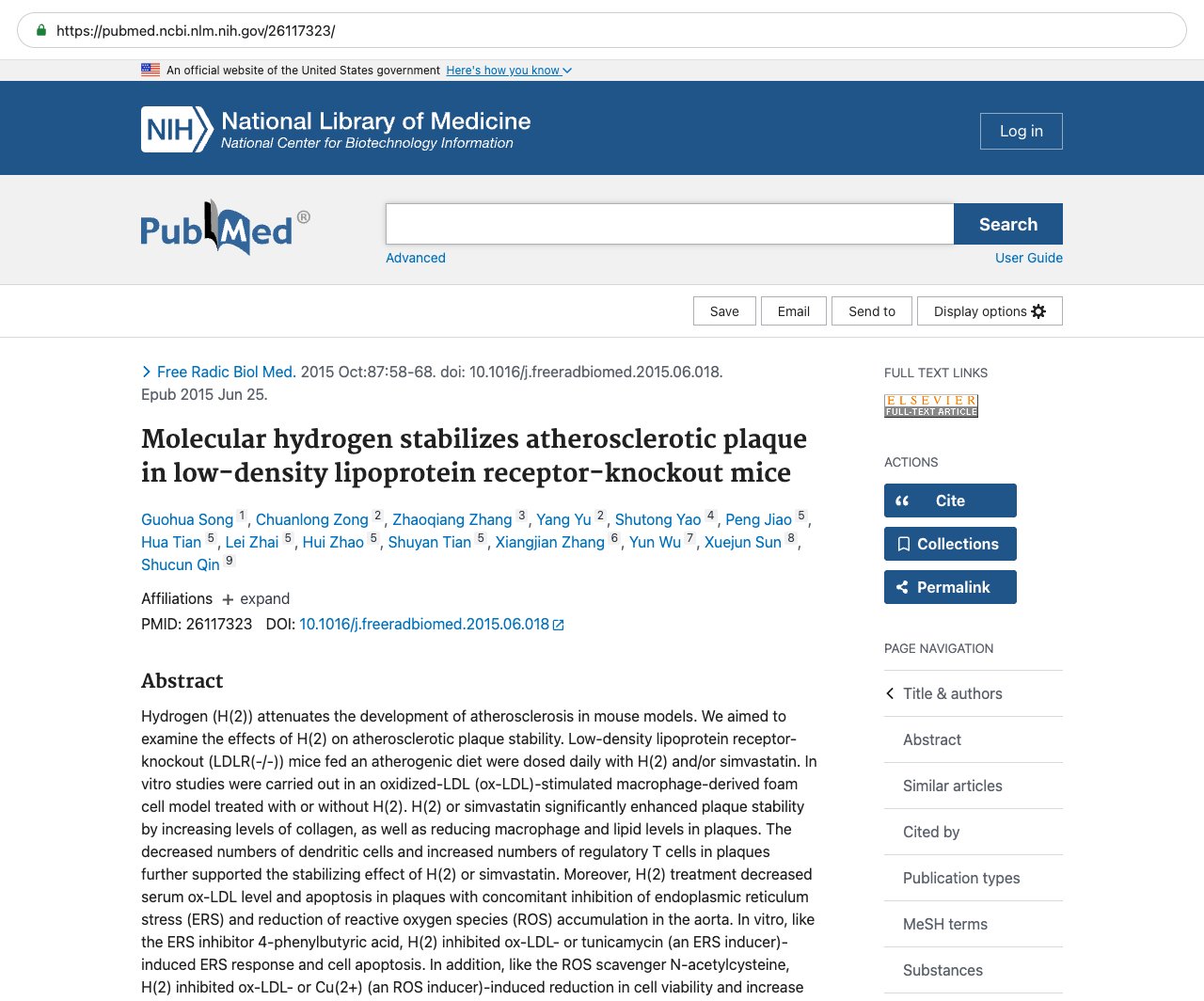
Screenshot of the PubMed page
This page mirrors the published abstract (© the authors / publisher) for reference and citation. The canonical source is the PubMed record linked above. This is not medical advice.