2015 · Xie et al. — Hydrogen-Rich Medium Attenuated Lipopolysaccharide-Induced Monocyte-Endothelial Cell Adhesion and Vascular Endothelial Permeability via Rho-Associated Coiled-Coil Protein Kinase.
Super-Abstract
In LPS-stimulated endothelial cell cultures, hydrogen-rich medium (H₂-RM) blocked monocyte-to-endothelium adhesion, decreased expression of adhesion molecules, and restored vascular barrier function — all via suppression of the ROCK signalling pathway. A parallel effect on neutrophil adhesion was also observed. This is a cell-culture (in-vitro) study; findings cannot be directly applied to human sepsis therapy.
Commentary
Sepsis kills through a cascade of vascular dysfunction: inflammation triggers endothelial ROCK activation, which disrupts cell-cell junctions, increases vascular permeability, and promotes leukocyte adhesion and transmigration — amplifying tissue damage. This study shows that H₂-rich medium can interrupt this cascade at the ROCK level. Key findings: H₂-RM reduced ICAM-1 and VCAM-1 (adhesion molecules), maintained transepithelial/endothelial electrical resistance (TEER — a functional measure of barrier integrity), and preserved VE-cadherin expression. The ROCK inhibitor Y-27632 produced a similar effect, supporting the pathway-specificity of H₂'s action. The mechanism proposed is that H₂ reduces ROS-driven ROCK activation, thereby preserving endothelial junction proteins. This is mechanistically coherent with H₂'s established selective antioxidant effect, but the study is limited to cell culture — no in-vivo verification is provided.
Key quotes
- „hydrogen-rich medium could inhibit adhesion of monocytes to endothelial cells and decrease levels of adhesion molecules, whereas the levels of transepithelial/endothelial electrical resistance values and the expression of vascular endothelial cadherin were increased after hydrogen-rich medium treatment.“ — dual effect: less adhesion, better barrier — the two core in-vitro results
- „hydrogen-rich medium could lessen the expression of ROCK, as a similar effect of its inhibitor Y-27632.“ — mechanistic result: H₂ suppresses ROCK like a specific ROCK inhibitor — pointing to a defined signalling pathway
- „hydrogen-rich medium could regulate adhesion of monocytes/polymorphonuclear neutrophils to endothelial cells and vascular endothelial permeability, and this effect might be related to the decreased expression of ROCK protein.“ — summary conclusion: ROCK downregulation as the probable mechanism
Our assessment
A focused in-vitro mechanistic study with clear, internally consistent results. The ROCK pathway is a well-validated target in vascular biology, and linking H₂'s anti-inflammatory action to ROCK suppression adds mechanistic depth to H₂ research. Limitations are significant: this is a cell-culture study only. LPS stimulation of cultured endothelial cells is a simplification of the complex in-vivo sepsis environment. Whether drinking H₂ water or inhaling H₂ gas achieves sufficient local H₂ concentrations in vascular endothelium in vivo — and whether ROCK suppression mediates this effect in living organisms — is not yet established. These results justify follow-up animal studies.
Study design
- Type: in-vitro cell culture study · Model: vascular endothelial cells + monocytes/PMN neutrophils, LPS stimulation · H₂ delivery: hydrogen-rich medium (concentration not specified in abstract)
- Key endpoints: monocyte/neutrophil adhesion, adhesion molecules (ICAM-1, VCAM-1), TEER, VE-cadherin expression, ROCK protein expression · Result: H₂-RM reduced adhesion and ROCK expression, restored TEER and VE-cadherin — comparable to ROCK inhibitor Y-27632
Abstract
Sepsis is the leading cause of death in critically ill patients. In recent years, molecular hydrogen, as an effective free radical scavenger, has been shown a selective antioxidant and anti-inflammatory effect, and it is beneficial in the treatment of sepsis. Rho-associated coiled-coil protein kinase (ROCK) participates in junction between normal cells, and regulates vascular endothelial permeability. In this study, we used lipopolysaccharide to stimulate vascular endothelial cells and explored the effects of hydrogen-rich medium on the regulation of adhesion of monocytes to endothelial cells and vascular endothelial permeability. We found that hydrogen-rich medium could inhibit adhesion of monocytes to endothelial cells and decrease levels of adhesion molecules, whereas the levels of transepithelial/endothelial electrical resistance values and the expression of vascular endothelial cadherin were increased after hydrogen-rich medium treatment. Moreover, hydrogen-rich medium could lessen the expression of ROCK, as a similar effect of its inhibitor Y-27632. In addition, hydrogen-rich medium could also inhibit adhesion of polymorphonuclear neutrophils to endothelial cells. In conclusion, hydrogen-rich medium could regulate adhesion of monocytes/polymorphonuclear neutrophils to endothelial cells and vascular endothelial permeability, and this effect might be related to the decreased expression of ROCK protein.
Source & links
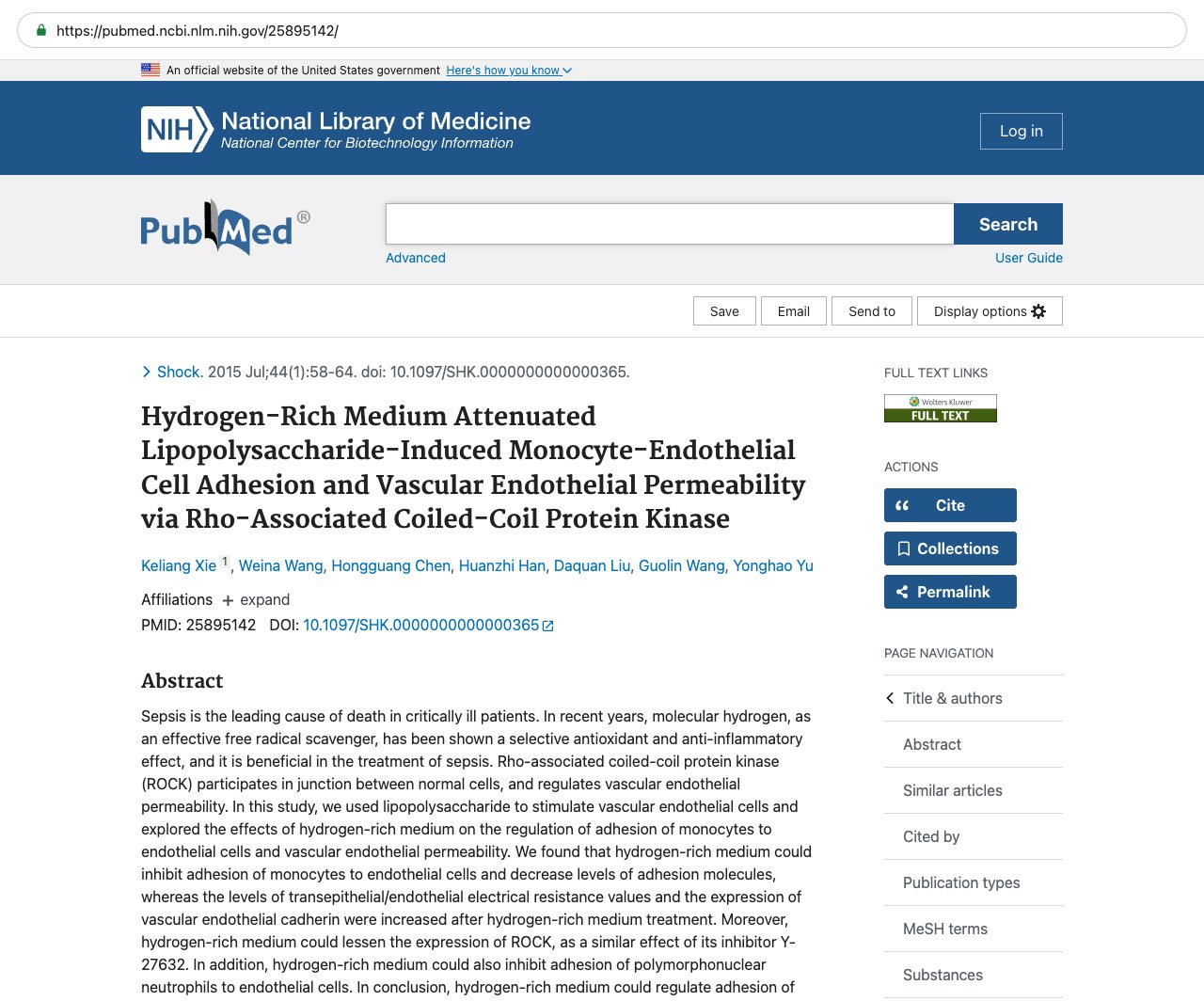
Screenshot of the PubMed page
This page mirrors the published abstract (© the authors / publisher) for reference and citation. The canonical source is the PubMed record linked above. This is not medical advice.