1990 · Gibson — Alternative pathways for hydrogen disposal during fermentation in the human colon.
Super-Abstract
When gut bacteria ferment carbohydrates, they produce hydrogen gas that must be disposed of — and the colon has several competing routes for doing so. This in-vitro study with stool samples from 30 healthy adults found that methanogenesis was the dominant disposal pathway in most people, while sulphate reduction dominated in a minority — with both processes appearing mutually exclusive. (Gut, 1990.)
Commentary
This study used hydrogen gas as a tracer/metabolic product in the context of colonic microbiology — not as a therapeutic agent. The researchers incubated faecal slurries with starch substrate and quantified the competing fates of microbially produced H₂: methane formation, sulphate reduction to H₂S, and acetogenesis. The finding that methanogenesis and sulphate reduction appear mutually exclusive — likely governed by sulphate availability and colonic pH — has implications for understanding gut microbiome diversity and individual variation in breath hydrogen tests. This work is foundational microbiology with no therapeutic angle; its relevance to molecular hydrogen research lies in explaining why breath H₂ excretion varies enormously between individuals.
Key quotes
- „Sulphate reduction and methanogenesis seem to be mutually exclusive in the colon and this is probably linked to sulphate availability.“ — key structural finding about competing H₂ disposal pathways
- „Sulphate reduction, methanogenesis, and acetogenesis were strongly influenced by pH.“ — pH as a master regulator of which pathway dominates
- „a number of competing pathways for hydrogen disposal are possible in the large gut and that a variety of factors such as colonic pH and sulphate availability can determine which of these mechanisms predominates.“ — conclusion: individual variation in H₂ disposal is explained by colonic conditions
Our assessment
This is a foundational in-vitro microbiology study — not a therapeutic investigation. It helps explain why breath hydrogen tests show wide inter-individual variation: some people are „methane producers“, others are „sulphate reducers“, and only a small fraction excretes large amounts of H₂ in breath. Limitation: stool slurry experiments do not fully replicate in-vivo colonic conditions. The study provides mechanistic context for hydrogen metabolism in the gut but offers no evidence on therapeutic H₂ use in humans or animals.
Study design
- Type: in-vitro study (ex-vivo faecal slurry incubation) · n: 30 healthy adult stool donors · H₂ source: endogenous microbial fermentation of Lintner's starch substrate
- Result: methanogenesis was dominant in 23/30 subjects; high sulphate reduction (with elevated H₂S) in 7/30; acetogenesis low in all groups; sulphate reduction and methanogenesis mutually exclusive, regulated by pH and sulphate availability
Abstract
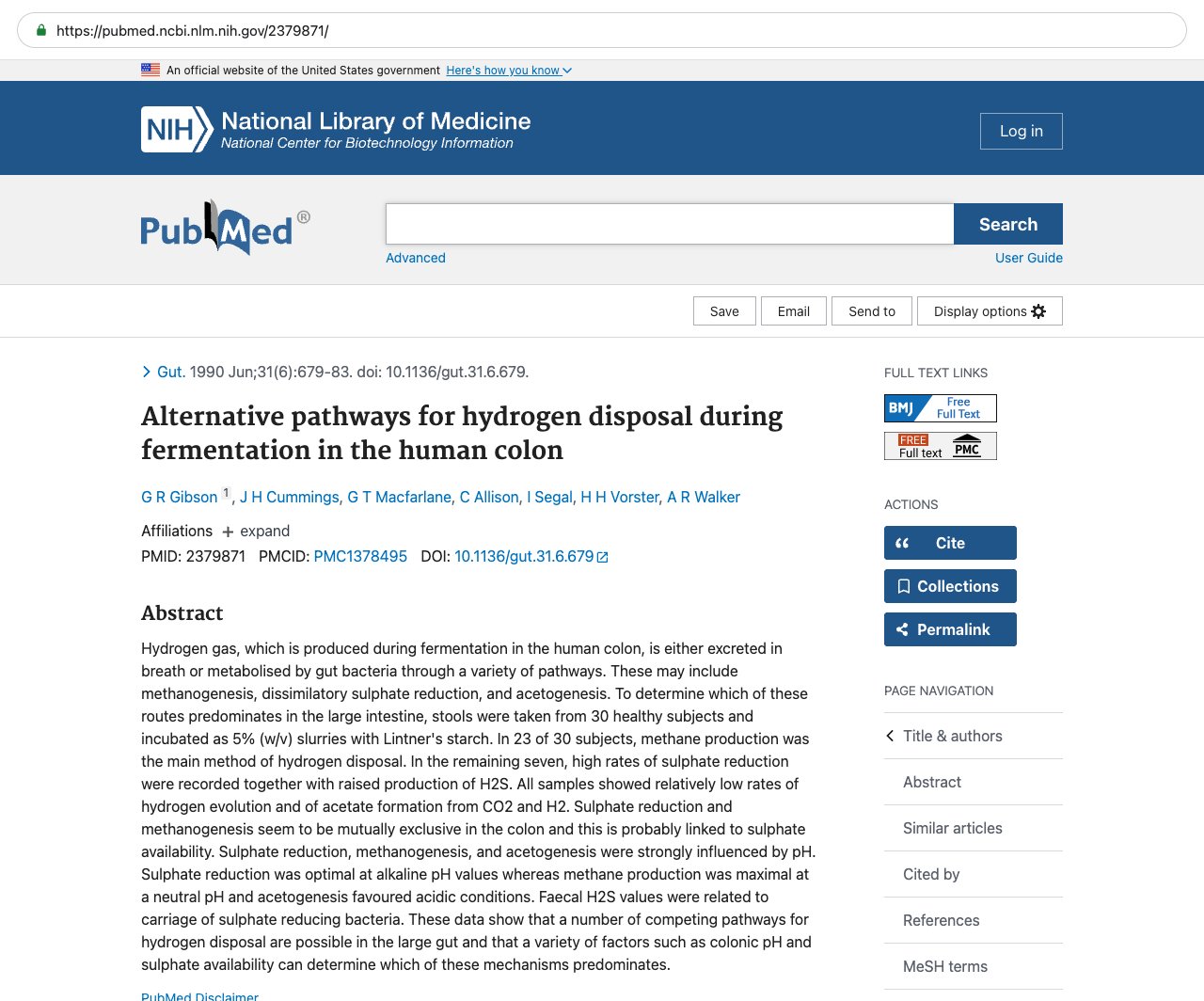
Hydrogen gas, which is produced during fermentation in the human colon, is either excreted in breath or metabolised by gut bacteria through a variety of pathways. These may include methanogenesis, dissimilatory sulphate reduction, and acetogenesis. To determine which of these routes predominates in the large intestine, stools were taken from 30 healthy subjects and incubated as 5% (w/v) slurries with Lintner's starch. In 23 of 30 subjects, methane production was the main method of hydrogen disposal. In the remaining seven, high rates of sulphate reduction were recorded together with raised production of H2S. All samples showed relatively low rates of hydrogen evolution and of acetate formation from CO2 and H2. Sulphate reduction and methanogenesis seem to be mutually exclusive in the colon and this is probably linked to sulphate availability. Sulphate reduction, methanogenesis, and acetogenesis were strongly influenced by pH. Sulphate reduction was optimal at alkaline pH values whereas methane production was maximal at a neutral pH and acetogenesis favoured acidic conditions. Faecal H2S values were related to carriage of sulphate reducing bacteria. These data show that a number of competing pathways for hydrogen disposal are possible in the large gut and that a variety of factors such as colonic pH and sulphate availability can determine which of these mechanisms predominates.
Source & links
Screenshot of the PubMed page
This page mirrors the published abstract (© the authors / publisher) for reference and citation. The canonical source is the PubMed record linked above. This is not medical advice.