2026 · Grepl — Sixty-minute inhalation of molecular hydrogen decreases blood oxygen saturation but does not alter autonomic cardiac regulation at rest in healthy females: a randomized, double-blind, placebo-controlled crossover study
Super-Abstract
One hour of H₂ inhalation at rest lowers blood oxygen saturation minimally (95.9% vs. 96.7%, p ≤ 0.007) without altering autonomic cardiac regulation. In a double-blind placebo crossover in 20 healthy women, the drop was statistically significant but clinically meaningless — heart rate variability stayed unchanged. (Canadian Journal of Physiology and Pharmacology, 2026.)
Commentary
This is an honest, „sober“ safety and physiology study — important because it shows what H₂ does NOT do at rest. Design: randomized, double-blind, placebo-controlled, crossover. 20 physically active women (22 years) inhaled either molecular hydrogen or ambient air as placebo for 60 minutes on two occasions, with seven days of washout in between. Oxygen saturation and heart rate variability were monitored continuously. Result: oxygen saturation fell under H₂ statistically significantly from 96.7% to 95.9% (p ≤ 0.007) — but, the authors stress explicitly, this drop is clinically irrelevant and does not endanger homeostasis. In autonomic cardiac regulation (heart rate variability, time and frequency domain) there was no change whatsoever (all p ≥ 0.32). Why this is valuable: it is a clean safety data point for H₂ inhalation and at the same time a reminder of scientific honesty — not every effect shows a benefit; here what shows above all is harmlessness. Honestly: small sample (n = 20), only healthy young women, only resting conditions.
Key quotes
- „a statistically significant (p ≤ 0.007) decrease in oxygen saturation during molecular hydrogen inhalation (95.9 ± 1.0%) compared to placebo (96.7 ± 0.7%), but this decrease should not be considered clinically significant.“ — significant, but clinically meaningless
- „No significant changes (all p ≥ 0.32) were observed in time-domain or frequency-domain heart rate variability indices.“ — no effect on autonomic cardiac regulation
- „molecular hydrogen inhalation does not induce functional changes in autonomic cardiac regulation, and the observed reduction in blood oxygen saturation does not compromise homeostatic stability.“ — the core safety statement
Our assessment
This study is valuable as safety and mechanism evidence: it shows that H₂ inhalation at rest does not disturb cardiovascular autonomy and only causes a clinically insignificant drop in saturation. Exactly such „negative/null findings“ strengthen the credibility of the H₂ topic, because they show that research does not report only positive results. Notable as sober evidence of the harmlessness of H₂ inhalation at rest. Limitation, stated honestly: very small sample (n = 20), only healthy young women, only rest (no exertion) — no statement on therapeutic benefit. Clean RCT design (evidence level 3).
Study design
- Type: RCT, randomized/double-blind/placebo-controlled, crossover · n: 20 (physically active women, 22.1 ± 1.6 years) · Duration: 2 × 60 min inhalation, 7-day washout · H₂ delivery: inhalation (vs. ambient air as placebo)
- Result figures: SpO₂ H₂ 95.9 ± 1.0% vs. placebo 96.7 ± 0.7% (p ≤ 0.007, clinically not relevant); HRV indices unchanged (all p ≥ 0.32)
Abstract
Molecular hydrogen has gained attention for its potential antioxidant, anti-inflammatory, and ergogenic effects. However, its impact on blood oxygen saturation and autonomic cardiac regulation under resting conditions remains unclear. This randomized, double-blind, placebo-controlled crossover study investigated the effects of a 60 min molecular hydrogen inhalation on oxygen saturation and heart rate variability in healthy females. Twenty physically active participants (22.1 ± 1.6 years) completed two inhalation sessions with either molecular hydrogen or placebo (ambient air), separated by a 7-day washout period. Oxygen saturation and heart rate variability were continuously monitored during the 60 min of inhalation. The results using 60 min averages showed a statistically significant (p ≤ 0.007) decrease in oxygen saturation during molecular hydrogen inhalation (95.9 ± 1.0%) compared to placebo (96.7 ± 0.7%), but this decrease should not be considered clinically significant. No significant changes (all p ≥ 0.32) were observed in time-domain or frequency-domain heart rate variability indices. These findings suggest that, under resting conditions, molecular hydrogen inhalation does not induce functional changes in autonomic cardiac regulation, and the observed reduction in blood oxygen saturation does not compromise homeostatic stability.
Source & links
Screenshot of the PubMed page
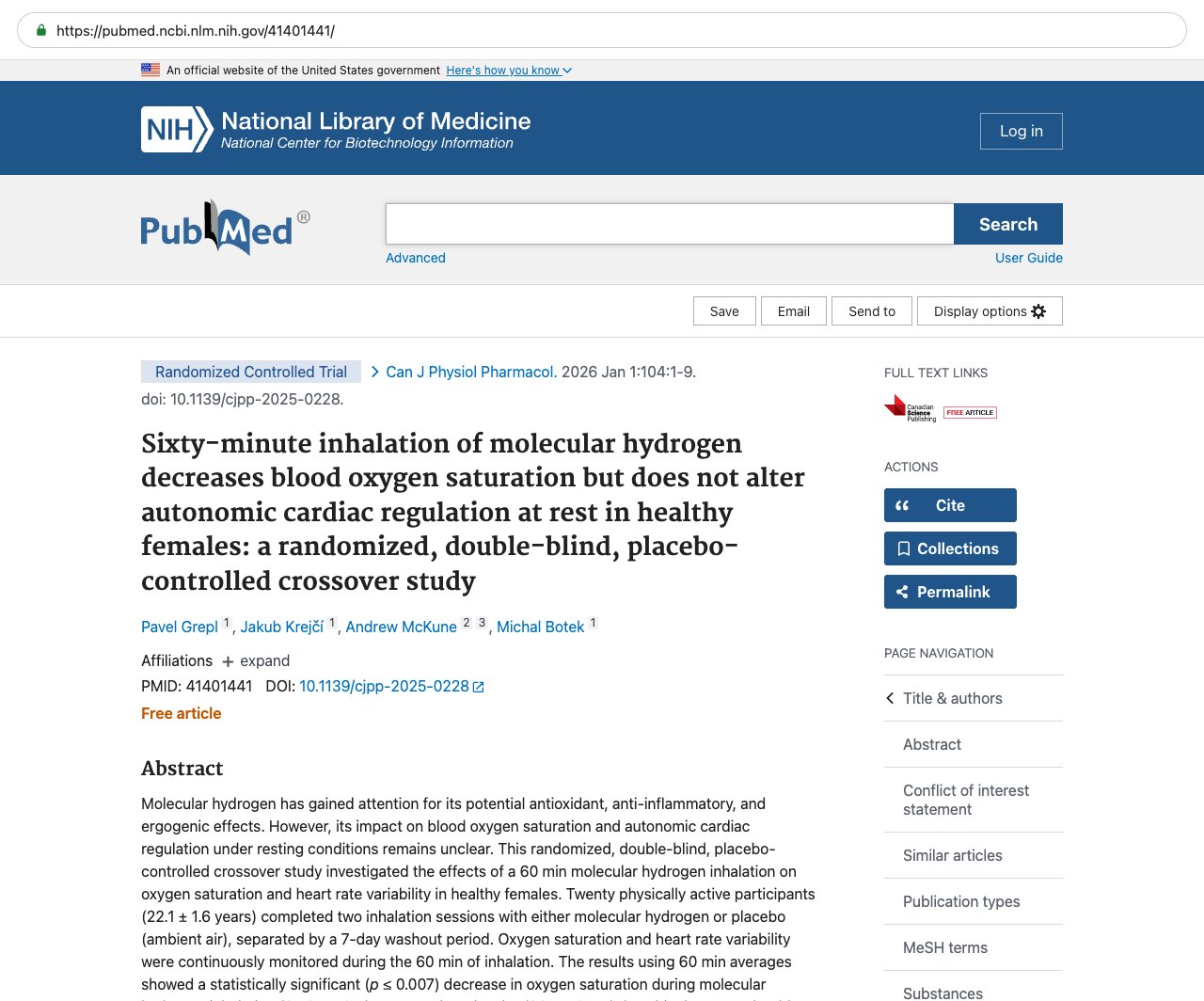
This page mirrors the published abstract (© the authors / publisher) for reference and citation. The canonical source is the PubMed record linked above. This is not medical advice.