2015 · Guan et al. — Effects of vitamin C, vitamin E, and molecular hydrogen on the placental function in trophoblast cells.
Super-Abstract
In cultured trophoblast cell lines, high doses of vitamins C and E reduced cell viability and increased the pro-inflammatory cytokine TNF-α — whereas molecular hydrogen (H₂) at equivalent concentrations did neither, suggesting a more favourable safety profile for H₂ as an antioxidant in placental biology. However, H₂ did suppress hCG secretion, warranting further investigation. These are in-vitro findings only; no human pregnancy data.
Commentary
Preeclampsia is a serious hypertensive disorder of pregnancy linked to placental oxidative stress. Antioxidant supplementation has been proposed as a protective strategy, but trials with vitamins C and E have been disappointing or even harmful. This cell culture study systematically compares the effects of the three antioxidants (vitamin C, vitamin E, molecular H₂) on two trophoblast cell lines (JAR and JEG-3) across a wide concentration range. The findings challenge the safety of high-dose vitamins C and E for placental cells: at 500 µmol/L, both vitamins suppressed cell viability and vitamin C/E at lower doses already elevated TNF-α expression — a pro-inflammatory signal. H₂ (up to 500 µmol/L) did not affect cell proliferation or TNF-α expression, but did suppress hCG secretion at 50–500 µmol/L. hCG is a key hormone for early pregnancy maintenance; its suppression by H₂ is an unexpected finding that adds a cautionary note. The authors conclude H₂ is a candidate for managing oxidative stress in preeclampsia but explicitly state it needs further study. Importantly, this is an in-vitro study — trophoblast cell lines do not fully replicate complex human placental physiology.
Key quotes
- „Cell viability was significantly suppressed by 500 μmol/L vitamins C and E (P < 0.05), but not by 500 μmol/L molecular hydrogen (P > 0.05).“ — key safety comparison: high-dose vitamins C/E harm cells; equivalent H₂ does not
- „The expression of TNF-α was increased by 100 μmol/L vitamin C and 50 μmol/L vitamins E, separately or combined (P < 0.05), but not by molecular hydrogen (0-500 μmol/L).“ — inflammatory marker result: vitamins C and E raise TNF-α; H₂ does not
- „hydrogen showed no such effects on cell proliferation and TNF-α expression, but it could affect the level of hCG, indicating hydrogen as a potential candidate of antioxidant in the management of preeclampsia (PE) should be further studied.“ — balanced conclusion: H₂ looks safer than vitamins for most endpoints but the hCG effect requires follow-up
Our assessment
A useful in-vitro comparative study that provides a mechanistic rationale for why H₂ may be a safer antioxidant option than vitamins C and E in placental biology. The safety advantage (no cytotoxicity, no TNF-α elevation) is a meaningful differentiator. However, the unexpected suppression of hCG secretion by H₂ is an important cautionary finding that has not yet been explained or replicated. This study is strictly in-vitro — cell lines do not capture the full complexity of human placenta. No conclusions about safety or efficacy in pregnant women can be drawn. Further animal and clinical studies are required.
Study design
- Type: in-vitro cell culture study · Model: human trophoblast cell lines JAR and JEG-3 · H₂ delivery: dissolved molecular H₂ in culture medium (0–500 µmol/L for 48 h)
- Comparators: vitamin C (0–5,000 µmol/L), vitamin E (0–5,000 µmol/L) · Endpoints: cell viability (MTS assay), hCG secretion, TNF-α secretion + mRNA (real-time RT-PCR) · Result: H₂ safe at all doses for viability/TNF-α; suppresses hCG at ≥50 µmol/L; vitamins C/E harm cells and raise TNF-α at high doses
Abstract
AIM: This study aimed to investigate the effects of three different antioxidants, namely vitamin C, vitamin E, and molecular hydrogen, on cytotrophoblasts in vitro. METHODS: Two trophoblast cell lines, JAR and JEG-3, were exposed to different concentrations of vitamin C (0, 25, 50, 100, 500, 1,000, 5,000 μmol/L), vitamin E (0, 25, 50, 100, 500, 1,000, 5,000 μmol/L), and molecular hydrogen (0, 25, 50, 100, 500 μmol/L) for 48 h. The cell viability was detected using the MTS assay. The secretion of human chorionic gonadotropin (hCG) and the tumor necrosis factor-α (TNF-α) were assessed and the expression of TNF-α mRNA was observed by real-time RT-PCR. RESULTS: Cell viability was significantly suppressed by 500 μmol/L vitamins C and E (P < 0.05), but not by 500 μmol/L molecular hydrogen (P > 0.05). The expression of TNF-α was increased by 100 μmol/L vitamin C and 50 μmol/L vitamins E, separately or combined (P < 0.05), but not by molecular hydrogen (0-500 μmol/L), as validated by real-time RT-PCR. But the secretion of hCG was both inhibited by 50-500 μmol/L molecular hydrogen and high levels of vitamin C and E, separately or combined. CONCLUSION: High levels of antioxidant vitamins C and E may have significant detrimental effects on placental function, as reflected by decreased cell viability and secretion of hCG; and placental immunity, as reflected by increased production of TNF-a. Meanwhile hydrogen showed no such effects on cell proliferation and TNF-α expression, but it could affect the level of hCG, indicating hydrogen as a potential candidate of antioxidant in the management of preeclampsia (PE) should be further studied.
Source & links
Screenshot of the PubMed page
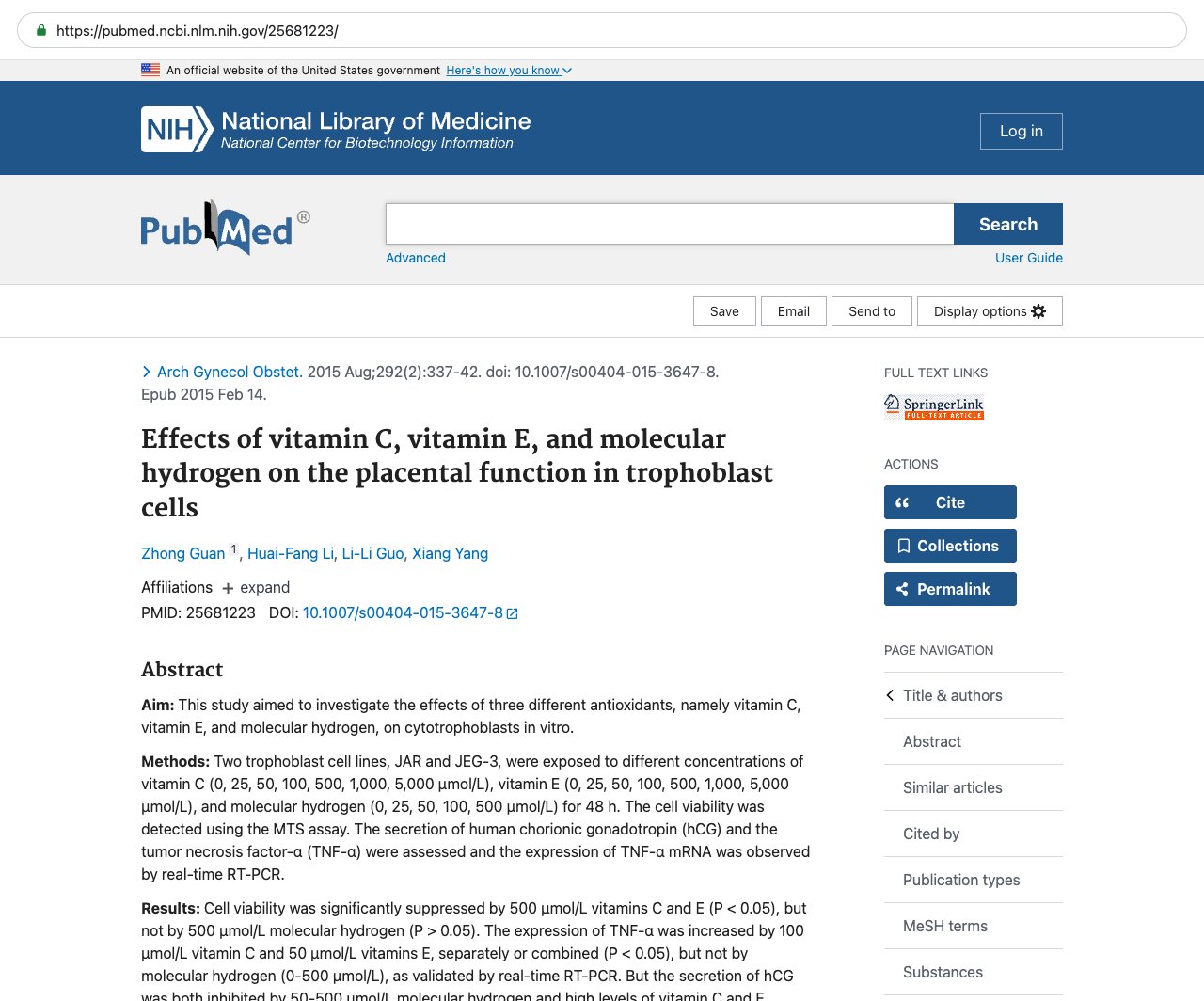
This page mirrors the published abstract (© the authors / publisher) for reference and citation. The canonical source is the PubMed record linked above. This is not medical advice.