2023 Biomedicine & pharmacotherapy = Biomedecine & pharmacotherapie Review / Meta-analysis Unspecified
2023 · He et al. — The Role of Hydrogen Therapy in Alzheimer's Disease Management: Insights into Mechanisms, Administration Routes, and Future Challenges
Super-Abstract
This review comprehensively examines the therapeutic potential of molecular hydrogen in Alzheimer's disease (AD), focusing on how H₂ may counteract key pathological processes including oxidative stress, amyloid-beta metabolism, tau phosphorylation, neuroinflammation, and mitochondrial dysfunction. The authors survey mechanisms of action and routes of administration, and discuss the current challenges and future prospects for clinical application. No new experimental data are generated — this is a literature synthesis.
Commentary
Alzheimer's disease presents one of medicine's most stubborn therapeutic challenges: despite decades of research, pharmacological options remain limited and often burdened by side effects. Oxidative stress is increasingly recognised as a central — though not sole — driver of AD pathology, making antioxidant strategies a logical target. This review situates H₂ within that context, tracing how its selective radical-scavenging (particularly against hydroxyl radicals and peroxynitrite) and anti-neuroinflammatory effects could theoretically intersect with multiple AD pathways simultaneously. The breadth of mechanisms covered — amyloid-beta, tau, autophagy, mitochondria, synaptic dysfunction — is the review's conceptual strength. However, the human clinical evidence base for H₂ specifically in AD is still very thin: most data come from animal models, and the few human studies are small and preliminary. The authors acknowledge this gap and frame their review as an agenda-setter for future research rather than a clinical endorsement.
Key quotes
- „Oxidative stress has been identified as a central player in AD pathology, influencing various aspects including amyloid-beta metabolism, tau phosphorylation, autophagy, neuroinflammation, mitochondrial dysfunction, and synaptic dysfunction.“ — the rationale for H₂ in AD: oxidative stress touches every major pathological pathway
- „Among the emerging non-drug approaches, hydrogen therapy has garnered attention for its potential in mitigating these pathological conditions.“ — H₂ is positioned as a non-pharmacological candidate among emerging AD interventions
- „We delve into its mechanisms of action, administration routes, and discuss the current challenges and future prospects, with the aim of providing valuable insights to facilitate the clinical application of hydrogen-based therapies in AD management.“ — the stated aim: a practical roadmap for clinical research, not a treatment recommendation
Our assessment
A well-structured review situating H₂ therapy within the complex molecular landscape of Alzheimer's disease. The mechanistic coverage is broad and scientifically grounded. Honest limitation: this is a review article, not an experimental study. Human clinical evidence for H₂ in AD specifically remains sparse. The review is best read as a research agenda and mechanistic framework — not as clinical guidance. The gap between mechanistic plausibility and proven efficacy in AD patients has not yet been bridged.
Study design
- Type: narrative review · n: n/a (literature synthesis) · H₂ delivery: multiple routes reviewed
- Focus: mechanisms (ROS scavenging, anti-neuroinflammation, amyloid/tau modulation, mitophagy, synaptic protection) + administration routes + clinical challenges in Alzheimer's disease
- Result: mechanistic rationale well-supported by preclinical evidence; human clinical data in AD remain limited; authors call for controlled human trials
Abstract
Alzheimer's disease (AD) is a progressive neurodegenerative disorder predominantly affecting the elderly. While conventional pharmacological therapies remain the primary treatment for AD, their efficacy is limited effectiveness and often associated with significant side effects. This underscores the urgent need to explore alternative, non-pharmacological interventions. Oxidative stress has been identified as a central player in AD pathology, influencing various aspects including amyloid-beta metabolism, tau phosphorylation, autophagy, neuroinflammation, mitochondrial dysfunction, and synaptic dysfunction. Among the emerging non-drug approaches, hydrogen therapy has garnered attention for its potential in mitigating these pathological conditions. This review provides a comprehensively overview of the therapeutic potential of hydrogen in AD. We delve into its mechanisms of action, administration routes, and discuss the current challenges and future prospects, with the aim of providing valuable insights to facilitate the clinical application of hydrogen-based therapies in AD management.
Source & links
Screenshot of the PubMed page
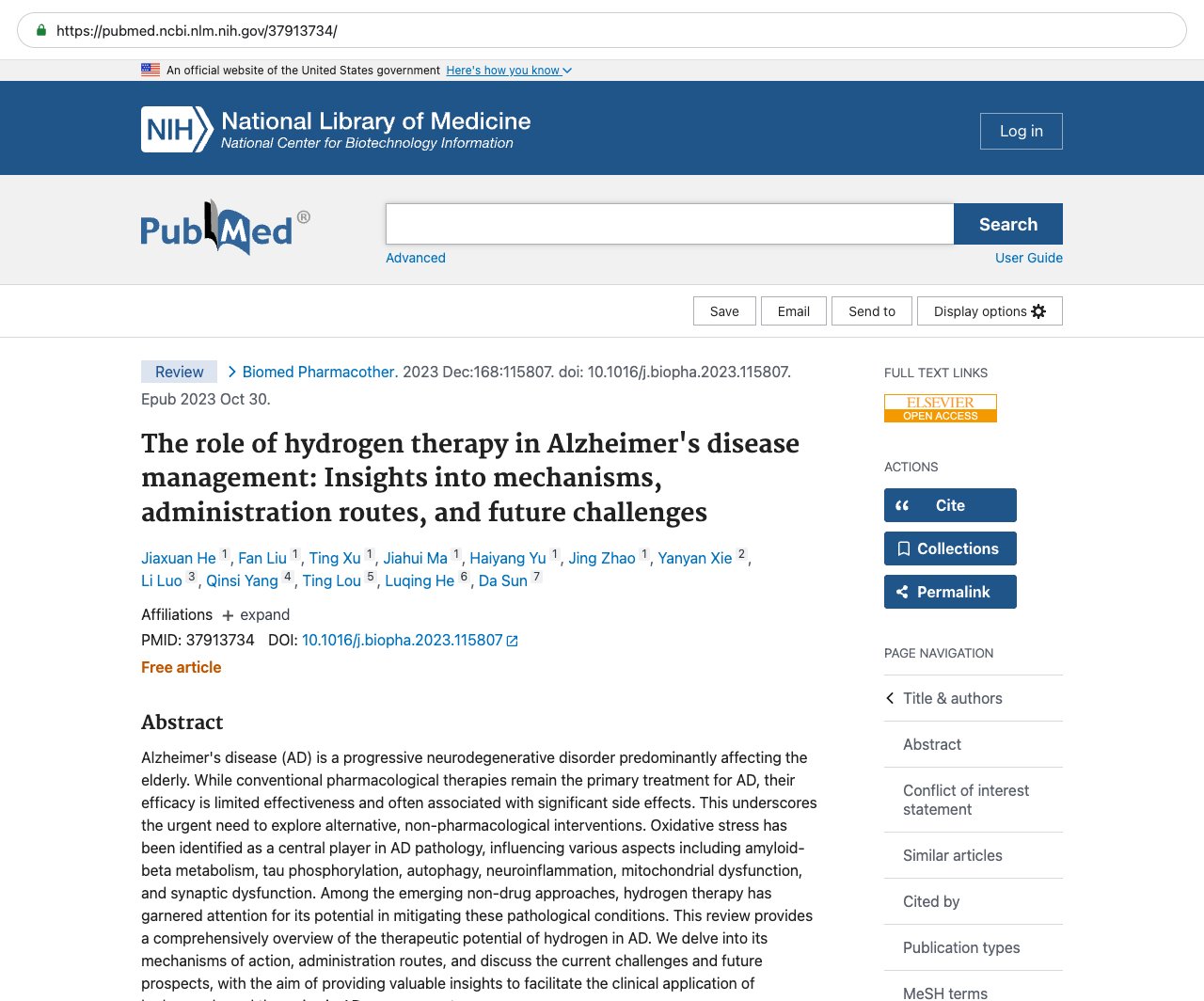
This page mirrors the published abstract (© the authors / publisher) for reference and citation. The canonical source is the PubMed record linked above. This is not medical advice.