2026 · Dumbuya — The protective effects of molecular hydrogen in sepsis-associated encephalopathy: current status.
Super-Abstract
Sepsis-associated encephalopathy (SAE) — brain dysfunction that develops during severe infections — currently has no specific approved therapy. This review summarizes preclinical evidence that molecular hydrogen (H₂) may help by reducing oxidative stress, neuroinflammation, and mitochondrial damage in the brain. No human clinical trial data for H₂ in SAE is presented; existing evidence comes from animal models only. Treatment protocols are not yet standardized. (European Journal of Pharmacology, 2026.)
Commentary
SAE is a common, severe, and poorly treated complication of sepsis — cognitive impairment can persist long after the acute infection resolves. This review provides a structured overview of the proposed neuroprotective mechanisms of H₂ in this context: scavenging reactive oxygen species, suppressing glial cell activation, and protecting mitochondrial function. The paper is honest about the current state: evidence is entirely preclinical, dosing and delivery protocols vary across studies, and long-term effects are unknown. The conclusion that H₂ is 'well-tolerated with minimal adverse effects' reflects animal safety data, not established human safety in the SAE context. This is a useful map of the research landscape, but not a basis for clinical H₂ use in sepsis patients.
Key quotes
- „Mechanisms contributing to SAE include oxidative stress, inflammation, mitochondrial dysfunction, and blood-brain barrier disruption.“ — context: why SAE is difficult to treat and where H₂ might intervene
- „variations in treatment protocols (such as dosage, delivery methods, and administration routes) limit the generalizability of findings.“ — honest limitation acknowledged by the authors: no standard protocol exists
- „H2 therapy is well-tolerated with minimal adverse effects.“ — safety summary from animal data — not yet established in human SAE trials
Our assessment
Evidence level: narrative review (EV 4). No original experimental data; synthesis of preclinical animal literature only. This is a useful orientation paper that accurately maps the proposed mechanisms and current research gaps. Limitations clearly stated: zero human intervention trials in SAE; heterogeneous animal study protocols make cross-study comparison difficult; optimal dose, timing, and administration route remain undefined; no long-term safety data in humans. Bottom line: H₂ is a plausible but entirely unproven candidate for SAE neuroprotection — much more research is needed before any clinical translation.
Study design
- Type: narrative review · n: n/a (literature synthesis) · H₂ delivery: inhalation and other routes reviewed across animal studies
- Result: no pooled effect sizes; narrative summary of preclinical neuroprotective effects (anti-oxidant, anti-inflammatory, mitochondrial protection); honest acknowledgment that protocol standardization is lacking and human evidence is absent
Abstract
Sepsis-associated encephalopathy (SAE) is a severe neurological complication that arises in patients with sepsis, characterised by cognitive impairment and neurological dysfunction. Mechanisms contributing to SAE include oxidative stress, inflammation, mitochondrial dysfunction, and blood-brain barrier disruption. Recent studies indicate that molecular hydrogen (H2) offers therapeutic benefits for SAE due to its antioxidant and anti-inflammatory properties. H2 therapy has shown promise in alleviating oxidative stress, neuroinflammation, and neuronal damage linked to SAE, primarily through scavenging reactive oxygen species, suppressing astrocyte and microglia activation, and mitigating mitochondrial dysfunction. However, variations in treatment protocols (such as dosage, delivery methods, and administration routes) limit the generalizability of findings. Despite these challenges, H2 therapy is well-tolerated with minimal adverse effects. This review synthesises the current evidence on H2 therapy in SAE and highlights key directions for future research, focusing on standardising protocols, optimising treatment regimens, and investigating long-term impacts.
Source & links
Screenshot of the PubMed page
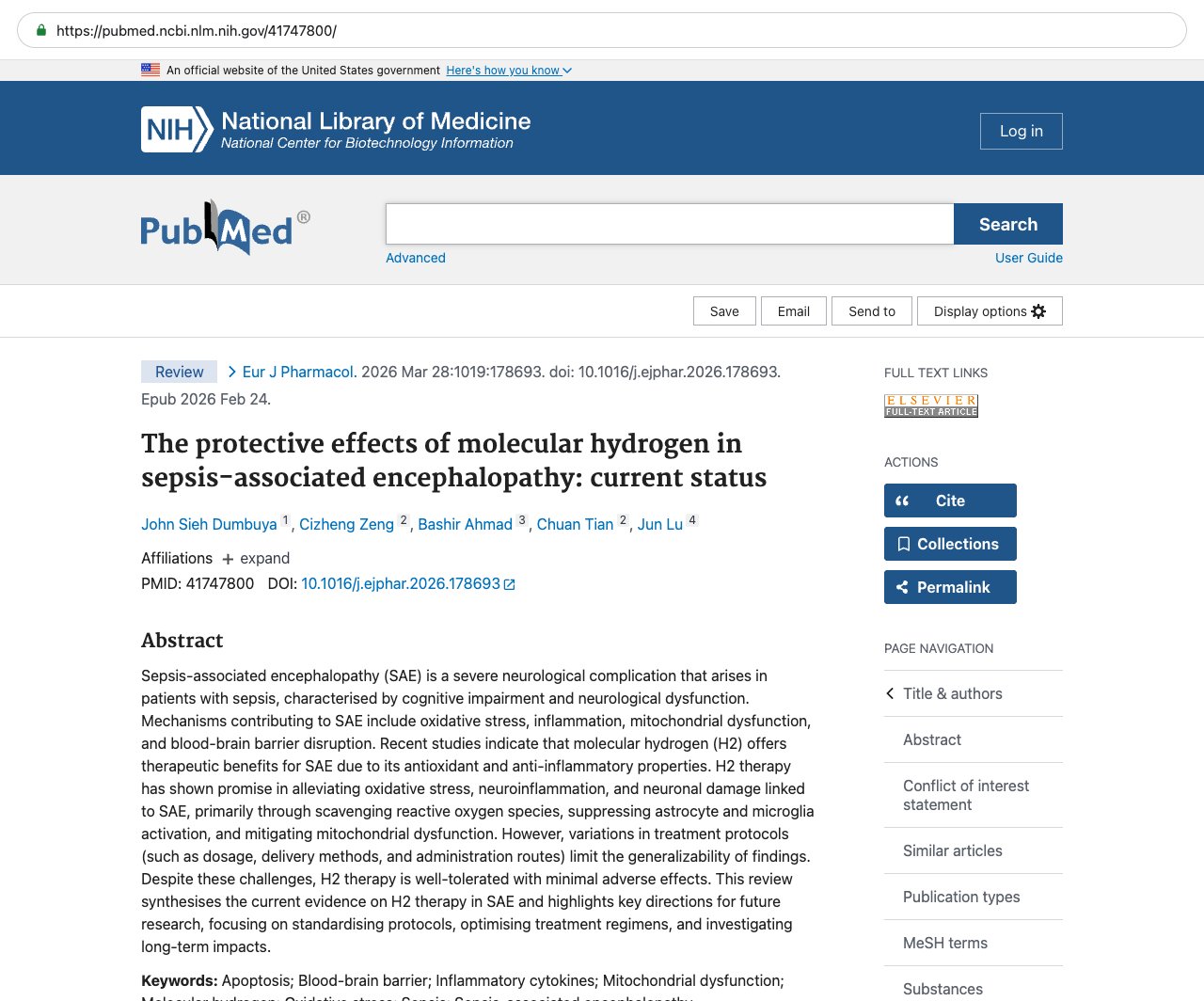
This page mirrors the published abstract (© the authors / publisher) for reference and citation. The canonical source is the PubMed record linked above. This is not medical advice.