2021 · Hirano — Protective effects of hydrogen gas inhalation on radiation-induced bone marrow damage in cancer patients: a retrospective observational study
Super-Abstract
Hydrogen inhalation mitigated bone marrow damage from irradiation — without weakening the tumor effect. In cancer patients undergoing intensity-modulated radiotherapy, 5% H₂ gas significantly limited the drop in white blood cells and platelets (p = 0.0011 and p = 0.0275, respectively). (Medical Gas Research, 2021 — small retrospective observational study.)
Commentary
Modern radiotherapy (IMRT) is more precise than before but still damages the bone marrow — blood formation suffers. This study from a clinic in Tokyo retrospectively examined whether H₂ gas mitigates this. Two groups were compared: a control group (n = 7) received 30 minutes of mild hyperbaric oxygen therapy after each irradiation, while the H₂ group (n = 16) instead breathed 5% H₂ gas for 30 minutes. The result: in both groups, white blood cells and platelets dropped due to irradiation — but markedly less so in the H₂ group (white blood cells p = 0.0011, platelets p = 0.0275). Red blood cells, hemoglobin and hematocrit remained unaffected. Crucial for oncology: the tumor's response to irradiation was similar in both groups — so H₂ protected the healthy tissue without sabotaging the therapeutic effect. Honestly though: this is a small retrospective observational study (only 23 patients in total), not a randomized trial. The groups differed in age, and the control received a different treatment (oxygen) instead of a true placebo. For robust proof, controlled studies are needed.
Key quotes
- „H2 gas treatment significantly alleviates the reducing effects of white blood cells and platelets (P = 0.0011 and P = 0.0275, respectively).“ — significantly smaller drop in leukocytes and platelets under H₂
- „Tumor responses to IMRT were similar between the two groups.“ — no indication that H₂ weakens the radiation's anti-tumor effect
- „H2 gas inhalation therapy alleviated IMRT-induced bone marrow damage without compromising the anti-tumor effects of IMRT.“ — the core message: protecting the bone marrow without losing radiation efficacy
Our assessment
Highly relevant for the narrative „H₂ selectively protects healthy tissue“ — here specifically as an adjunct therapy to cancer treatment. The argument „mitigates side effects without weakening the therapy“ is strong because it addresses exactly the concern that an antioxidant might neutralize the radiation effect. Mechanistically it fits Ohsawa 2007 (selective scavenging of hydroxyl radical and peroxynitrite). Limitations honestly: retrospective, very small (n = 16 vs. 7), no randomization, no true placebo control (comparison group received hyperbaric oxygen), differing age distribution. Classified as pilot/observational evidence. Important: no promise of cure — H₂ does not replace oncological therapy but is only studied here as a supportive measure.
Study design
- Type: retrospective observational study (two arms, non-randomized) · n: 23 (H₂ = 16, control = 7) · Duration: IMRT once daily over 1–4 weeks; H₂ for 30 min after each irradiation · H₂ delivery: inhalation of 5% H₂ gas in a health-care chamber (control: mild hyperbaric oxygen therapy)
- Result: significantly smaller drop in leukocytes (p = 0.0011) and platelets (p = 0.0275) in the H₂ group; erythrocytes/hemoglobin/hematocrit unchanged; comparable tumor response in both groups
Abstract
Although intensity-modulated radiation therapy (IMRT) has been developed as an alternative to conventional radiotherapy, reducing bone marrow damage is limited. Thus, a novel technology is needed to further mitigate IMRT-induced bone marrow damage. Molecular hydrogen (H2) was recently reported as a preventive and therapeutic antioxidant that selectively scavenges hydroxyl radical (·OH) and peroxynitrite (ONOO-). This observational study aimed to examine whether H2 gas treatment improves IMRT-induced bone marrow damage in cancer patients. The study was performed at Clinic C4 in Tokyo, Japan between May 2015 and November 2016. During this period, all enrolled patients received IMRT once per day for 1 to 4 weeks. After each time of IMRT, the patients of control group (n = 7, 3 men and 4 women, age range: 26-70 years) received mild hyperbaric oxygen therapy in health care chamber for 30 minutes, and the patients of H2 group (n = 16, 8 men and 8 women, age range: 35-82 years) received 5% H2 gas in health care chamber for 30 minutes once per day. Radiation-induced bone marrow damage was evaluated by hematological examination of peripheral blood obtained before and after IMRT, and the data were expressed by the ratio after to before treatment. The total number of radiation times and total exposure doses of radiation were similar between the control and H2 groups. IMRT with health care chamber therapy significantly reduced white blood cells and platelets, but not red blood cells, hemoglobin and hematocrit. In contrast, H2 gas treatment significantly alleviates the reducing effects of white blood cells and platelets (P = 0.0011 and P = 0.0275, respectively). Tumor responses to IMRT were similar between the two groups. The results obtained demonstrated that H2 gas inhalation therapy alleviated IMRT-induced bone marrow damage without compromising the anti-tumor effects of IMRT. The present study suggests that this novel approach of H2 gas inhalation therapy may be applicable to IMRT-induced bone marrow damage in cancer patients. The study protocol was approved by an Ethics Committee Review of Tokyo Clinic and Research Institute ICVS Incorporated (Tokyo, Japan) on February 1, 2019, and was registered in the University Hospital Medical Information Network (UMIN) Clinical Trials Registry (UMIN ID: UMIN000035864) on February 20, 2019.
Source & links
Screenshot of the PubMed page
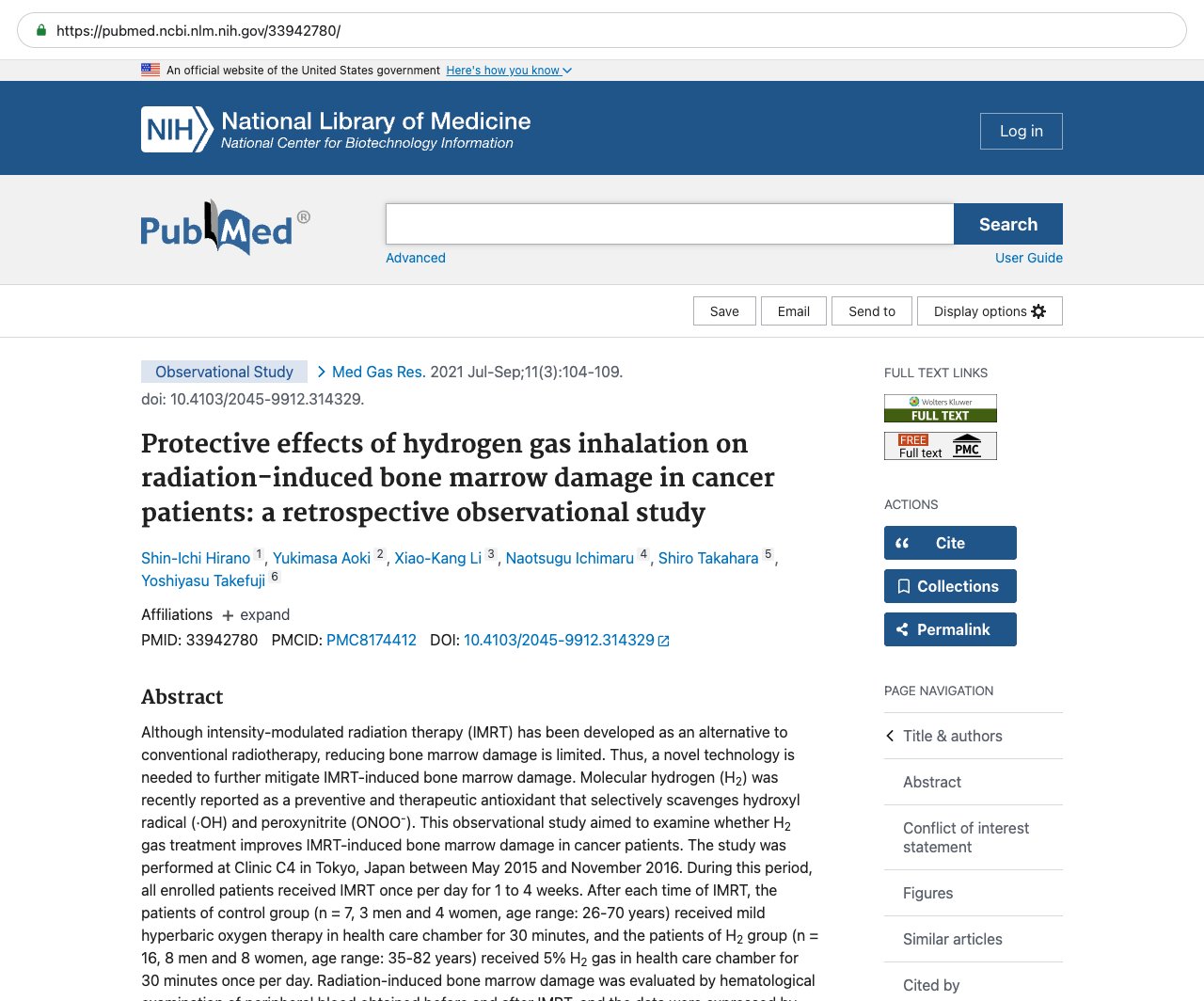
This page mirrors the published abstract (© the authors / publisher) for reference and citation. The canonical source is the PubMed record linked above. This is not medical advice.