2021 · Hirano — Potential Therapeutic Applications of Hydrogen in Chronic Inflammatory Diseases: Possible Inhibiting Role on Mitochondrial Stress.
Super-Abstract
This review proposes a mechanism by which molecular hydrogen (H₂) may inhibit NLRP3 inflammasome activation — a central driver of chronic inflammation — by reducing reactive oxygen species (ROS) produced inside mitochondria. The authors suggest this pathway could explain H₂'s potential in chronic inflammatory diseases including COVID-19. (International Journal of Molecular Sciences, 2021.)
Commentary
The NLRP3 inflammasome is a multi-protein complex in immune cells that, when activated by mitochondrial ROS, triggers the release of potent inflammatory cytokines (particularly IL-1β and IL-18) and can initiate pyroptotic cell death. Its dysregulation underlies numerous chronic diseases — from gout and type 2 diabetes to atherosclerosis and COVID-19-associated lung injury. Hirano et al. hypothesize that H₂, by selectively scavenging the hydroxyl radical (·OH) generated inside mitochondria, could suppress this NLRP3 activation cascade and thereby dampen chronic inflammation at its source. The paper reviews the existing literature on mitochondrial ROS and NLRP3, then builds the mechanistic hypothesis for H₂. Crucially, the authors are transparent that „the ability for H₂ to inhibit NLRP3 inflammasome activation via mitochondrial oxidation is poorly understood“ — this is an emerging hypothesis with supporting mechanistic evidence, not an established clinical pathway. No new experimental data are presented.
Key quotes
- „ROS activate NLRP3 inflammasomes, and that this stimulation triggers the production of proinflammatory cytokines.“ — the central pathological mechanism H₂ is proposed to interrupt
- „the ability for H₂ to inhibit NLRP3 inflammasome activation via mitochondrial oxidation is poorly understood.“ — honest statement from the authors: this is an emerging hypothesis, not established science
- „we hypothesize a possible mechanism by which H2 inhibits mitochondrial oxidation.“ — key word: hypothesis — the paper presents a model to be tested, not a proven pathway
Our assessment
This is a hypothesis review, not a clinical trial. The NLRP3 inflammasome connection is a scientifically compelling and currently active research area. The proposed mechanism — H₂ → mitochondrial ·OH scavenging → NLRP3 inhibition → reduced chronic inflammation — is coherent and anchored in existing biochemistry. However, the authors explicitly label it as a hypothesis. Experimental validation (especially in human disease) is still largely lacking. This paper is best read as a mechanistic framework piece that motivates further research.
Study design
- Type: mechanistic hypothesis review · Scope: mitochondrial ROS, NLRP3 inflammasome activation, H₂ as a putative inhibitor · H₂ delivery: various modalities discussed
- Conclusion: H₂ may suppress chronic inflammation via mitochondrial ·OH scavenging and NLRP3 inhibition — this is a proposed mechanism, not a proven clinical pathway; further experimental verification required
Abstract
Mitochondria are the largest source of reactive oxygen species (ROS) and are intracellular organelles that produce large amounts of the most potent hydroxyl radical (·OH). Molecular hydrogen (H2) can selectively eliminate ·OH generated inside of the mitochondria. Inflammation is induced by the release of proinflammatory cytokines produced by macrophages and neutrophils. However, an uncontrolled or exaggerated response often occurs, resulting in severe inflammation that can lead to acute or chronic inflammatory diseases. Recent studies have reported that ROS activate NLRP3 inflammasomes, and that this stimulation triggers the production of proinflammatory cytokines. It has been shown in literature that H2 can be based on the mechanisms that inhibit mitochondrial ROS. However, the ability for H2 to inhibit NLRP3 inflammasome activation via mitochondrial oxidation is poorly understood. In this review, we hypothesize a possible mechanism by which H2 inhibits mitochondrial oxidation. Medical applications of H2 may solve the problem of many chronic inflammation-based diseases, including coronavirus disease 2019 (COVID-19).
Source & links
Screenshot of the PubMed page
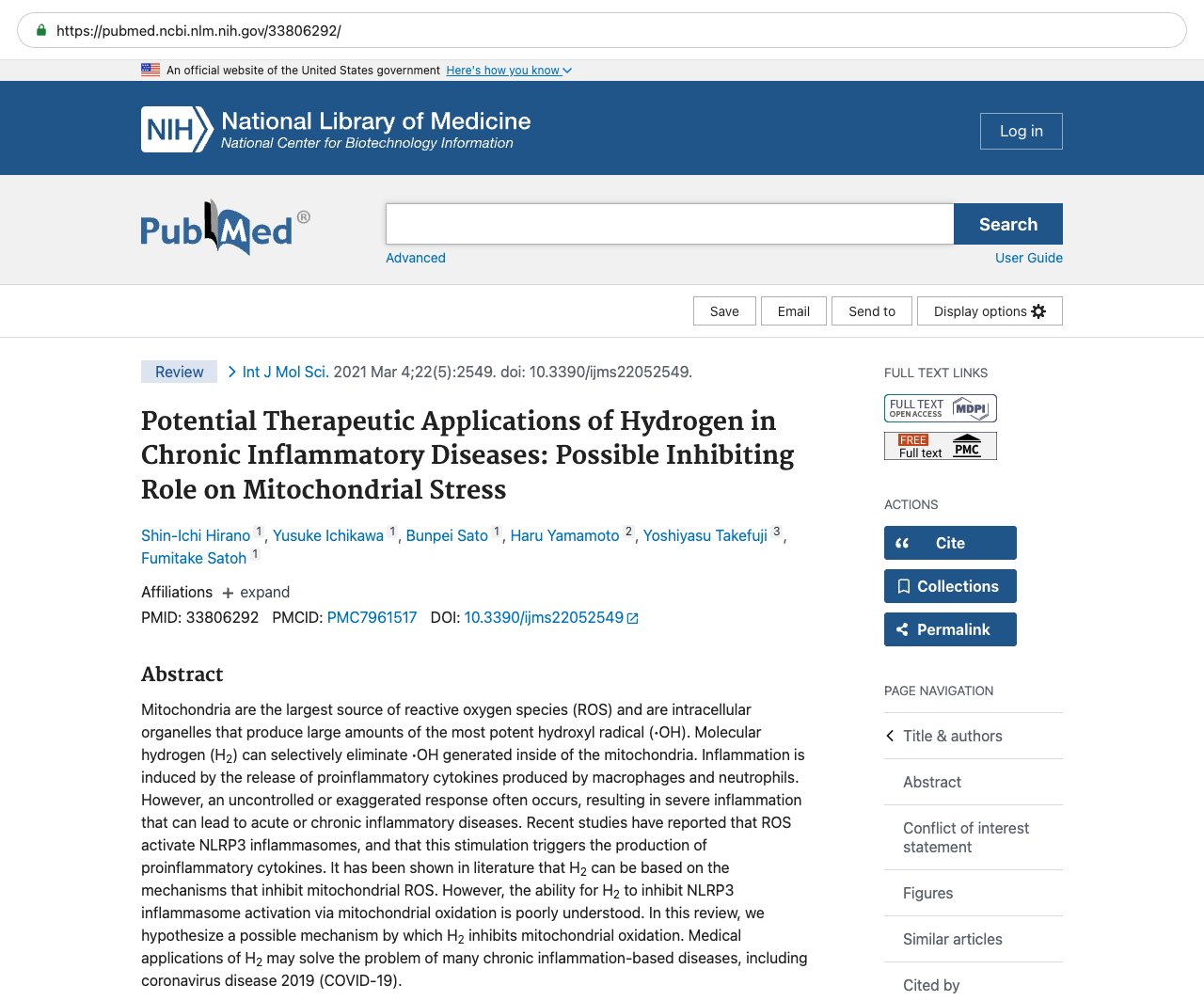
This page mirrors the published abstract (© the authors / publisher) for reference and citation. The canonical source is the PubMed record linked above. This is not medical advice.