2010 Zhejiang da xue xue bao. Yi xue ban = Journal of Zhejiang University. Medical sciences Review / Meta-analysis Unspecified
2010 · Hong — Research Advances on Hydrogen Therapy in Nervous System Diseases
Super-Abstract
This review summarises experimental evidence that molecular hydrogen (H₂) exerts significant protective effects in various neurological diseases — including ischaemia, hypoxia, neurodegeneration, and spinal cord injury — through anti-oxidative, anti-inflammatory, and anti-apoptotic mechanisms. The review draws exclusively on animal and cell studies; clinical evidence in humans is not yet available. (Journal of Zhejiang University, Medical Sciences, 2010.)
Commentary
Oxidative stress — driven by reactive oxygen species (ROS) — is a central pathological mechanism in many neurological disorders. Hydrogen's selective scavenging of the most toxic ROS (hydroxyl radicals and peroxynitrite), without disturbing the physiologically useful lower-level ROS, makes it theoretically well suited to neuroprotection. This Chinese-language review (abstract in English) synthesises the then-available experimental literature on H₂ in neurology: ischaemia-reperfusion models, hypoxic brain injury, neurodegenerative disease models (Parkinson's, Alzheimer's analogs), and spinal cord contusion. The review concludes that H₂ shows consistent benefit in these preclinical models through three mechanisms: antioxidation, anti-inflammation, and inhibition of programmed cell death (apoptosis). The authors suggest this opens new avenues for neurological disease prevention and treatment. However, all cited evidence is from experimental (animal/cell) studies — no human clinical trials are summarised. This is an important and honest limitation of a 2010 review.
Key quotes
- „A large body of experimental studies has proved that hydrogen, through anti-oxidation, anti-inflammatory and inhibiting apoptosis, has a significant therapeutic effect in various neurological diseases, such as ischemia, hypoxia, degeneration and spinal cord contusion.“ — the review's main conclusion — explicitly referring to experimental (not clinical) studies
- „hydrogen has selective antioxidative effect. It selectively reduces the hydroxyl radical (*OH) and peroxynitrite (ONOO(-)), the most cytotoxic of reactive oxygen species (ROS); however, it does not affect other ROS, which play important physiological roles at low concentrations.“ — the mechanistic basis for H₂'s selective neuroprotective potential
- „It provides us with a new clinical method for the prevention and treatment of neurological diseases.“ — the authors' optimistic suggestion — based on preclinical data, not yet validated clinically
Our assessment
This is a narrative review of preclinical (animal and cell) studies on H₂ in neurological diseases. It does not present new data; it synthesises existing experimental literature available as of 2010. The conclusion that H₂ has significant therapeutic effects in neurological diseases refers to animal and cell culture models only — this is not established in human clinical trials. Honest note: the mechanistic rationale is sound and the preclinical evidence is internally consistent, but the translation from animal neurology models to human patients remains a significant open question. The paper is a useful entry point for the neuroprotective H₂ literature but must not be cited as proof of human clinical benefit.
Study design
- Type: narrative review · n: n/a (literature synthesis) · H₂ delivery: various (inhalation, H₂-rich water, saline — as used in cited animal/cell studies)
- Result: preclinical evidence synthesised for H₂ neuroprotection via anti-oxidation, anti-inflammation, anti-apoptosis across ischaemia, hypoxia, neurodegeneration, and spinal cord injury models; no human clinical trial data reviewed
Abstract
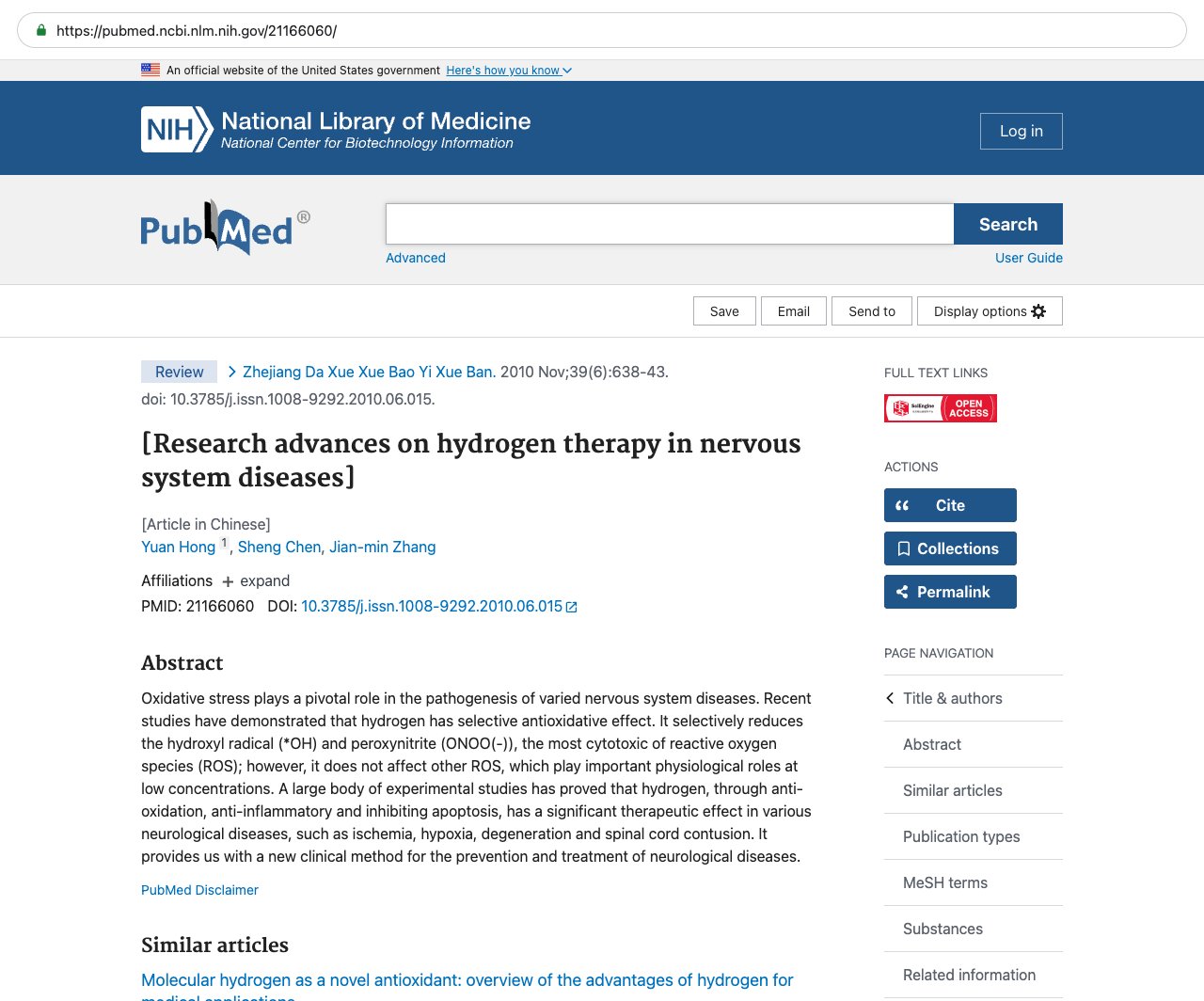
Oxidative stress plays a pivotal role in the pathogenesis of varied nervous system diseases. Recent studies have demonstrated that hydrogen has selective antioxidative effect. It selectively reduces the hydroxyl radical (*OH) and peroxynitrite (ONOO(-)), the most cytotoxic of reactive oxygen species (ROS); however, it does not affect other ROS, which play important physiological roles at low concentrations. A large body of experimental studies has proved that hydrogen, through anti-oxidation, anti-inflammatory and inhibiting apoptosis, has a significant therapeutic effect in various neurological diseases, such as ischemia, hypoxia, degeneration and spinal cord contusion. It provides us with a new clinical method for the prevention and treatment of neurological diseases.
Source & links
Screenshot of the PubMed page
This page mirrors the published abstract (© the authors / publisher) for reference and citation. The canonical source is the PubMed record linked above. This is not medical advice.