2021 · Hong — Effects of concomitant use of hydrogen water and photobiomodulation on Parkinson disease: A pilot study
Super-Abstract
H₂ water combined with photobiomodulation lowered Parkinson symptom scores — safely and without side effects. In a small proof-of-concept study (18 patients, 2 weeks), UPDRS scores dropped significantly from the very first week and remained better than baseline even one week after the end of therapy. (Medicine, 2021 — pilot study without control group.)
Commentary
Parkinson is the second most common neurodegenerative disease — so far there are only symptomatic therapies, no cure. Oxidative stress and mitochondrial dysfunction play a key role. The idea of this study is cleverly combined: photobiomodulation (PBM, i.e. light therapy) can stimulate the mitochondria and produce more ATP — but in doing so also generates more reactive oxygen species (ROS). It is exactly those that H₂ water is meant to scavenge as an antioxidant. 18 patients (Hoehn-Yahr stage II–III) received daily PBM + H₂ for two weeks. Result: the UPDRS scores (the standard Parkinson scale) dropped significantly from the first week onward, and the improvement persisted until the end of therapy. NO side effects occurred. One week after stopping, the scores rose slightly again but remained significantly better than at the start. Quite honestly, and the authors say this clearly themselves: this is a pure proof-of-concept pilot study — only 18 patients, NO control group, NO blinding, short duration. With a scale that partly relies on subjective rating, placebo and expectation effects cannot be ruled out here. Moreover, H₂ is combined with light therapy — the H₂ share of the effect cannot be isolated. A larger, controlled study is needed.
Key quotes
- „We noted that the UPDRS scores began significantly decreasing from the first week, and this improvement persisted until the end of therapy.“ — significant symptom improvement from week 1, lasting until the end of therapy
- „no adverse event was recorded“ — no side effects observed (safety signal)
- „This novel, proof-of-concept study demonstrated that PBM+H2 therapy is safe and reduces disease severity. A larger-scaled clinical trial is warranted“ — the authors' own framing: proof-of-concept, larger study needed
Our assessment
Notable as an example in the neurodegeneration/H₂ field, fitting the mechanistic foundation (H₂ selectively scavenges the most aggressive ROS — Ohsawa 2007). The combination design with light therapy fits the mechanistic picture „H₂ protects against the oxidative price of other therapies“, but it complicates attributing the effect cleanly to H₂ alone. Limitations honestly, and they are considerable: very small sample (n = 18), no control or placebo group, no blinding, short treatment duration (2 weeks), combined intervention (H₂ not isolable), subjective endpoint components. Classified as pilot/proof-of-concept evidence. No promise of cure — Parkinson remains incurable; H₂ is an experimental add-on here.
Study design
- Type: pilot study (phase I/II, single-arm, open-label, no control group) · n: 18 (Parkinson, Hoehn-Yahr II–III, age 30–80) · Duration: 2 weeks daily therapy + 1-week follow-up after cessation · H₂ delivery: H₂ water combined with photobiomodulation (PBM)
- Result: UPDRS significantly decreased from week 1, persisting to end of therapy; after 1-week pause a slight rebound, but still significantly better than baseline; no adverse events (specific p-values/point differences not reported in the abstract)
Abstract
BACKGROUND: Parkinson disease (PD), the second most common neurodegenerative disease, has no cure or applicable disease-modifying approach, only symptomatic therapy. Oxidative stress and mitochondrial dysfunction play key roles in PD pathophysiology. Animal studies have demonstrated that photobiomodulation (PBM) may enhance mitochondrial function and boost adenosine triphosphate production, thus alleviating PD symptoms; however, this process can cause increased reactive oxygen species (ROS) production. Molecular hydrogen (H2) is a potent and possibly therapeutic antioxidant that can mitigate the effect of ROS. PBM targeting the brainstem may facilitate neuronal activity, and the concomitant H2 may clear additional ROS produced by PBM. Therefore, this study aimed to determine the safety and effectiveness of PBM + H2 in patients with PD. METHODS: We included 18 patients with PD (age 30-80 years) who were at Hoehn and Yahr stages II-III. All the participants received daily PBM + H2 therapy for 2 weeks. The adverse event and the Unified Parkinson Disease Rating Scale (UPDRS) scores were recorded. RESULTS: We noted that the UPDRS scores began significantly decreasing from the first week, and this improvement persisted until the end of therapy. Moreover, no adverse event was recorded. After 1 week of therapy cessation, UPDRS scores slightly increased but the improvement remained significant compared with the baseline. CONCLUSION: This novel, proof-of-concept study demonstrated that PBM+H2 therapy is safe and reduces disease severity. A larger-scaled clinical trial is warranted to completely investigate the effects of PBM + H2 therapy on PD.
Source & links
Screenshot of the PubMed page
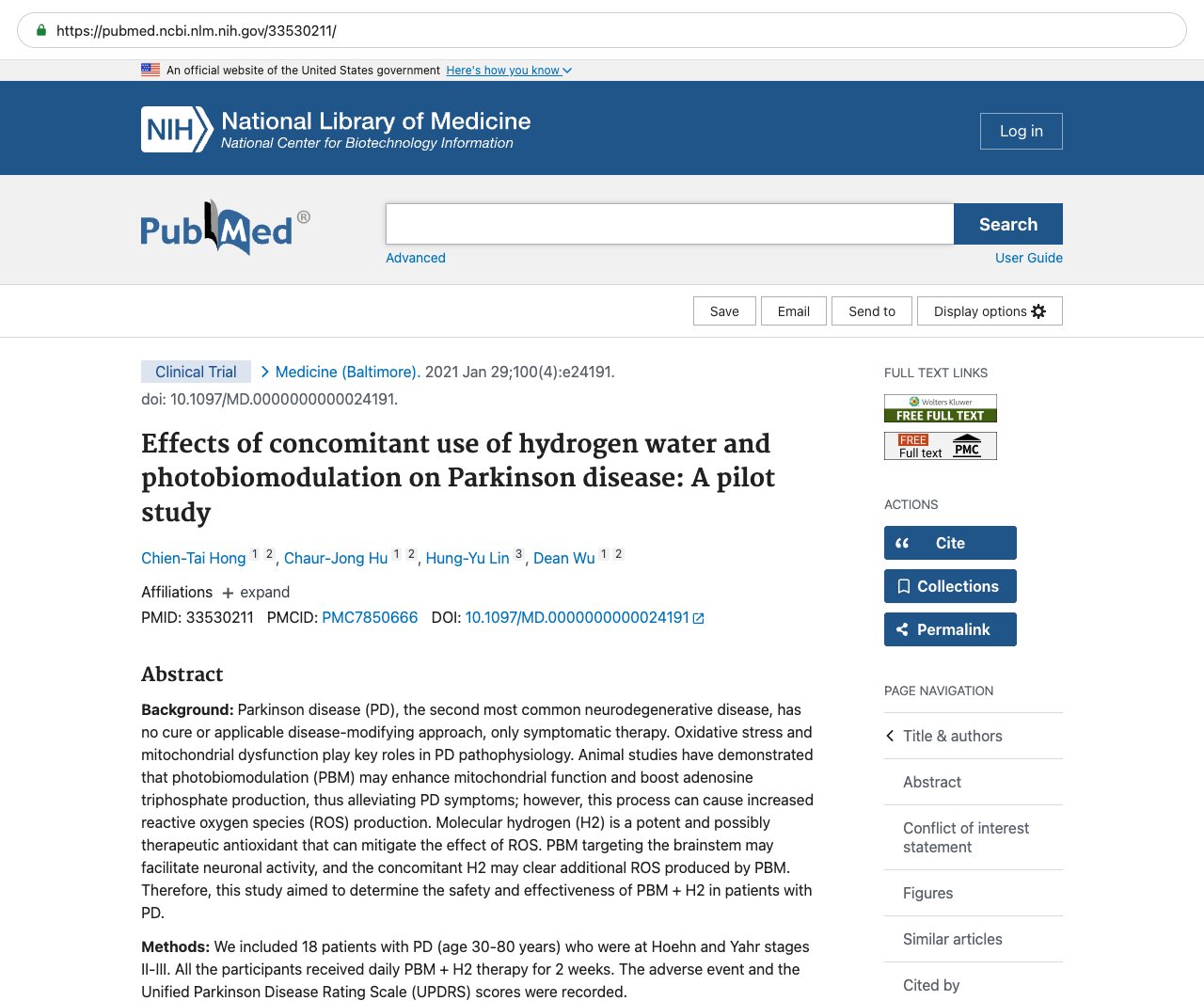
This page mirrors the published abstract (© the authors / publisher) for reference and citation. The canonical source is the PubMed record linked above. This is not medical advice.