2020 · Hori — Two-week continuous supplementation of hydrogen-rich water increases peak oxygen uptake during an incremental cycling exercise test in healthy humans: a randomized, single-blinded, placebo-controlled study
Super-Abstract
Two weeks of daily hydrogen-rich water significantly increased peak oxygen uptake (VO₂peak) in healthy people in the cycle ergometer test. A single serving, by contrast, brought no measurable effect — the benefit only emerges with continuous intake. (Medical Gas Research, 2020, randomized, single-blinded, placebo-controlled.)
Commentary
This is about a core question in endurance sport: does hydrogen water improve aerobic capacity? The study cleanly distinguishes between a single dose and a two-week continuous use — and that is exactly the important insight. In a randomized, single-blinded, placebo-controlled design, healthy subjects completed an incremental cycle ergometer test, once after a single 500-ml serving and once after two weeks of daily intake (on all weekdays, i.e. ten times, 5 liters in total). The result: the single dose changed neither peak oxygen uptake nor oxidative stress, antioxidants or lactate. Only the two-week continuous use significantly increased VO₂peak and tended to raise the peak load — and that without measurable change in lactate or oxidative stress. What it means: H₂ water here does not seem to act via an acute antioxidant effect but rather via a slower adaptation, possibly of mitochondrial metabolism, as the authors hint with reference to animal studies. Honestly though: it is a small study and only single-blinded — with a subjectively influenceable exhaustion test, that is a real weakness. The authors cautiously phrase it as „potentially augments“.
Key quotes
- „The single intake of HW did not significantly increase peak oxygen uptake and peak load, and did not significantly alter the responses in oxidative stress, antioxidant activity, and lactate levels.“ — a single dose does nothing
- „the 2-week continuous consumption of HW significantly augmented peak oxygen uptake and tended to increase the peak load without any significant changes in lactate levels, oxidative stress, and antioxidant responses.“ — only the continuous use works
- „the continuous supplementation of HW potentially augments the aerobic capacity, implying that continuous supplementation of H2 might help improve aerobic exercise performance and physical health.“ — cautious conclusion of the authors
Our assessment
Relevant to aerobic capacity in endurance and fitness training — and especially valuable because it provides an honest differentiation: continuous intake beats the quick „pre-workout sip“. This points to continuous daily intake rather than a single dose as the effective regimen, and it also debunks the expectation that a single sip before a competition delivers instant performance. Limitation, stated honestly: small number of subjects, only single-blinded (bias possible in a will-dependent exhaustion test), and the mechanism remains open since oxidative stress and antioxidants did not change. It fits thematically with the other sports studies on this topic, which show a mixed picture.
Study design
- Type: RCT (randomized, single-blinded, placebo-controlled) · n: healthy subjects (number not stated in the abstract) · Duration: single dose vs. 2 weeks (10× 500 ml, 5 L total) · H₂ delivery: H₂-rich water (HW), 500 ml per dose
- Result: single dose: VO₂peak/peak load n.s.; 2 weeks: VO₂peak significantly ↑, peak load trend ↑; lactate, oxidative stress, antioxidants each unchanged (exact figures/p-values not given in the abstract)
Abstract
The various beneficial effects of the intake of molecular hydrogen (H2) have been demonstrated in the field of sports science. Although supplementation of H2 has been reported to increase mitochondrial metabolism in animal studies, the effects of the administration of H2 on aerobic capacity during exercise in humans are still not clear. We investigated whether a single or 2-week continuous intake of H2-rich water (HW) enhanced the aerobic capacity during incremental exercise in healthy humans. In this randomized, single-blinded, placebo-controlled experimental study, the participants performed an incremental cycling exercise to measure peak oxygen uptake and peak load before and after a single (500 mL) or a 2-week supplementation (total 5 L) of HW. In the latter experiment, the participants drank the 500 mL of HW on all weekdays (i.e., 10 times). The single intake of HW did not significantly increase peak oxygen uptake and peak load, and did not significantly alter the responses in oxidative stress, antioxidant activity, and lactate levels. However, importantly, the 2-week continuous consumption of HW significantly augmented peak oxygen uptake and tended to increase the peak load without any significant changes in lactate levels, oxidative stress, and antioxidant responses. In conclusion, the continuous supplementation of HW potentially augments the aerobic capacity, implying that continuous supplementation of H2 might help improve aerobic exercise performance and physical health. This study protocol was approved by the Ethical Committee of Chubu University (approval No. 260086-2) on March 29, 2018.
Source & links
Screenshot of the PubMed page
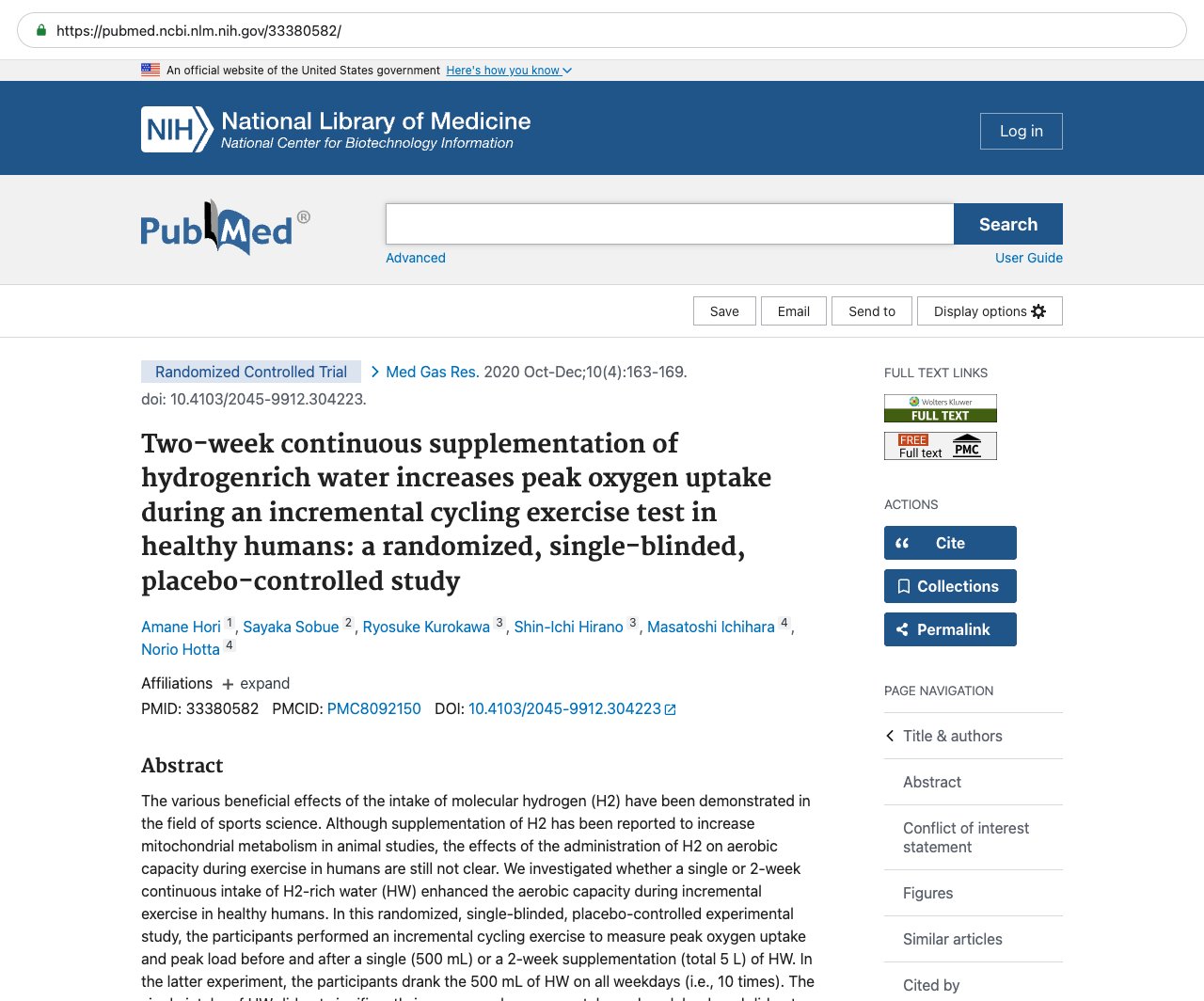
This page mirrors the published abstract (© the authors / publisher) for reference and citation. The canonical source is the PubMed record linked above. This is not medical advice.