2025 · Kuzmanovic — The effects of drinking hydrogen-rich water for six weeks on exercise-related biomarkers in exercise-naïve men and women over 50 years following resistance training program: a randomized controlled pilot trial
Super-Abstract
Hydrogen-rich water supports strength training from 50 on: In a randomized, double-blind pilot RCT (n = 27, age ~58 yrs), 6 weeks of H₂ water lowered markers of acute muscle damage significantly more than placebo, improved the blood lipid profile (total and LDL cholesterol ↓) and raised free testosterone (all p ≤ 0.05). (Research in Sports Medicine, 2025.)
Commentary
This study looks at a group that is especially interesting for H₂ water: untrained people over 50 who are starting strength training. The design is clean — <strong>randomized, double-blind, placebo-controlled, parallel groups</strong> — with 27 healthy participants (18 women, average age around 58 years). One group drank H₂ water with 12 mg of hydrogen per serving twice daily for 6 weeks, the other a nearly hydrogen-free control water (under 0.1 ppm). Important for honesty: pure muscle performance improved in <strong>both</strong> groups — that is the expected training effect, where H₂ did not work better than placebo. The difference lay in the biomarkers: H₂ water reduced markers of acute exercise-induced muscle damage significantly more than placebo (p ≤ 0.05), lowered total and LDL cholesterol and raised free testosterone and cortisol. For sleep quality there was a trend in favor of H₂ that narrowly missed significance (p = 0.119). Limitations stated honestly: small sample (n = 27), only a pilot study, no effect on actual strength performance beyond placebo.
Key quotes
- „HRW significantly outperformed the control water in reducing biomarkers of acute muscular damage caused by resistance exercise (p ≤ 0.05)“ — the clearest advantage of H₂ water: less muscle damage
- „HRW led to a significant increase in serum free testosterone and cortisol levels, along with reductions in total cholesterol and LDL-cholesterol levels at the follow-up (p ≤ 0.05)“ — hormone and blood lipid shifts
- „HRW could be advanced as a risk-free and effective beverage for promoting training-specific adaptations in exercise-naïve men and women over 50 years of age.“ — the authors' assessment of the studied population
Our assessment
Directly relevant to H₂ supplementation in active aging and beginner strength training — exactly the demographic group of particular interest here. The double-blind, placebo-controlled design is strong and rules out expectation effects. Honest about the content: the effect shows up in the biomarkers (muscle damage, blood lipids), not in pure strength performance, which increased equally well in both groups. Limitation, stated honestly: explicitly declared a pilot study, small sample (n = 27), short duration (6 weeks), co-author (Ostojic) is a prolific H₂ researcher (possible confirmation bias). No superiority evidence for training performance itself.
Study design
- Type: RCT, randomized/double-blind/placebo-controlled, parallel groups (declared a pilot) · n: 27 (18 women, age 57.6 ± 6.7 yrs, untrained) · Duration: 6 weeks · H₂ delivery: H₂ water, 12 mg H₂/serving, 2×/day (control <0.1 ppm)
- Result figures: muscle performance ↑ in both groups (p ≤ 0.05, no H₂ advantage); acute muscle damage marker: H₂ > placebo (p ≤ 0.05); free testosterone ↑, cortisol ↑, total + LDL cholesterol ↓ (p ≤ 0.05); sleep quality: trend favoring H₂ (p = 0.119, n.s.)
Abstract
The primary objective of this pilot study was to assess the impact of consuming hydrogen-rich water (HRW) for a duration of six weeks on exercise-related biomarkers in previously untrained men and women aged over 50 years, subsequent to a resistance training program. Twenty-seven apparently healthy middle-aged adults (age 57.6 ± 6.7 years; 18 females) voluntarily provided written consent to participate in this randomized, placebo-controlled experimental trial. All participants were allocated in a double-blind parallel-group design to receive either HRW (12 mg of dihydrogen per serving) or control water (<0.1 ppm of dihydrogen) administered two times per day during a 6-week intervention interval. Muscle performance indices showed a significant improvement following both HRW and control water interventions compared to the baseline values (p ≤ 0.05). HRW led to a significant increase in serum free testosterone and cortisol levels, along with reductions in total cholesterol and LDL-cholesterol levels at the follow-up (p ≤ 0.05). Moreover, HRW significantly outperformed the control water in reducing biomarkers of acute muscular damage caused by resistance exercise (p ≤ 0.05) and tended to outcompete placebo in improving sleep quality (p = 0.119). HRW could be advanced as a risk-free and effective beverage for promoting training-specific adaptations in exercise-naïve men and women over 50 years of age.
Source & links
Screenshot of the PubMed page
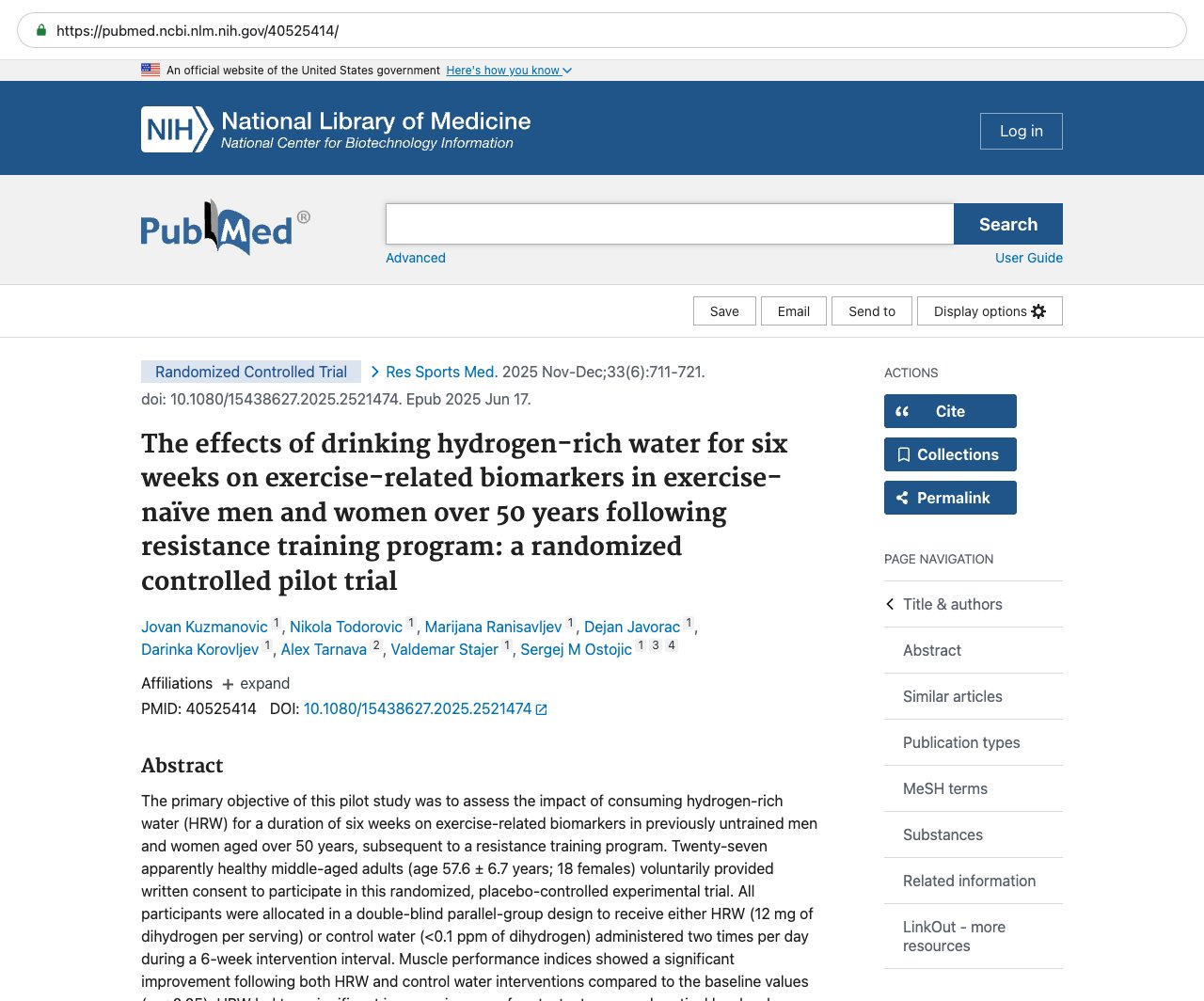
This page mirrors the published abstract (© the authors / publisher) for reference and citation. The canonical source is the PubMed record linked above. This is not medical advice.