2025 · Lin et al. — Molecular Hydrogen Capsule Therapy for Primary Biliary Cholangitis With Elevated IgG4: A Case Report on Immune Marker Normalization
Super-Abstract
Primary biliary cholangitis (PBC) is a chronic autoimmune liver disease that often responds inadequately to the standard drug ursodeoxycholic acid (UDCA). This case report documents a 44-year-old man with PBC, elevated liver enzymes (AST 279, ALT 183 U/l), and dysregulated immune markers who was started on hydrogen capsule therapy. Over four months, liver enzymes declined substantially and immune checkpoint markers — including KLRG-1, PD-1, and Tim3 — normalized. (In Vivo, 2025.)
Commentary
PBC is an autoimmune condition where bile ducts are progressively destroyed by autoreactive T cells, and many patients respond sub-optimally to UDCA — the current standard of care. This case is interesting for several reasons: the patient had an unusual elevation of IgG4 (suggesting possible IgG4-related disease overlap), and the tracked immune markers go beyond standard laboratory panels into the territory of checkpoint biology (KLRG-1 = killer cell lectin-like receptor G1, Tim3 = T cell exhaustion marker, PD-1 = programmed death-1). The normalization of these markers during H₂ capsule therapy over four months — alongside falling liver enzymes and a subjective improvement in fatigue and pruritus — paints a consistent picture. However, as with all single-case reports, spontaneous fluctuation in PBC activity cannot be excluded. The IgG4 reduction is a notable secondary finding.
Key quotes
- „Over four months, AST and ALT levels declined to 95 U/l and 70 U/l, respectively, without adverse effects.“ — objective enzyme improvement from severely elevated baseline
- „Immune markers (KLRG-1, PD-1, and Tim3), previously reduced during PBC flares, normalized post-treatment.“ — normalization of immune checkpoint markers alongside clinical improvement
- „IgG4 levels decreased, suggesting reduced autoimmune activity.“ — secondary immune marker improvement — reduction of IgG4
Our assessment
Single case report — no control, no placebo, no washout. PBC has well-known fluctuating disease activity, meaning spontaneous improvement between flares is plausible without any intervention. UDCA was continued alongside H₂ capsules, so the additive contribution of H₂ cannot be isolated. The immunological detail (KLRG-1, Tim3, PD-1, IgG4) is the most scientifically interesting aspect, as these markers are mechanistically relevant to autoimmune liver disease. However, without replication in a larger cohort or controlled trial, these findings remain preliminary. Limitation: the H₂ source (capsules) and dose are not described precisely enough for clinical replication.
Study design
- Type: single case report · n: 1 (44-year-old male with PBC, splenomegaly, elevated IgG4) · H₂ delivery: hydrogen capsules (exact formulation not specified); UDCA continued
- Endpoints: AST, ALT, IgG4; immune markers KLRG-1, PD-1, Tim3 via flow cytometry; hepatic imaging; fatigue, pruritus
- Result: AST 279→95 U/l, ALT 183→70 U/l over 4 months; immune markers normalized; IgG4 decreased; stable fibrosis on imaging; patient-reported fatigue and pruritus improvement
Abstract
BACKGROUND/AIM: Primary biliary cholangitis (PBC) is a chronic autoimmune liver disease characterized by bile duct destruction, cholestasis, and inflammation, often leading to fibrosis and cirrhosis. While ursodeoxycholic acid (UDCA) is the standard treatment, some patients exhibit suboptimal responses, necessitating adjunctive therapies. Molecular hydrogen (H2), known for its antioxidant and anti-inflammatory properties, has shown potential in mitigating oxidative stress and immune dysregulation in autoimmune liver diseases. This case report evaluates the therapeutic efficacy of H2 capsules in managing PBC with elevated liver enzymes and immune dysregulation. CASE REPORT: A 44-year-old male with PBC, splenomegaly, and elevated IgG4 levels presented with acute cholestatic hepatitis. Laboratory tests revealed significantly elevated aspartate transaminase (AST) (279 U/l) and alanine aminotransferase (ALT) (183 U/l). Despite UDCA therapy, liver enzymes remained persistently high. On August 30, 2024, molecular hydrogen capsule therapy was introduced as adjunctive treatment. Over four months, AST and ALT levels declined to 95 U/l and 70 U/l, respectively, without adverse effects. Immune markers (KLRG-1, PD-1, and Tim3), previously reduced during PBC flares, normalized post-treatment. Imaging confirmed stable fibrosis, and IgG4 levels decreased, suggesting reduced autoimmune activity. The patient also reported improvements in fatigue and pruritus, enhancing overall quality of life. CONCLUSION: Molecular hydrogen capsules therapy may serve as a safe and effective adjunctive treatment for PBC, contributing to improved liver enzyme levels, immune regulation, and patient well-being. Further studies are warranted to validate these findings and establish standardized treatment protocols in autoimmune liver diseases.
Source & links
Screenshot of the PubMed page
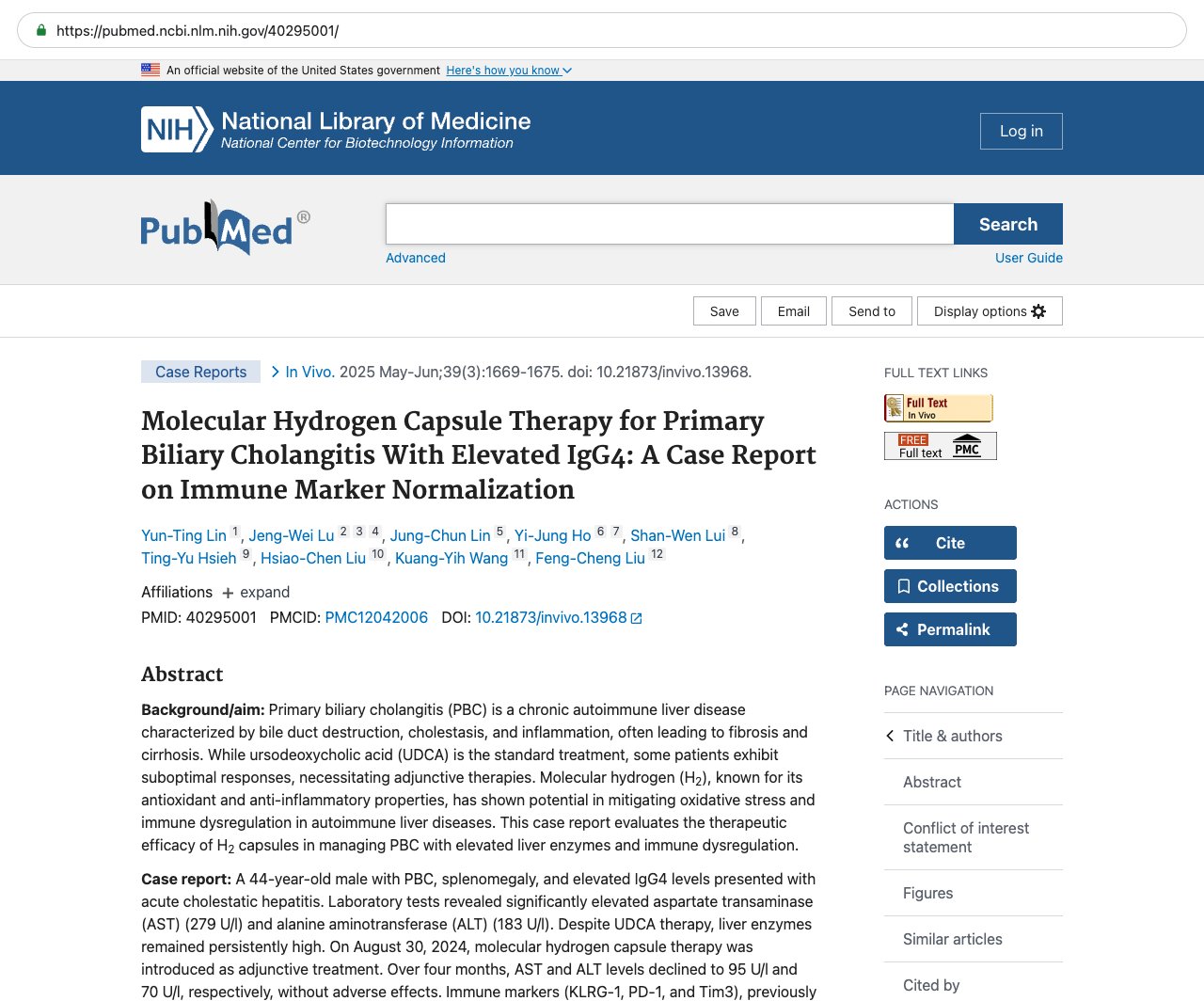
This page mirrors the published abstract (© the authors / publisher) for reference and citation. The canonical source is the PubMed record linked above. This is not medical advice.