2020 · Hu — Molecular hydrogen: A potential radioprotective agent
Super-Abstract
H₂ as a radioprotective agent: Most radiation damage arises from hydroxyl radicals (•OH) from the radiolysis of water — exactly the radical that H₂ selectively neutralizes. This review therefore sees hydrogen as a promising, novel radioprotector. (Biomedicine & Pharmacotherapy, 2020.)
Commentary
This review ties directly into the core mechanism of H₂ medicine: ionizing radiation damages tissue mainly indirectly — it splits water molecules (radiolysis) and thereby generates the highly aggressive hydroxyl radical. Since H₂ is known to selectively scavenge precisely this •OH without touching the physiologically useful oxygen species, using H₂ as radiation protection is an obvious thought. The authors compile the possible mechanisms, the various routes of administration, and the existing evidence from in-vitro, animal and early clinical work. Their conclusion is cautiously optimistic: H₂ has „good potential“ in radioprotection, but the data above all justify more research. Important for honesty: this is a review, not an original study — it summarizes and contextualizes but provides no new hard figures or patient endpoints. As an orientation for the topic „H₂ and irradiation“ (e.g. side effects of cancer radiotherapy) it is nonetheless a good entry point.
Key quotes
- „Most of the ionizing radiation-induced damage is caused by hydroxyl radicals (OH) from radiolysis of H2O.“ — why radiation damage can be addressed with H₂ in the first place
- „Since hydrogen can mitigate such damage through multiple mechanisms, it presents noteworthy potential as a novel radio-protective agent.“ — the central thesis of the review
- „We conclude that hydrogen has good potential in radio-protection, with evidence that warrants greater research efforts in this field.“ — the honest, cautious conclusion of the authors
Our assessment
A thematically focused review that transfers the known selectivity mechanism to a concrete field of application: protection against radiation damage. Relevant for instance in the context of collateral damage from oncological radiotherapy. For us it provides no product argument in the narrow sense, but it supports the overarching narrative of H₂ as a selective radical scavenger. Limitation, stated honestly: it is a narrative review (evidence level 4) — no original measurements, no sample, possible selection of the cited studies. The authors themselves emphasize that robust clinical evidence still needs to be developed.
Study design
- Type: narrative review · n: n/a (literature synthesis) · Duration: n/a · H₂ delivery: discussed in the review (inhalation, H₂ water, H₂-rich saline)
- Result: no original measurements; conclusion: H₂ with „good potential“ as a radioprotector, further research needed
Abstract
In recent years, many studies have shown that hydrogen has therapeutic and preventive effects on various diseases. Its selective antioxidant properties were well noticed. Most of the ionizing radiation-induced damage is caused by hydroxyl radicals (OH) from radiolysis of H2O. Since hydrogen can mitigate such damage through multiple mechanisms, it presents noteworthy potential as a novel radio-protective agent. This review analyses possible mechanisms for hydrogen's radioprotective properties and effective delivery methods. We also look into details of vitro and vivo studies for hydrogen's radioprotective effects, and clinical practices. We conclude that hydrogen has good potential in radio-protection, with evidence that warrants greater research efforts in this field.
Source & links
Screenshot of the PubMed page
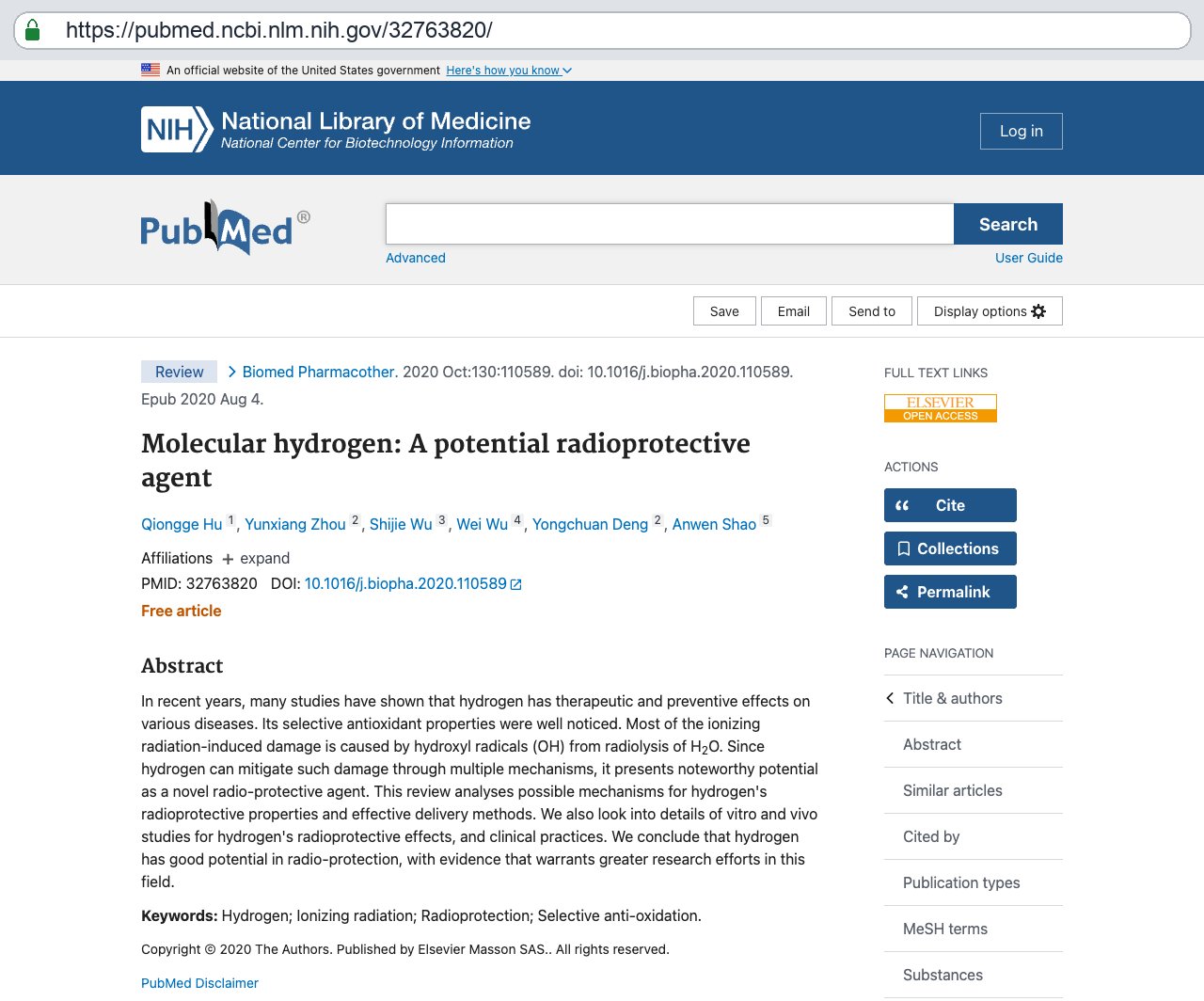
This page mirrors the published abstract (© the authors / publisher) for reference and citation. The canonical source is the PubMed record linked above. This is not medical advice.