1995 · Hundley et al. — Assessment of left-to-right intracardiac shunting by velocity-encoded, phase-difference magnetic resonance imaging
Super-Abstract
MRI flow measurements in the major heart vessels agreed very well (r = 0.94) with invasive catheterisation data in detecting and quantifying left-to-right intracardiac shunts in 21 adults. Hydrogen inhalation was used as the clinical reference method to confirm the presence of shunting — not as a therapeutic agent. The practical finding: non-invasive MRI can replace catheterisation for shunt assessment. (Circulation, 1995.)
Commentary
This is a cardiology methods paper comparing two diagnostic imaging approaches. Hydrogen inhalation appears here in its classic diagnostic role: inhaled H₂ passes from the lungs into the bloodstream; in patients with a cardiac shunt, it appears abnormally early in the pulmonary artery — a rapid, sensitive bedside test for shunt detection. This has nothing to do with molecular hydrogen therapy. The study's contribution is validating MRI as a non-invasive alternative to catheterisation, which is clinically important for avoiding procedural risks in patients with suspected congenital heart defects.
Key quotes
- „There was a good correlation (r = .94) between the invasive and MRI assessments of shunt magnitude.“ — MRI matches catheterisation accuracy for shunt quantification
- „The presence of left-to-right intracardiac shunting was assessed with hydrogen inhalation.“ — H₂ inhalation used as a diagnostic reference — not therapy
- „MRI correctly identified the 12 patients with a ratio of pulmonary to systemic flow (Qp/Qs) of < 1.5 … and the 9 patients with a Qp/Qs of ≥ 1.5.“ — perfect classification accuracy against the clinical reference
Our assessment
Important context: this study does not investigate molecular hydrogen (H₂) as a therapeutic intervention. Hydrogen inhalation is used as the established clinical reference test for detecting intracardiac left-to-right shunts — a diagnostic procedure used in cardiac catheterisation laboratories. The study topic is diagnostic cardiology and cardiac MRI validation. The design is prospective and blinded (n = 21). Limitations: single-centre, small sample, only large-vessel MRI measurements reported. Not relevant to H₂ therapy.
Study design
- Type: prospective blinded comparison study · n: 21 adults (aged 15–72 years) · H₂ delivery: inhalation as diagnostic tracer only — not therapeutic
- Result: MRI correctly identified all 21 patients as shunt-positive or negative; r = 0.94 correlation with invasive shunt quantification; H₂ inhalation confirmed shunt presence in 12 of 21 patients
Abstract
BACKGROUND: Velocity-encoded, phase-difference magnetic resonance imaging (MRI) has been shown to provide an accurate assessment of shunt magnitude in patients with large atrial septal defects, but its ability to determine shunt magnitude in patients with intracardiac left-to-right shunts of various locations and sizes has not been evaluated in a prospective and blinded manner. The objective of the present study was to determine whether velocity-encoded, phase-difference MRI can assess the magnitude of intracardiac left-to-right shunting in humans. METHODS AND RESULTS: Twenty-one subjects (15 women and 6 men; age range, 15 to 72 years) underwent velocity-encoded, phase-difference MRI measurements of flow in the proximal aorta and pulmonary artery, followed immediately by cardiac catheterization. The presence of left-to-right intracardiac shunting was assessed with hydrogen inhalation, after which shunt magnitude was measured by the oximetric and indocyanine green techniques. Of the 21 patients, 12 had left-to-right intracardiac shunting detected by hydrogen inhalation. There was a good correlation (r = .94) between the invasive and MRI assessments of shunt magnitude. In comparison to oximetry and indocyanine green, MRI correctly identified the 12 patients with a ratio of pulmonary to systemic flow (Qp/Qs) of < 1.5 (9 without intracardiac shunting and 3 with small shunts) and the 9 patients with a Qp/Qs of > or = 1.5 (6 with atrial septal defect, 1 with ventricular septal defect, 1 with patent ductus arteriosus, and 1 with both atrial septal defect and patent ductus arteriosus). CONCLUSIONS: Compared with measurements obtained during cardiac catheterization, velocity-encoded, phase-difference MRI measurements of flow in the proximal great vessels can reliably assess the magnitude of intracardiac left-to-right shunting.
Source & links
Screenshot of the PubMed page
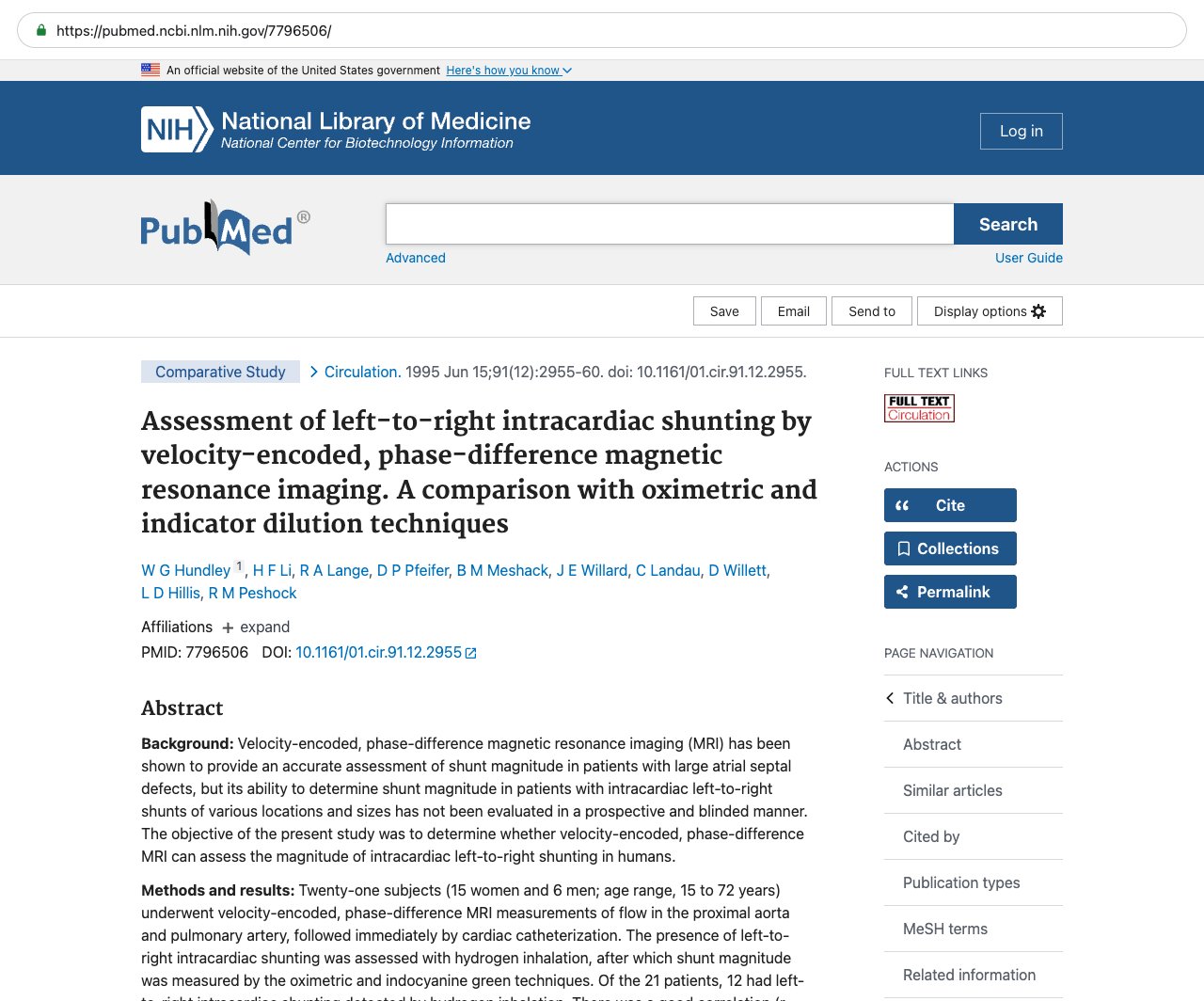
This page mirrors the published abstract (© the authors / publisher) for reference and citation. The canonical source is the PubMed record linked above. This is not medical advice.