2024 · Lin — Molecular Hydrogen Therapy in Sjögren's Syndrome With Pulmonary Arterial Hypertension and Right-sided Heart Failure: A Case Report of Improved Immune Markers Including Treg, B Cells and Plasma Cell.
Super-Abstract
A 56-year-old woman with Sjögren's syndrome-associated pulmonary arterial hypertension and right-sided heart failure — unresponsive to five standard drugs — experienced clinical stabilisation and measurable immune improvement after starting daily hydrogen capsules as an add-on. Treg cells rose, anti-Ro antibodies fell, and B cell subsets decreased. (In Vivo, 2024.)
Commentary
Connective tissue disease-associated pulmonary arterial hypertension (CTD-PAH) carries a grim prognosis, and this patient had already failed multiple vasodilators plus corticosteroids. The case is notable for the specificity of the immune markers tracked: CD127+ Treg cells, anti-Ro antibodies, and B cell subsets are all mechanistically relevant to Sjögren's syndrome pathophysiology. The authors propose H₂'s anti-inflammatory and immunomodulatory effects as the operative mechanism. As with all single-case reports, this cannot prove causation: the patient's condition may have naturally reached a plateau, and the background medications remained unchanged. The case serves as a proof-of-concept signal in a disease where new adjunctive options are urgently needed.
Key quotes
- „The patient received daily hydrogen capsules, which led to increased CD127+ Treg cells, reduced anti-Ro antibodies, and decreased B cell subsets.“ — the specific immune changes attributed to H₂ add-on therapy
- „H2 therapy exhibiting anti-inflammatory and immunomodulatory effects, leading to improved immune cell profiles and stabilizing clinical symptoms in a patient unresponsive to conventional treatments.“ — the mechanistic interpretation and clinical outcome
- „Molecular hydrogen therapy shows promise as a safe adjunctive treatment for CTD-PAH, offering a new approach for managing this challenging condition.“ — cautious authors' conclusion — adjunctive, not curative framing
Our assessment
A rare and difficult-to-study disease context makes this case clinically interesting but causally inconclusive. The immune marker specificity (CD127+ Treg, anti-Ro, B cell subsets) adds biological plausibility. Limitations: n=1; 10-year disease history with prior multiple drug failures means the baseline is highly unstable; no control arm; concurrent standard therapy continued unchanged; no stated H₂ dose. The safety observation (no adverse effects) is consistent with H₂'s known tolerability profile. Should be read as a hypothesis-generating signal only.
Study design
- Type: single case report · n: 1 (56-year-old female) · H₂ delivery: daily hydrogen capsules (dose not specified)
- Diagnosis: CTD-PAH (Sjögren's syndrome + ILD + PAH) with right heart failure, unresponsive to sildenafil, bosentan, macitentan, iloprost, corticosteroids
- Observed outcome: increased CD127+ Treg cells, reduced anti-Ro antibodies, decreased B cell subsets, clinical stabilisation — no adverse effects
Abstract
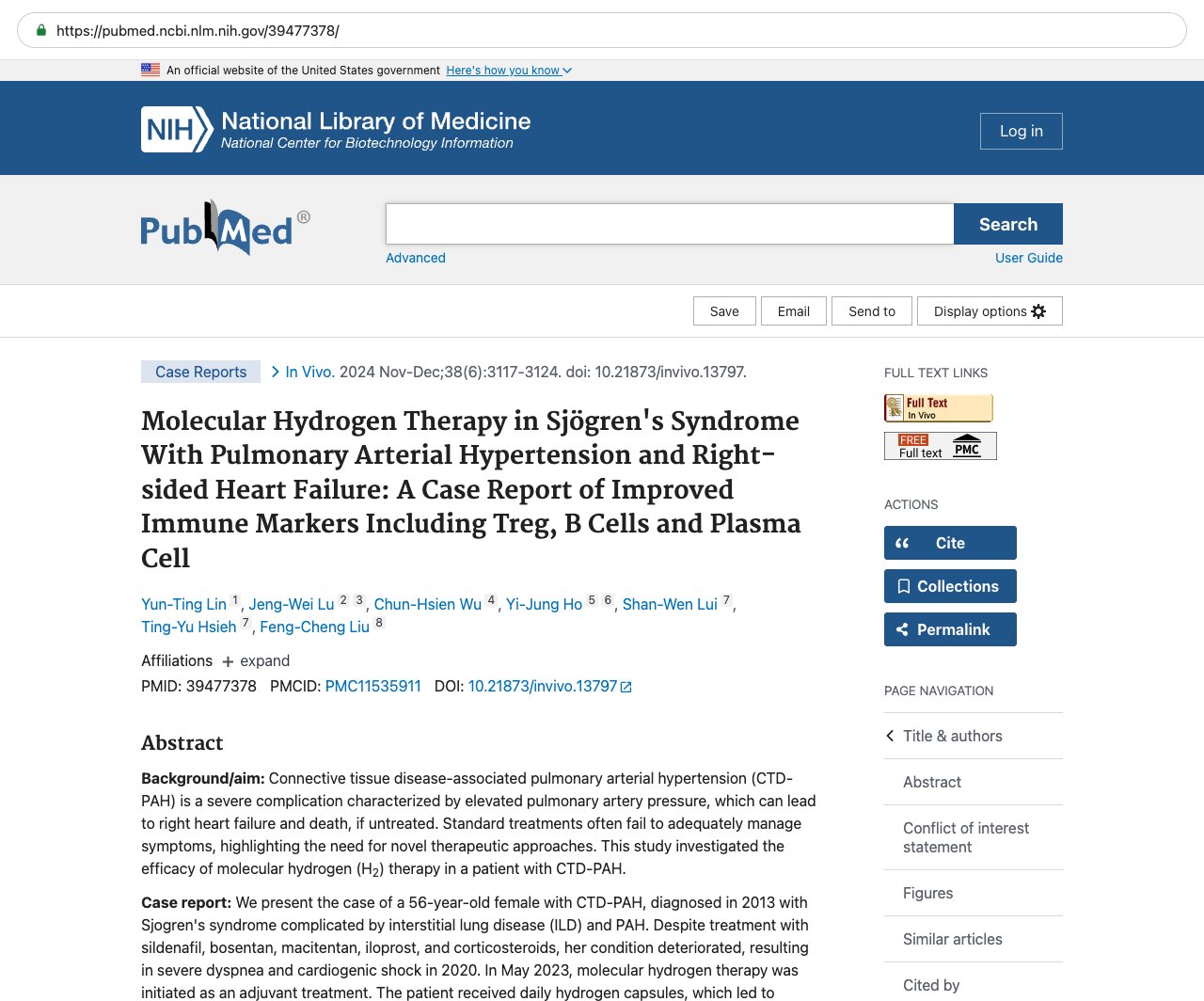
BACKGROUND/AIM: Connective tissue disease-associated pulmonary arterial hypertension (CTD-PAH) is a severe complication characterized by elevated pulmonary artery pressure, which can lead to right heart failure and death, if untreated. Standard treatments often fail to adequately manage symptoms, highlighting the need for novel therapeutic approaches. This study investigated the efficacy of molecular hydrogen (H2) therapy in a patient with CTD-PAH. CASE REPORT: We present the case of a 56-year-old female with CTD-PAH, diagnosed in 2013 with Sjogren's syndrome complicated by interstitial lung disease (ILD) and PAH. Despite treatment with sildenafil, bosentan, macitentan, iloprost, and corticosteroids, her condition deteriorated, resulting in severe dyspnea and cardiogenic shock in 2020. In May 2023, molecular hydrogen therapy was initiated as an adjuvant treatment. The patient received daily hydrogen capsules, which led to increased CD127+ Treg cells, reduced anti-Ro antibodies, and decreased B cell subsets. Her clinical symptoms stabilized without adverse effects. CONCLUSION: This case highlights the potential benefits of molecular hydrogen therapy in CTD-PAH. H2 therapy exhibiting anti-inflammatory and immunomodulatory effects, leading to improved immune cell profiles and stabilizing clinical symptoms in a patient unresponsive to conventional treatments. Further research is needed to elucidate the mechanisms of H2 therapy and validate its efficacy in larger cohorts. Molecular hydrogen therapy shows promise as a safe adjunctive treatment for CTD-PAH, offering a new approach for managing this challenging condition.
Source & links
Screenshot of the PubMed page
This page mirrors the published abstract (© the authors / publisher) for reference and citation. The canonical source is the PubMed record linked above. This is not medical advice.