2022 · Fu — Molecular hydrogen is a promising therapeutic agent for pulmonary disease
Super-Abstract
This review summarizes the growing body of evidence suggesting that molecular hydrogen can protect the lungs from a range of diseases — including acute lung injury, COPD, asthma, lung cancer, pulmonary hypertension, and pulmonary fibrosis — through its antioxidant, anti-inflammatory, and anti-apoptotic properties. As a review, this paper synthesizes existing research rather than reporting new experiments. The authors describe mechanisms and preclinical as well as some early clinical findings. (Journal of Zhejiang University Science B, 2022.)
Commentary
This narrative review provides a comprehensive tour of hydrogen's proposed lung-protective mechanisms. The lungs are particularly relevant because they are the first organ exposed to inhaled H₂ and are constantly under oxidative pressure from environmental pollutants, pathogens, and inflammatory cascades. The review covers six major respiratory conditions: acute lung injury (ALI, including COVID-19-related damage), COPD, asthma, lung cancer, pulmonary arterial hypertension (PAH), and pulmonary fibrosis. For each, the authors outline how H₂'s antioxidant and anti-inflammatory actions could theoretically interrupt the underlying pathology. The review also touches on H₂'s effects on autophagy and cell death pathways. Importantly, the evidence base for different conditions varies widely: ALI has more preclinical depth and some pilot clinical data; conditions like PAH have far less. This is a literature synthesis — it does not generate new efficacy data and cannot substitute for randomized controlled trials.
Key quotes
- „An increasing number of studies have revealed that hydrogen may protect the lungs from diverse diseases, including acute lung injury, chronic obstructive pulmonary disease, asthma, lung cancer, pulmonary arterial hypertension, and pulmonary fibrosis.“ — the scope of the review — six disease categories covered
- „Molecular hydrogen exerts biological effects on nearly all organs. It has anti-oxidative, anti-inflammatory, and anti-aging effects and contributes to the regulation of autophagy and cell death.“ — broad biological properties cited as the mechanistic basis
- „we highlight the multiple functions of hydrogen and the mechanisms underlying its protective effects in various lung diseases, with a focus on its roles in disease pathogenesis and clinical significance.“ — the review's stated objective
Our assessment
A useful narrative review that maps the existing H₂ research landscape for lung diseases. Its value is as an orientation and reference document. As a review, it does not produce new experimental evidence. The strength of evidence differs considerably by disease: some areas (acute lung injury) are better supported; others (PAH, pulmonary fibrosis) remain at an early mechanistic stage. Readers should treat conclusions as a map of research directions, not as established clinical guidance.
Study design
- Type: narrative review · Scope: lung diseases (ALI/COVID-19, COPD, asthma, lung cancer, pulmonary arterial hypertension, pulmonary fibrosis) · H₂ delivery: various (inhalation predominates in cited studies; no single delivery method across all reviewed work)
- Result: synthesis of preclinical and some early clinical evidence; central conclusion: H₂'s antioxidant, anti-inflammatory, and anti-apoptotic properties underlie its potential lung-protective effects; no pooled effect sizes or meta-analytic statistics
Abstract
Molecular hydrogen exerts biological effects on nearly all organs. It has anti-oxidative, anti-inflammatory, and anti-aging effects and contributes to the regulation of autophagy and cell death. As the primary organ for gas exchange, the lungs are constantly exposed to various harmful environmental irritants. Short- or long-term exposure to these harmful substances often results in lung injury, causing respiratory and lung diseases. Acute and chronic respiratory diseases have high rates of morbidity and mortality and have become a major public health concern worldwide. For example, coronavirus disease 2019 (COVID-19) caused by severe acute respiratory syndrome coronavirus 2 (SARS-CoV-2) has become a global pandemic. An increasing number of studies have revealed that hydrogen may protect the lungs from diverse diseases, including acute lung injury, chronic obstructive pulmonary disease, asthma, lung cancer, pulmonary arterial hypertension, and pulmonary fibrosis. In this review, we highlight the multiple functions of hydrogen and the mechanisms underlying its protective effects in various lung diseases, with a focus on its roles in disease pathogenesis and clinical significance.
Source & links
Screenshot of the PubMed page
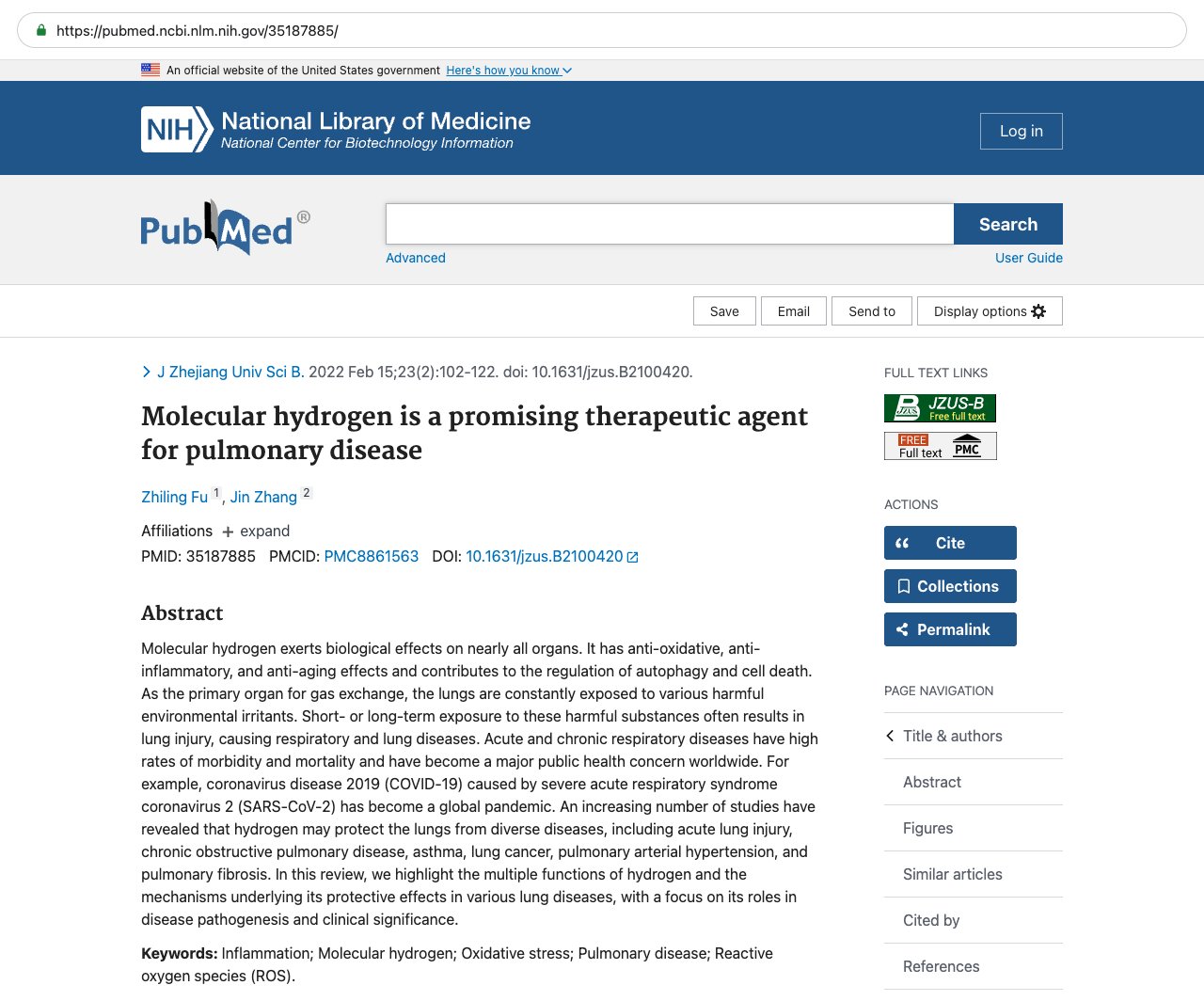
This page mirrors the published abstract (© the authors / publisher) for reference and citation. The canonical source is the PubMed record linked above. This is not medical advice.