2016 · Iida — The Clinical Application of Hydrogen as a Medical Treatment
Super-Abstract
This Japanese review surveys research on hydrogen-rich water and hydrogen gas as potential medical treatments, covering disease models such as ischaemia-reperfusion injury, and explores routes of H₂ administration (oral, intravenous, local) and the possible role of H₂ as an antioxidant signalling molecule. This is a literature review, not a clinical trial — it summarises existing research rather than generating new evidence.
Commentary
Published in Acta Medica Okayama, this review by Iida and colleagues synthesises the state of hydrogen research as understood around 2016, with a focus on clinical applicability. The authors note that H₂ has shown effects across multiple disease models, particularly ischaemia-reperfusion injury, and has been investigated in multiple delivery formats — inhaled gas, hydrogen-rich water (oral), intravenous hydrogen-rich saline, and local application. The review highlights H₂'s potential role not just as a radical scavenger but as a signalling molecule that may modulate oxidative stress pathways. The paper reflects a time when H₂ clinical trial data was limited and much was inferred from animal and in-vitro models. As a review, it provides a useful historical snapshot of the field's trajectory but offers no new experimental evidence. The authors' optimism about clinical prospects should be read in light of the still-developing evidence base at the time.
Key quotes
- „Hydrogen has been shown to be effective not only through intake as a gas, but also as a liquid medication taken orally, intravenously, or locally.“ — summary of the delivery routes reviewed
- „Now that hydrogen is in the limelight as a gaseous signaling molecule due to its potential ability to inhibit oxidative stress signaling, new research developments are highly anticipated.“ — the forward-looking statement on H₂'s mechanistic identity
- „Herein we review the recent research on hydrogen-rich water, and we examine the possibilities for its clinical application.“ — the review's stated scope
Our assessment
This is a review article — it summarises existing studies rather than generating new evidence. As a 2016 survey, it captures the field at an early stage, when clinical data were sparse and most evidence was preclinical. The review is fairly broad but not systematic (no meta-analytic pooling, no stated inclusion criteria). Its value is historical and contextual — useful for understanding how hydrogen research has developed — rather than as direct clinical evidence. Readers should note that many clinical trials have since been conducted, making this review partly outdated.
Study design
- Type: narrative review (literature survey) · n: n/a (literature analysis) · H₂ delivery: multiple routes reviewed (gas inhalation, hydrogen-rich water oral, intravenous hydrogen-rich saline, local application)
- Outcome: narrative summary; no pooled effect sizes; conclusion: H₂ shows promise across disease models and delivery routes, with ischaemia-reperfusion injury as the leading application; call for further clinical research
Abstract
In recent years, it has become evident that molecular hydrogen is a particularyl effective treatment for various disease models such as ischemia-reperfusion injury; as a result, research on hydrogen has progressed rapidly. Hydrogen has been shown to be effective not only through intake as a gas, but also as a liquid medication taken orally, intravenously, or locally. Hydrogen's effectiveness is thus multifaceted. Herein we review the recent research on hydrogen-rich water, and we examine the possibilities for its clinical application. Now that hydrogen is in the limelight as a gaseous signaling molecule due to its potential ability to inhibit oxidative stress signaling, new research developments are highly anticipated.
Source & links
Screenshot of the PubMed page
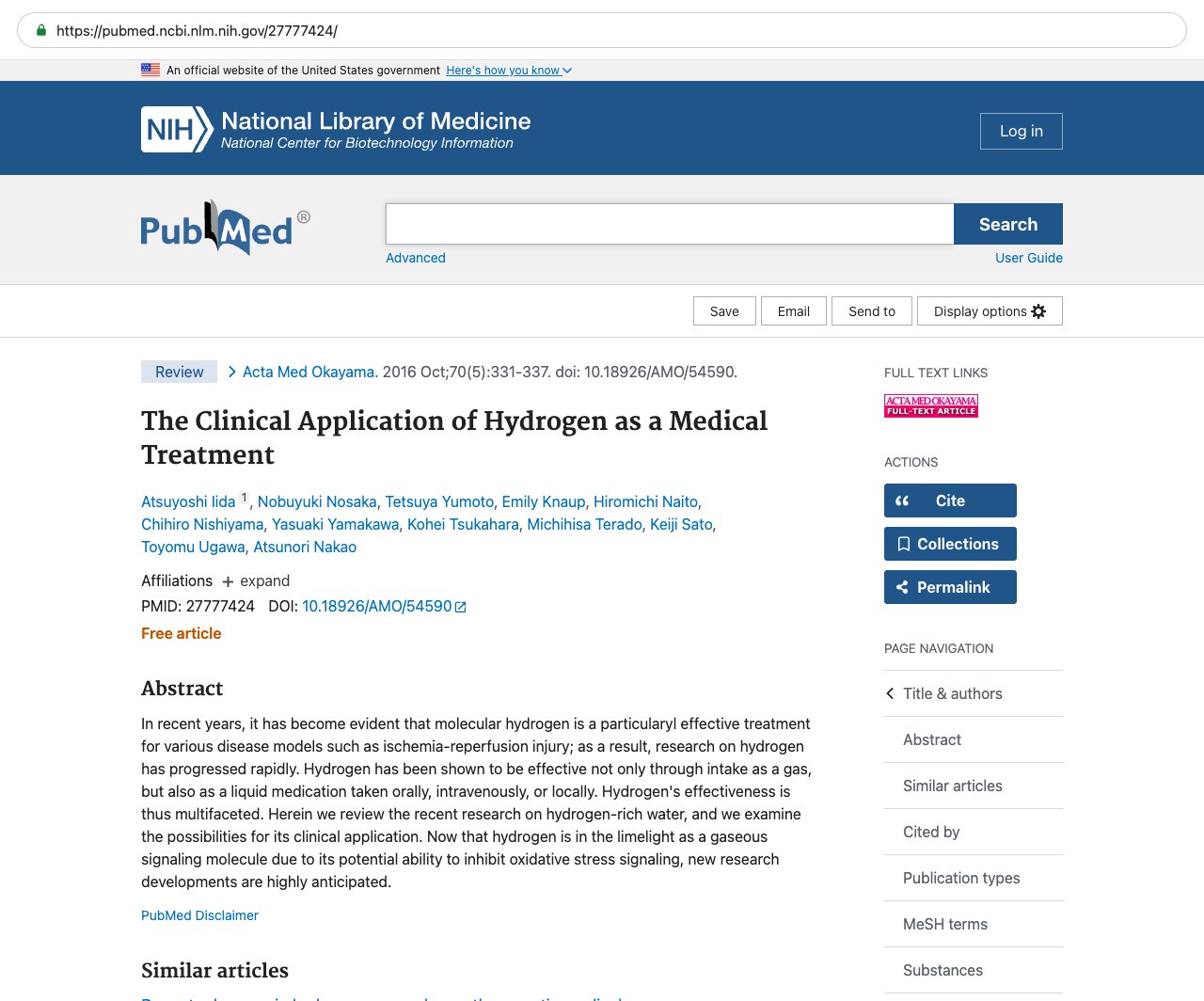
This page mirrors the published abstract (© the authors / publisher) for reference and citation. The canonical source is the PubMed record linked above. This is not medical advice.