2014 · Ishibashi et al. — Therapeutic efficacy of infused molecular hydrogen in saline on rheumatoid arthritis: a randomized, double-blind, placebo-controlled pilot study.
Super-Abstract
In 24 patients with rheumatoid arthritis (RA), intravenous infusion of H₂-enriched saline (500 mL/day, 5 days) significantly reduced disease activity scores (DAS28), lowered IL-6 and the oxidative damage marker 8-OHdG, and reduced MMP-3 — a marker of joint destruction — after 4 weeks. The double-blind, placebo-controlled design makes this one of the more rigorous early H₂ trials. (International Immunopharmacology, 2014.)
Commentary
Rheumatoid arthritis is driven by chronic immune-mediated inflammation: IL-6 fuels the systemic response, TNF-α sustains joint destruction, and MMP-3 (matrix metalloproteinase-3) actively degrades cartilage and bone. The fact that a 5-day IV H₂-saline protocol produced statistically significant reductions in DAS28, IL-6, and MMP-3 — with the effect persisting to 4 weeks post-infusion — is a meaningful result for a pilot study of this size. The 37% IL-6 reduction in the H₂ group versus a 34% increase in placebo is a particularly striking contrast. The oxidative stress marker 8-OHdG also dropped significantly (4.7%). Notably, TNF-α did not change significantly — suggesting the mechanism may act downstream of TNF or through a parallel pathway. The study is small (n=24, 12 per arm) and short, but the double-blind, placebo-controlled design is appropriate and the results are internally consistent.
Key quotes
- „In the H2-infused group, average DAS28 decreased from 5.18 ± 1.16 to 4.02 ± 1.25 immediately post infusion and reached 3.74 ± 1.22 after 4 weeks.“ — disease activity significantly improved; effect persisted 4 weeks after infusion
- „IL-6 levels in the H2 group significantly decreased in 4 weeks by 37.3 ± 62.0% compared to baseline, whereas it increased by 33.6 ± 34.4% in the placebo group.“ — striking divergence in the key inflammatory cytokine between groups
- „Drop infusion of H2 safely and effectively reduced RA disease activity.“ — authors' conclusion: safety and efficacy signal confirmed
Our assessment
One of the stronger early H₂ clinical trials due to its double-blind, placebo-controlled design and multiple relevant biomarkers. Results are positive and statistically significant for DAS28, IL-6, 8-OHdG, and MMP-3. The null finding for TNF-α is honest and informative, suggesting H₂ does not act as a broad TNF-α inhibitor. Limitations: very small n (12 per arm), short duration (5-day infusion + 4-week follow-up), single-center, no long-term remission data. The study is best interpreted as a proof-of-concept warranting a larger, longer RCT in RA.
Study design
- Type: randomized, double-blind, placebo-controlled pilot RCT · n: 24 RA patients (12 H₂, 12 placebo) · H₂ delivery: IV infusion of 500 mL H₂-saline (1 ppm H₂) daily for 5 consecutive days
- Outcomes: DAS28 disease activity score, serum IL-6, TNF-α, MMP-3, urinary 8-OHdG (oxidative stress)
- Result: significant DAS28 reduction (5.18→3.74), IL-6 −37% (vs. +34% placebo), MMP-3 −19%, 8-OHdG −4.7%; TNF-α no significant change
Abstract
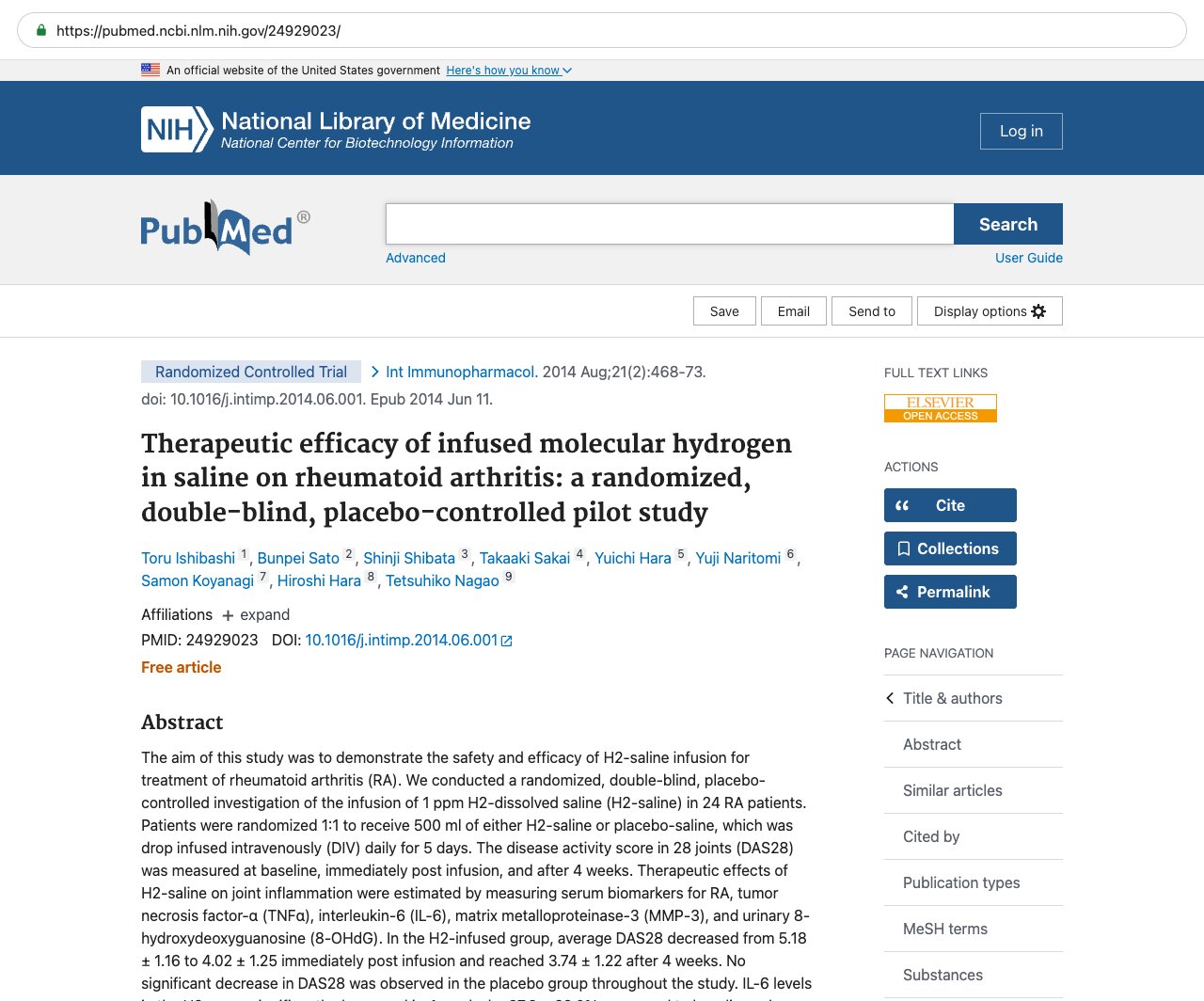
The aim of this study was to demonstrate the safety and efficacy of H2-saline infusion for treatment of rheumatoid arthritis (RA). We conducted a randomized, double-blind, placebo-controlled investigation of the infusion of 1 ppm H2-dissolved saline (H2-saline) in 24 RA patients. Patients were randomized 1:1 to receive 500 ml of either H2-saline or placebo-saline, which was drop infused intravenously (DIV) daily for 5 days. The disease activity score in 28 joints (DAS28) was measured at baseline, immediately post infusion, and after 4 weeks. Therapeutic effects of H2-saline on joint inflammation were estimated by measuring serum biomarkers for RA, tumor necrosis factor-α (TNFα), interleukin-6 (IL-6), matrix metalloproteinase-3 (MMP-3), and urinary 8-hydroxydeoxyguanosine (8-OHdG). In the H2-infused group, average DAS28 decreased from 5.18 ± 1.16 to 4.02 ± 1.25 immediately post infusion and reached 3.74 ± 1.22 after 4 weeks. No significant decrease in DAS28 was observed in the placebo group throughout the study. IL-6 levels in the H2 group significantly decreased in 4 weeks by 37.3 ± 62.0% compared to baseline, whereas it increased by 33.6 ± 34.4% in the placebo group. TNFα levels did not change remarkably in the H2 or placebo groups in 4 weeks post-infusion compared to baseline. The relative ratio of 8-OHdG in the H2 group also significantly decreased by 4.7%. After 4 weeks, MMP3 was significantly reduced by 19.2% ± 24.6% in the H2 group, and increased by 16.9% ± 50.2% in the placebo group. Drop infusion of H2 safely and effectively reduced RA disease activity.
Source & links
Screenshot of the PubMed page
This page mirrors the published abstract (© the authors / publisher) for reference and citation. The canonical source is the PubMed record linked above. This is not medical advice.