2015 · Ostojic — Molecular hydrogen in sports medicine: new therapeutic perspectives.
Super-Abstract
Molecular hydrogen (H₂) may offer a novel approach for addressing exercise-induced oxidative stress and sports injuries, with potential to also improve exercise performance. This review summarizes clinical and research evidence on H₂ across oxidative stress-related conditions and frames its specific relevance for sports medicine. (International Journal of Sports Medicine, 2015.)
Commentary
Ostojic draws together research from diverse oxidative-stress-mediated disease contexts — including diabetes, rheumatoid arthritis, and neurodegenerative conditions — to build the case that H₂ could be specifically relevant in sports medicine. The review highlights newly identified mechanisms: beyond direct antioxidant action, H₂ influences cell signaling pathways and may function as an alkalizing agent. The sports medicine framing is the paper's distinctive contribution, connecting H₂ research to a high-demand performance and recovery context. However, as a review, it synthesizes existing literature without contributing original data; the clinical sports-specific trial base was still nascent at the time of writing.
Key quotes
- „In particular, hydrogen therapy may be an effective and specific innovative treatment for exercise-induced oxidative stress and sports injury, with potential for the improvement of exercise performance.“ — the central sports medicine hypothesis — promising, but still needing dedicated trial evidence
- „Beneficial effects of molecular hydrogen in clinical environment are observed especially in oxidative stress-mediated diseases, such as diabetes mellitus, brain stem infarction, rheumatoid arthritis, or neurodegenerative diseases.“ — the broader disease context from which sports applications are extrapolated
- „A number of more recent studies have reported that molecular hydrogen affects cell signal transduction and acts as an alkalizing agent, with these newly identified mechanisms of action having the potential to widen its application in clinical medicine even further.“ — beyond antioxidant action: signaling and pH effects as additional mechanisms
Our assessment
A narrative review making the case for H₂'s relevance in sports medicine by synthesizing evidence from adjacent disease areas. The argument is plausible — exercise-induced oxidative stress is a well-established phenomenon — but the direct sports-specific clinical evidence at the time of writing was limited. The proposed performance enhancement angle is speculative and would require dedicated randomized trials for validation. Readers interested in the mechanistic rationale will find value here; those seeking definitive performance data should look for subsequent controlled studies.
Study design
- Type: narrative review · n: n/a (synthesis of clinical and preclinical studies) · H₂ delivery: multiple routes (summarized from included studies — H₂-rich water, H₂ saline, inhalation)
- Result: H₂ shown to have antioxidant, anti-inflammatory, and anti-apoptotic effects in diverse disease contexts; exercise-induced oxidative stress and sports injury proposed as specific application areas; alkalizing and cell-signaling mechanisms identified as additional action pathways
Abstract
In the past 2 decades, molecular hydrogen emerged as a novel therapeutic agent, with antioxidant, anti-inflammatory and anti-apoptotic effects demonstrated in plethora of animal disease models and human studies. Beneficial effects of molecular hydrogen in clinical environment are observed especially in oxidative stress-mediated diseases, such as diabetes mellitus, brain stem infarction, rheumatoid arthritis, or neurodegenerative diseases. A number of more recent studies have reported that molecular hydrogen affects cell signal transduction and acts as an alkalizing agent, with these newly identified mechanisms of action having the potential to widen its application in clinical medicine even further. In particular, hydrogen therapy may be an effective and specific innovative treatment for exercise-induced oxidative stress and sports injury, with potential for the improvement of exercise performance. This review will summarize recent research findings regarding the clinical aspects of molecular hydrogen use, emphasizing its application in the field of sports medicine.
Source & links
Screenshot of the PubMed page
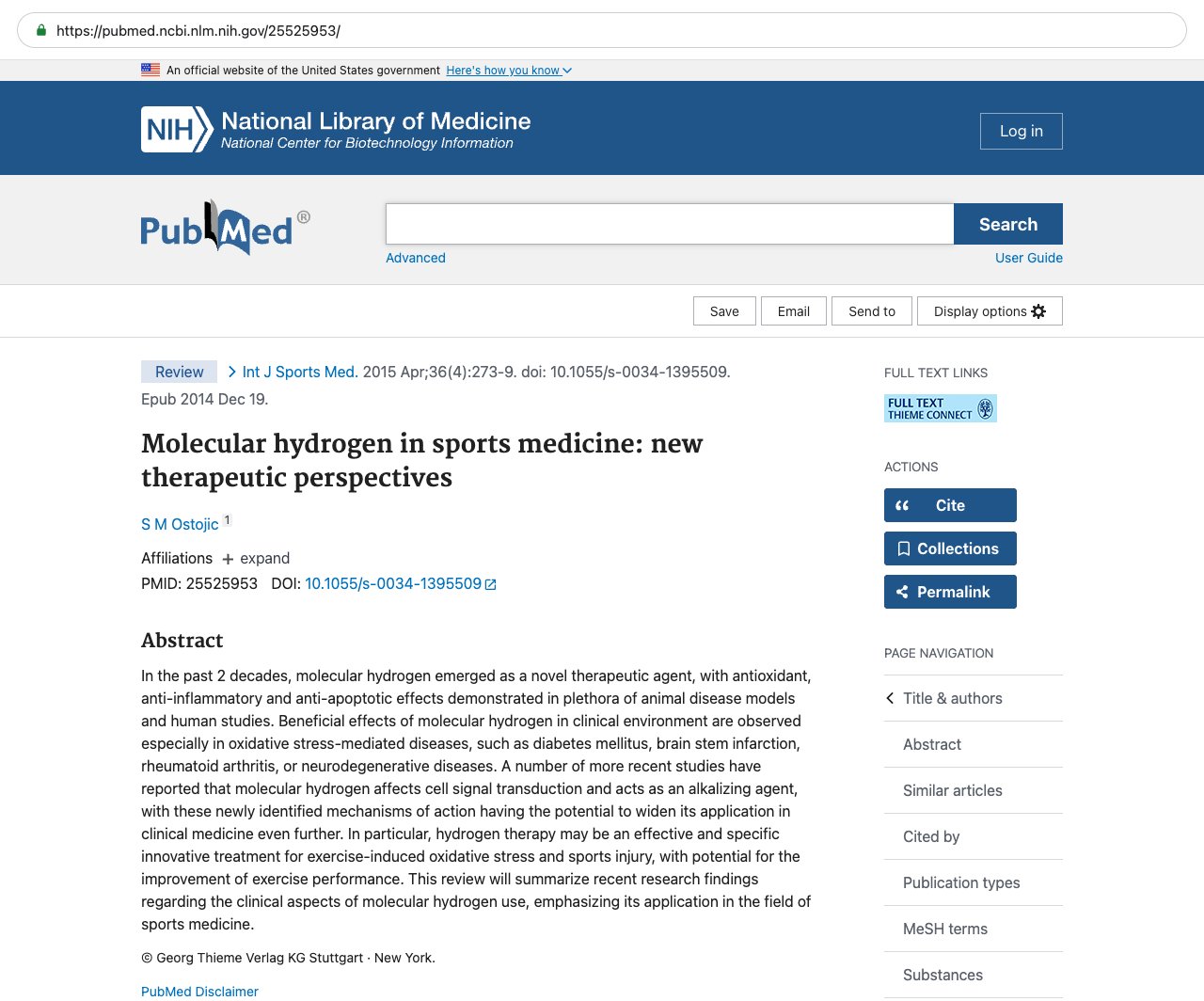
This page mirrors the published abstract (© the authors / publisher) for reference and citation. The canonical source is the PubMed record linked above. This is not medical advice.