2011 · Ito et al. — Open-Label Trial and Randomized, Double-Blind, Placebo-Controlled, Crossover Trial of Hydrogen-Enriched Water for Mitochondrial and Inflammatory Myopathies
Super-Abstract
In a randomised, double-blind crossover trial in patients with dermatomyositis (10) or mitochondrial myopathies (12), 0.5 litres of hydrogen-enriched water per day for 8 weeks had no objective clinical effect, and only blood lactate in mitochondrial myopathies improved significantly. A preceding open-label trial (1.0 litre per day for 12 weeks, 14 participants) also found no objective change in clinical symptoms, but reported significant effects on several blood markers, including the lactate-to-pyruvate ratio. Each trial measured 18 serum parameters, so the isolated laboratory findings need confirmation. (Medical Gas Research, 2011.)
Commentary
Molecular hydrogen has shown effects in more than 30 animal models, especially of diseases driven by oxidative stress and inflammation. This paper reports two trials in muscle diseases. In the open-label trial, five patients with progressive muscular dystrophy (PMD), four with polymyositis/dermatomyositis (PM/DM) and five with mitochondrial myopathies (MM) drank 1.0 litre of hydrogen-enriched water per day for 12 weeks. In the randomised, double-blind, placebo-controlled crossover trial, patients with dermatomyositis (10) and MM (12) drank 0.5 litres per day of hydrogen-enriched water or placebo water for 8 weeks. Both trials measured 18 serum parameters every 4 weeks. The results name lactate, the lactate-to-pyruvate ratio, fasting blood glucose, matrix metalloproteinase-3 (MMP3) and triglycerides. The open-label trial also measured urinary 8-isoprostane, and clinical symptoms were assessed in both. The abstract does not give the hydrogen concentration of the water, a primary endpoint or a washout period between crossover phases.
Key quotes
- „In the double-blind trial, no objective clinical effects were observed, but a significant improvement was detected in lactate in MM.“ — the main result of the randomised part: no clinical effect, one significant blood marker
- „No adverse effect was observed in either trial except for hypoglycemic episodes in an insulin-treated MELAS patient, which subsided by reducing the insulin dose.“ — safety across both trials, including one patient with episodes of low blood sugar
- „Hydrogen-enriched water improves mitochondrial dysfunction in MM and inflammatory processes in PM/DM.“ — the authors' conclusion, which goes further than the double-blind results
Our assessment
The randomised crossover part is the stronger of the two designs, and it showed no objective clinical effect. Of 18 serum parameters, only lactate in mitochondrial myopathies changed significantly. The lactate-to-pyruvate ratio and MMP3 moved in a favourable direction without statistical significance. The larger laboratory effects come from the open-label trial, which had no control group, and the abstract does not state their direction. The authors' conclusion that the water improves mitochondrial dysfunction and inflammation rests on laboratory markers. They attribute the weaker double-blind results to the lower hydrogen dose and shorter observation, but the two trials also differed in design and patients. Limitations: very small groups spread over several diseases, an uncontrolled first trial, many laboratory parameters without a named primary endpoint, blood markers instead of clinical outcomes, and no hydrogen concentration or washout stated. One insulin-treated patient had episodes of low blood sugar that resolved after the insulin dose was reduced.
Study design
- Type: uncontrolled open-label trial, then a randomised, double-blind crossover trial · n: 14 in the first trial (five PMD, four PM/DM, five MM), 22 in the crossover trial (10 dermatomyositis, 12 MM) · H₂ delivery: hydrogen-enriched drinking water, 1.0 litre per day for 12 weeks (first trial) or 0.5 litres per day for 8 weeks (crossover), concentration not stated
- Comparator: placebo water in the crossover trial; no control group in the open-label trial
- Result: no primary endpoint named. Crossover trial: no objective clinical effects, significant improvement in lactate in MM, favourable but non-significant responses in lactate-to-pyruvate ratio (MM) and MMP3 (dermatomyositis). Open-label trial: no objective change in clinical symptoms, significant effects (direction not stated) in lactate-to-pyruvate ratio (PMD, MM), fasting blood glucose (PMD), MMP3 and triglycerides (PM/DM). No adverse effects except hypoglycaemic episodes in one insulin-treated patient
Abstract
BACKGROUND: Molecular hydrogen has prominent effects on more than 30 animal models especially of oxidative stress-mediated diseases and inflammatory diseases. In addition, hydrogen effects on humans have been reported in diabetes mellitus type 2, hemodialysis, metabolic syndrome, radiotherapy for liver cancer, and brain stem infarction. Hydrogen effects are ascribed to specific radical-scavenging activities that eliminate hydroxyl radical and peroxynitrite, and also to signal-modulating activities, but the detailed molecular mechanisms still remain elusive. Hydrogen is a safe molecule that is largely produced by intestinal bacteria in rodents and humans, and no adverse effects have been documented. METHODS: We performed open-label trial of drinking 1.0 liter per day of hydrogen-enriched water for 12 weeks in five patients with progressive muscular dystrophy (PMD), four patients with polymyositis/dermatomyositis (PM/DM), and five patients with mitochondrial myopathies (MM), and measured 18 serum parameters as well as urinary 8-isoprostane every 4 weeks. We next conducted randomized, double-blind, placebo-controlled, crossover trial of 0.5 liter per day of hydrogen-enriched water or placebo water for 8 weeks in 10 patients with DM and 12 patients with MM, and measured 18 serum parameters every 4 weeks. RESULTS: In the open-label trial, no objective improvement or worsening of clinical symptoms was observed. We, however, observed significant effects in lactate-to-pyruvate ratios in PMD and MM, fasting blood glucose in PMD, serum matrix metalloproteinase-3 (MMP3) in PM/DM, and serum triglycerides in PM/DM. In the double-blind trial, no objective clinical effects were observed, but a significant improvement was detected in lactate in MM. Lactate-to-pyruvate ratios in MM and MMP3 in DM also exhibited favorable responses but without statistical significance. No adverse effect was observed in either trial except for hypoglycemic episodes in an insulin-treated MELAS patient, which subsided by reducing the insulin dose. CONCLUSIONS: Hydrogen-enriched water improves mitochondrial dysfunction in MM and inflammatory processes in PM/DM. Less prominent effects with the double-blind trial compared to the open-label trial were likely due to a lower amount of administered hydrogen and a shorter observation period, which implies a threshold effect or a dose-response effect of hydrogen.
Source & links
Screenshot of the PubMed page
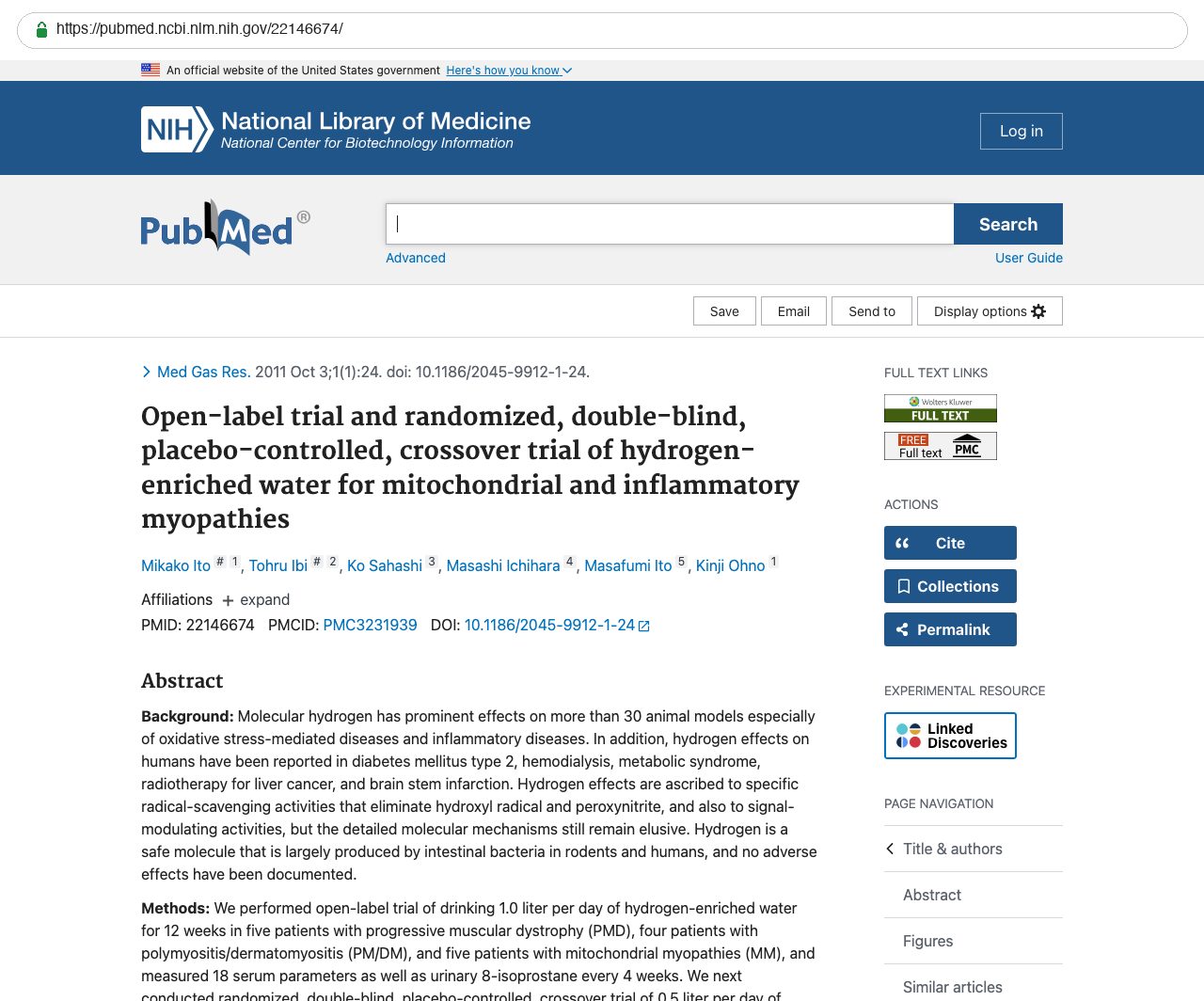
This page mirrors the published abstract (© the authors / publisher) for reference and citation. The canonical source is the PubMed record linked above. This is not medical advice.