2021 · Javorac — Hydrotherapy with hydrogen-rich water compared with RICE protocol following acute ankle sprain in professional athletes: a randomized non-inferiority pilot trial
Super-Abstract
Hydrogen-rich baths were just as effective as the gold-standard RICE procedure (rest, ice, compression, elevation) for acute ankle sprain in professional athletes. In a randomized non-inferiority pilot trial (n = 18) there were no significant differences between H₂ hydrotherapy and RICE in swelling, range of motion and balance. (Research in Sports Medicine, 2021.)
Commentary
An acute ankle sprain is one of the most common sports injuries, and the standard treatment has for decades been RICE — rest, ice, compression and elevation. This study tried something bold: instead of RICE, one group of professional athletes received intensive baths with hydrogen-rich water in the first 24 hours after the injury. The design is a randomized non-inferiority pilot study with 18 athletes, 9 per group. The H₂ group took six 30-minute ankle baths, i.e. one every four hours; the RICE group received the usual protocol. The result: in none of the measured endpoints was there a significant difference — swelling reduction (2.1% vs. 1.6%; p = 0.26), range of motion (p = 0.60) and single-leg balance (p = 0.06 with eyes open, p = 0.59 with eyes closed). In other words: the H₂ baths were equivalent to the proven RICE method. Important for honesty: this is a very small pilot study (n = 18), and „non-inferior“ does not mean „better“ — at this sample size real differences could simply have gone undetected. The authors themselves stress that further studies are needed.
Key quotes
- „HRW was equivalent to RICE protocol to reduce ankle swelling (2.1 ± 0.9% vs. 1.6 ± 0.8%; P = 0.26), range of motion (2.4 ± 1.3 cm vs. 2.7 ± 0.8 cm; P = 0.60)“ — no significant difference in swelling and range of motion
- „This non-inferiority pilot trial supports the use of HRW as an effective choice in AAS management.“ — the core message: H₂ hydrotherapy as an equivalent option
- „However, more studies are needed to corroborate these findings in other soft tissue injuries.“ — the authors' honest caveat
Our assessment
Directly relevant for H₂ bath and hydrotherapy products in the sport sector — an everyday application with a large target group (club sport, physiotherapy practices). The finding should be read cautiously: equivalence, not superiority, was shown. That is nevertheless strong, because H₂ baths can be positioned as a more comfortable, warmer alternative to the unpleasant ice protocol. Limitation, stated honestly: very small sample (n = 18), pilot character, no blinding possible (a bath vs. ice are obviously different), and the non-inferiority margin is not quantified in the abstract. Mechanistically the effect fits the antioxidant/anti-inflammatory profile of H₂ in tissue trauma.
Study design
- Type: RCT (randomized non-inferiority pilot study) · n: 18 (9 H₂ hydrotherapy / 9 RICE) · Duration: first 24 h after injury · H₂ delivery: six 30-min ankle baths with HRW (every 4 h)
- Result: swelling 2.1 ± 0.9% vs. 1.6 ± 0.8% (p = 0.26); range of motion 2.4 ± 1.3 cm vs. 2.7 ± 0.8 cm (p = 0.60); single-leg balance eyes open 18.4 vs. 10.7 s (p = 0.06), eyes closed 5.6 vs. 3.9 s (p = 0.59) — all n.s.
Abstract
We analysed the effects of an experimental novel protocol of intensive hydrotherapy with hydrogen-rich water (HRW) on injury recovery in athletic men who suffered an acute ankle sprain (AAS) and compared it with a RICE protocol (rest, ice, compression, elevation). Professional athletes (age 23.7 ± 4.0 years; weight 78.6 ± 5.7 kg, height 182.5 ± 4.3 cm; professional experience 5.9 ± 3.9 years) who incurred AAS during a sport-related activity were randomly assigned immediately after the injury to either hydrogen group (n = 9) or a conventional RICE treatment group (n = 9). Hydrogen group received six 30-min ankle baths with HRW throughout the first 24 h post-injury, with hydrotherapy administered every 4 hours during the intervention period. RICE group stood off the injured leg, with ice packs administered for 20 min every 3 hours, with the injured ankle compressed with an elastic bandage for 24 hours and elevated at all possible times above the level of the heart. HRW was equivalent to RICE protocol to reduce ankle swelling (2.1 ± 0.9% vs. 1.6 ± 0.8%; P = 0.26), range of motion (2.4 ± 1.3 cm vs. 2.7 ± 0.8 cm; P = 0.60), and single-leg balance with eyes opened (18.4 ± 8.2 sec vs. 10.7 ± 8.0 sec; P = 0.06) and closed (5.6 ± 8.4 sec vs. 3.9 ± 4.2 sec; P = 0.59). This non-inferiority pilot trial supports the use of HRW as an effective choice in AAS management. However, more studies are needed to corroborate these findings in other soft tissue injuries.
Source & links
Screenshot of the PubMed page
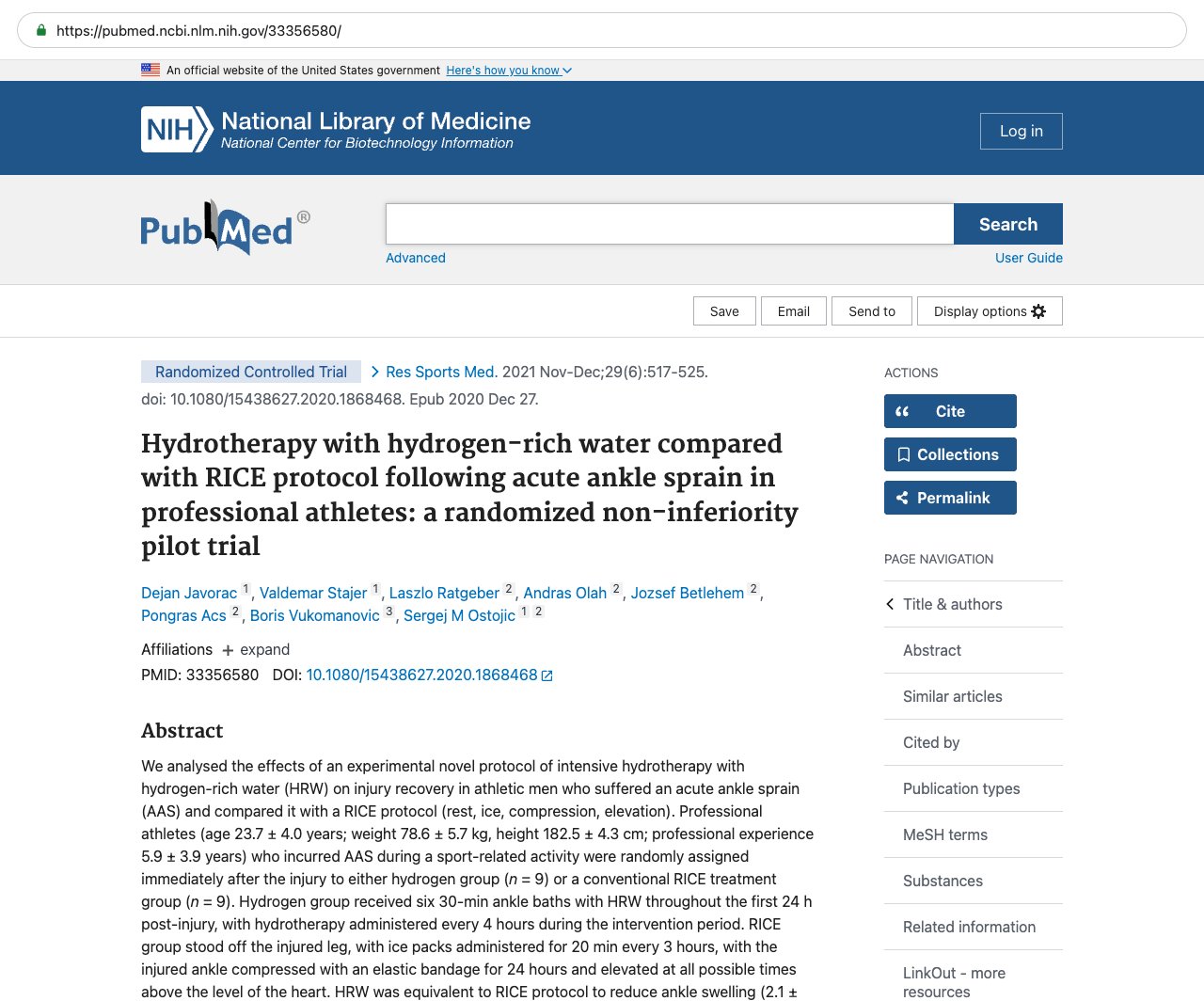
This page mirrors the published abstract (© the authors / publisher) for reference and citation. The canonical source is the PubMed record linked above. This is not medical advice.