2025 · Todorovic — The Effects of 8-Week Hydrogen-Rich Water Consumption on Appetite, Body Composition, Sleep Quality, and Circulating Glucagon-like Peptide-1 in Obese Men and Women (HYDRAPPET): A Randomized Controlled Trial
Super-Abstract
Hydrogen-rich water curbs food cravings and raises the satiety hormone GLP-1 in obese people. In a randomized, double-blind placebo design (36 participants, 1 L/day with 15 mg H₂, 8 weeks), cravings, total and LDL cholesterol fell, sleep quality improved and plasma GLP-1 rose. (Medicina, 2025 — registered on ClinicalTrials.gov NCT06722326.)
Commentary
The HYDRAPPET study asks something new: can hydrogen influence appetite? The design is solid — <strong>randomized, double-blind, placebo-controlled</strong> — with 36 obese participants (24 women, average 42 years, BMI 30.8). Over eight weeks they drank daily either one liter of hydrogen-rich water with 15 mg H₂ or one liter of control water without H₂. The results show a consistent metabolic pattern: cravings decreased (p = 0.05), subjective sleep quality improved (p = 0.05), total cholesterol (p = 0.02) and LDL cholesterol (p = 0.04) fell, and the satiety hormone GLP-1 rose in plasma (p = 0.05). This is mechanistically interesting because GLP-1 is currently the big topic in obesity medicine. No serious adverse events occurred. Honestly: the sample is small (n = 36), the duration short (8 weeks), and several p-values lie exactly at the significance threshold (p = 0.05) — the effects are real but statistically borderline and should be confirmed in larger studies.
Key quotes
- „hydrogen-rich water significantly mitigated cravings (p = 0.05), improved subjective sleep quality (p = 0.05), reduced total cholesterol (p = 0.02) and LDL cholesterol (p = 0.04), and increased plasma glucagon-like peptide-1 levels (p = 0.05) compared to the control.“ — the five core findings with p-values
- „No severe adverse effects were reported throughout the trial.“ — good tolerability over 8 weeks
- „these findings suggest that hydrogen-rich water may serve as a safe and effective dietary strategy to address appetite regulation and related metabolic indices in individuals with obesity.“ — the authors' conclusion
Our assessment
Medically relevant to appetite and metabolic regulation, because the study links one of the currently most-discussed topics in metabolic medicine — GLP-1 and appetite regulation — with a defined H₂ content (15 mg/L) and a clean double-blind design, plus proper registration (NCT06722326). This shifts the mechanistic picture from „antioxidant“ toward „metabolic lever“. Limitation, stated honestly: small sample (n = 36), only 8 weeks, and conspicuously many findings exactly at the p = 0.05 threshold — this is statistically fragile and does not allow strong causal statements. Patient-reported endpoints (cravings, sleep) are prone to residual bias.
Study design
- Type: RCT, randomized/double-blind/placebo-controlled (NCT06722326) · n: 36 (24 women; avg 42.1 yrs; avg BMI 30.8) · Duration: 8 weeks · H₂ delivery: 1.0 L/day hydrogen-rich water with 15 mg H₂ (control: 1.0 L without H₂)
- Result figures: cravings ↓ (p = 0.05); subjective sleep quality ↑ (p = 0.05); total cholesterol ↓ (p = 0.02); LDL ↓ (p = 0.04); plasma GLP-1 ↑ (p = 0.05); no serious adverse events
Abstract
Background and Objectives: Preliminary studies indicate that dihydrogen (H2) may affect molecular pathways involved in appetite regulation; however, its role in influencing patient-reported appetite outcomes in individuals with obesity remains uncertain. This randomized, placebo-controlled, double-blind trial aimed to evaluate the effects of H2 supplementation on appetite, body composition, sleep quality, obesity-specific quality of life, and related biomarkers in obese men and women. Materials and Methods: The study included 36 participants (24 females; age 42.1 ± 13.2 years; BMI 30.8 ± 4.2 kg/m2) randomized to receive either 1.0 L of hydrogen-rich water (15 mg of H2) or 1.0 L of control water (0 mg of H2) daily for eight weeks. Results: The results demonstrated that hydrogen-rich water significantly mitigated cravings (p = 0.05), improved subjective sleep quality (p = 0.05), reduced total cholesterol (p = 0.02) and LDL cholesterol (p = 0.04), and increased plasma glucagon-like peptide-1 levels (p = 0.05) compared to the control. No severe adverse effects were reported throughout the trial. Conclusions: These findings suggest that hydrogen-rich water may serve as a safe and effective dietary strategy to address appetite regulation and related metabolic indices in individuals with obesity. The study is registered at ClinicalTrials.gov (NCT06722326).
Source & links
Screenshot of the PubMed page
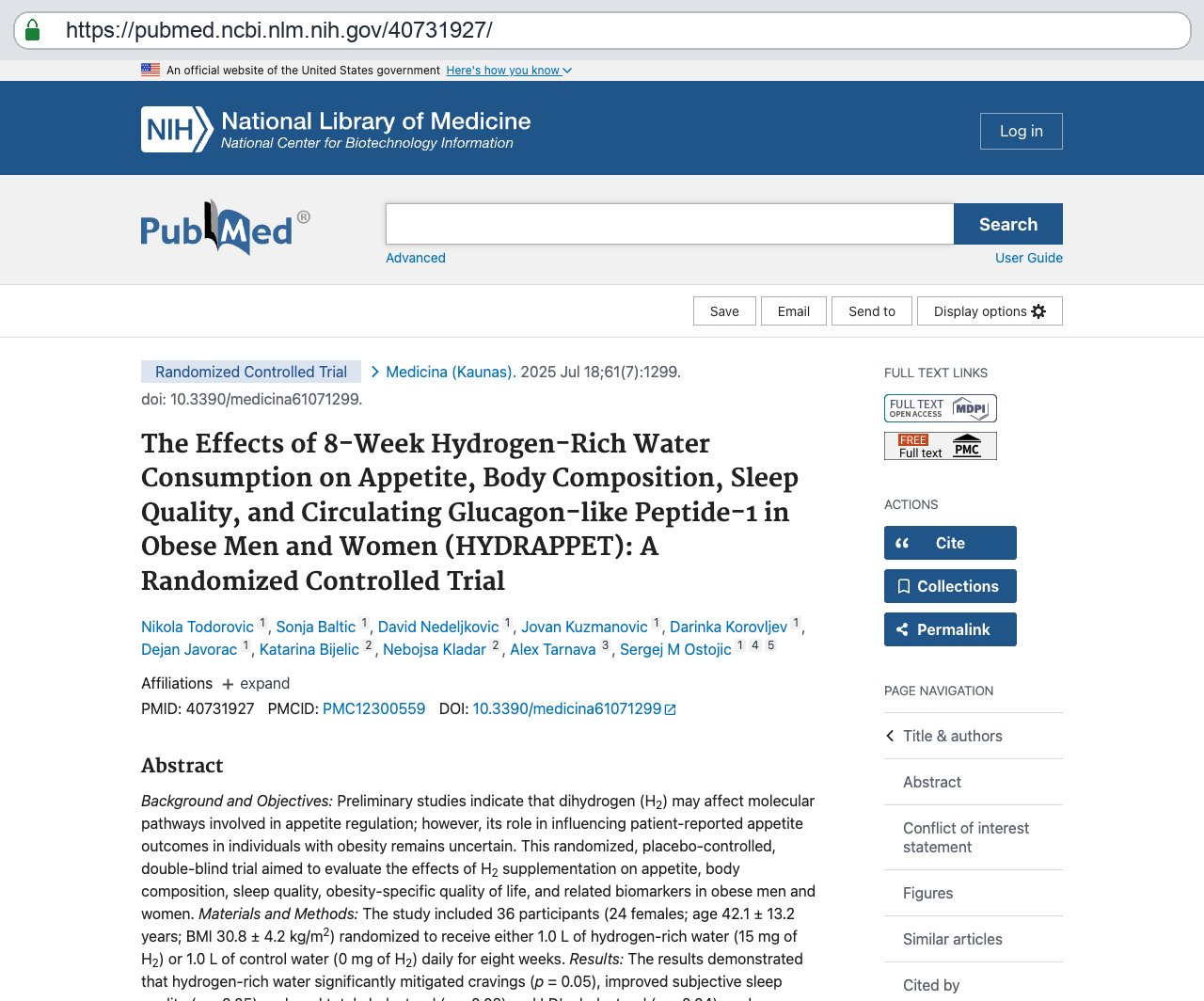
This page mirrors the published abstract (© the authors / publisher) for reference and citation. The canonical source is the PubMed record linked above. This is not medical advice.